
Subscribe
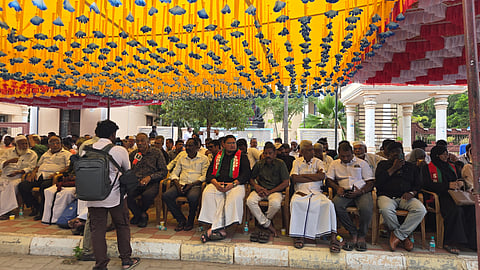
There were no slogans, speeches, or raised voices. Instead, people sat together in silence, their disappointment with the Supreme Court's latest order in the Thiruparankundram Karthigai Deepam dispute finding expression in a quiet protest in Madurai on Saturday, November 28.
Organised by the Madurai Religious Harmony People's Federation and the Muslim Aikkiya Jamaath, the protest brought together people from different religious communities, political backgrounds, and ideological positions. Gathering in front of the World Tamil Sangam, near the Gandhi Museum and the statue of Tamil poet Thiruvalluvar, the protesters said their silence was a message against what they see as an assault on constitutional values, secularism, and religious harmony.
The protest comes a day after the Supreme Court, hearing contempt proceedings over the failure to implement its November 20 order permitting the lighting of the Karthigai Deepam at the disputed Deepathoon pillar on Thiruparankundram hill, directed that lamps be lit there on November 28. The court also suspended the temple's Board of Trustees, appointed two former High Court judges as receivers to administer the temple, and directed the Central Reserve Police Force (CRPF) to take over security arrangements on the hill.
Speaking at the protest, Henri Tiphagne, a lawyer based in Madurai and founder and executive director of the human rights organisation People's Watch, said it was a black day for democracy.
The Supreme Court’s latest order disappointed many, he said, adding, “I want to reiterate that the country is in sorrow. There are very senior advocates who have called me privately saying how shameful the order of the Supreme Court [on November 27] was.”
Tiphagne questioned the proportionality of the directions issued by the Supreme Court in the contempt proceedings, particularly its decision to pull up senior state officials despite the state government's submissions that it had not yet placed its complete status report before the court.
He said the counsel representing the district administration had informed the court that only an interim report had been submitted and that a detailed report, including all relevant correspondence, would be filed shortly. The counsel representing the police had also enumerated the steps taken by the administration, he said.
“It is unprecedented that without hearing the state, you direct contempt proceedings against 11 senior officials of the state from various departments, despite pleas being made before the court. I don't think people will henceforth continue to trust a judiciary of this sort,” Tiphagne said.
He also criticised what he described as the disregard for the constitutional principles of fraternity and non-discrimination. The transfer of security responsibilities to the CRPF and the appointment of judicial receivers to administer the temple, he said, amounted to an extraordinary takeover of state functions.
“Today we sit with our brethren who are from the Islamic faith to tell them they are not alone,” he said. “We do it as different organisations from different religions, from different backgrounds, different platforms, different ideological positionings.”
He also expressed solidarity with government officials who, he said, had acted according to their conscience and constitutional responsibilities. Tiphagne hoped that the assurance given before the Supreme Court that the dargah would not be disturbed would be honoured, and that Muslims would continue to be able to visit the shrine and practise their religion without obstruction.
MD Pandian, convener of the Madurai Religious Harmony People's Federation, said the Supreme Court's November 27 order had shocked Muslims and secular-minded people.
“It has become an ego issue. Our silence will send a message, stronger than slogans or speeches,” he said.

Pandian said the location of the silent demonstration, near the Gandhi Museum and the statue of Thiruvalluvar, was significant. While Gandhi represented non-violence and secularism, Thiruvalluvar represented Tamil identity, he said. The protesters had chosen to gather there to express their opposition to what they feared could damage Madurai's religious harmony.
Liyakat Ali, president of the Madurai Muslim Aikkiya Jamaath, said the developments had raised concerns about the future of religious coexistence in the region.
“India is a pluralistic country. Tamil Nadu, especially, has never had religious differences of this nature. The courts are now becoming forces that could destroy peace in the country,” he said.
Ali said the Muslim community had not anticipated such a harsh order. He described the silent protest as a message to the Union government and maintained that local Hindus had not been responsible for creating tensions around the dispute.
“If people here wanted to create problems, they could have done so on the day of the Karthigai Deepam festival itself. These problems are being created by outside forces,” he said.
Documentary filmmaker Thavam, who made Thiruparankundram Files, a documentary on the controversy, said the state government could have handled the situation differently by exercising its constitutional and administrative powers to protect law and order and religious harmony.
He pointed out that the dispute over the Deepathoon was yet to reach a final conclusion in the civil proceedings and questioned the urgency with which the issue was being pursued.
Drawing a comparison with the Sabarimala verdict, Thavam said there had been little urgency in implementing other significant court judgements, including those concerning equality, while the Thiruparankundram issue had received immediate attention.
He said the dispute now appeared to have become an ego battle between the judiciary and the state government, and expressed concern about what the Supreme Court's latest directions could mean for access to the hill and the dargah.
The protesters said they wanted to make it clear that the dispute should not be reduced to a Hindu-Muslim confrontation. People from Madurai and Thiruparankundram, they said, had come together despite their differences to defend the region's longstanding religious coexistence.
The dispute centres on a stone pillar situated atop the Thiruparankundram hill, about 50 metres from the Hazrat Sultan Sikandar Badusha Dargah. The hill is home to the Arulmigu Subramaniaswamy Temple as well, and has long been a site of religious significance for both Hindus and Muslims. A century-old civil court ruling in 1923 had delineated the respective rights of the temple and the Muslim community over different portions of the hill.
The controversy now concerns the Hindu festival of Karthigai Deepam, during which a ceremonial lamp is lit. Traditionally, the lamp has been lit at the Deepa Mandapam near the Uchipillaiyar temple on the hill. However, Hindu groups have been demanding that the lamp also be lit at the disputed stone pillar, arguing that it is a traditional site for the ritual. The Tamil Nadu government and other parties have contested this, with the government arguing that the pillar is a survey stone and that allowing the ritual there could affect the existing status quo and lead to law and order problems.
The issue reached the Madras High Court after devotees approached it seeking permission to light the lamp at the pillar. In December 2025, a single judge allowed the ritual, directing the temple administration to make arrangements. A Division Bench subsequently modified the order, permitting a small team authorised by the temple to light the lamp once a year, subject to security and other conditions. The Tamil Nadu government challenged the Division Bench's decision in the Supreme Court.
On November 20, 2026, the Supreme Court permitted the lighting of the lamp at the Deepathoon as a one-time arrangement for this year's Karthigai Deepam celebrations. It directed that the ritual be carried out by a team authorised by the temple administration, with the Madurai district collector coordinating the arrangements. The court also clarified that the interim direction did not settle the larger questions concerning customary practices or property rights.
However, on November 24, the lamp was lit at the customary spot near the Uchipillaiyar temple and not at the Deepathoon. The Madurai district administration told the Supreme Court that it had made arrangements to implement the order, but the temple's Board of Trustees had not authorised a team to perform the ritual at the disputed pillar. Contempt petitions were subsequently filed alleging deliberate disobedience of the Supreme Court's directions.
On November 27, hearing the contempt petitions, the Supreme Court took a strong view of the failure to implement its November 20 order. It directed that the lamp be lit at the Deepathoon on November 28, suspended the temple's Board of Trustees and appointed two former Madras High Court judges as receivers to oversee the temple's administration. It also directed the CRPF to secure the hill, including the temple and the dargah, and issued notices to senior Tamil Nadu government officials seeking explanations over the alleged non-compliance.
Follow TNM's WhatsApp channel for news updates and story links.