
Subscribe
Madurai District Collector Nishant Krishna told the Supreme Court on Wednesday, November 25, that he made every effort to implement the court’s order permitting the lighting of the Karthigai Deepam or lamp at the disputed stone pillar near the Sikandar Badusha Dargah atop Thiruparankundram hill, but the temple’s Board of Trustees did not authorise a team to carry out the ceremony.
In a preliminary status report filed before the Supreme Court on November 25, the Collector said that the district administration had completed the arrangements, including finalising the team’s composition, route, timing and security arrangements. However, the Board of Trustees of the Arulmigu Subramaniaswamy Temple resolved to light the lamp at its customary location near the Uchipillaiyar Temple instead.
Meanwhile, advocate V Ramasubbu has filed a contempt petition in the Supreme Court against four officials: Madurai District Collector Nishant Krishna, Madurai City Police Commissioner S Rajendiran, Hindu Religious and Charitable Endowments (HR&CE) Commissioner TG Vinay, and the Executive Officer of the Thiruparankundram temple, Selvi G.
The petitioner alleges that the officials wilfully disobeyed the Supreme Court's November 20 order permitting the lighting of the Karthigai Deepam at the Deepathoon on November 24 through an authorised temple team, subject to specified safeguards. The petitioner has alleged wilful disobedience and sought punishment for the officials under the Contempt of Courts Act. The petition also accuses them of making a false submission before the High Court about complying with the Supreme Court's directions.
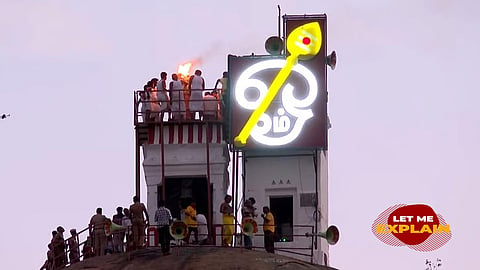
A Siva temple and the Uchi Pillaiyar temple are located on the lower part of the Tirupurakundram hill, while the dargah stands at its summit. For decades, the customary Karthigai Deepam has been lit near the Uchi Pillaiyar Temple by the temple management. In 2025, however, Hindutva groups went to court demanding that the lamp be lit on the ‘deepathoon’, a stone pillar located at the hilltop, about 50 metres from the dargah. The DMK government did not implement the court’s order, and the new TVK government has followed the same course, this time citing the temple Devasthanam’s decision.
What the Collector told the court
The Collector’s report was filed pursuant to the Supreme Court’s November 20 order, which had permitted the lighting of the lamp at the disputed pillar on November 24 as a “one-time arrangement”. The Court had directed that the ceremony be carried out exclusively by a team authorised by the Devasthanam, with the Collector responsible for coordinating the arrangements in consultation with the temple’s Executive Officer, the Archaeological Survey of India (ASI) and the Commissioner of Police.
The Collector said that the temple had not communicated any authorisation for the team that was to light the lamp at the disputed pillar. “At no point did the Devasthanam communicate to the District Collector any authorisation of persons to light the lamp at the Deepathoon,” he said.
He added that the district administration could not authorise people in the temple administration’s place, as the Supreme Court’s order had specified that the lamp could be lit only by persons authorised by the Devasthanam.
“I sincerely apologise for the lamp not been lit at the Deepathoon,” the Collector said, while maintaining that there had been no “wilful disobedience” of the Supreme Court’s directions on his part.
According to the Collector, he held a coordination meeting with officials from the police, the Hindu Religious and Charitable Endowments (HR&CE) Department, the Revenue Department and the temple administration on November 21. The meeting decided that the ceremony would be held between 6 pm and 6.30 pm on November 24, and that no more than 10 persons authorised by the Devasthanam would take part in the lighting.
At a subsequent meeting on November 22, attended by the ASI and other officials, the arrangements were finalised. These included the proposed method of lighting, preparatory work at the site, discussions regarding the 10-member team that would light the lamp, and the deployment of observers from the Revenue Department, police, fire services and ASI.
The temple administration had proposed erecting a steel or wooden scaffold near the pillar. Wet gunny sacks and clay would be placed on top of the pillar, on which a clay lamp would be placed and lit. The temple also proposed sending a preparatory team of 27 people, including technical experts, electrical workers and scaffolding workers, to the site.
However, the Collector noted that the temple administration’s proposal did not include formal authorisation for the 10-member team that would light the lamp. The temple’s Executive Officer subsequently informed him that the Board of Trustees had been requested to grant the necessary authorisation.
What transpired on November 24
On the morning of November 24, the Collector says he personally inspected the arrangements at the site. At 10.08 am, after finding that the preparatory team had not proceeded to the hill, he emailed the Executive Officer directing her to send the team immediately and explain the delay.
At 11.30 am, the Executive Officer sent two letters to the Collector. One said that the Board of Trustees had been asked to authorise the 10 persons selected to light the lamp. The other said that the preparatory work and lighting would proceed after the Board’s authorisation was received.
The Collector also said that he appeared before the Madurai Bench of the Madras High Court that day in connection with petitions challenging the prohibitory orders imposed across Madurai district. He said that, when the court adjourned for lunch, he was called to the judge’s chamber, where he was informed that the Supreme Court’s order had to be complied with strictly.
At around 4.30 pm, the High Court pronounced its order directing the authorities to comply with the Supreme Court’s directions. The Collector said that, immediately afterwards, at 5.03 pm, he emailed the Executive Officer directing her to proceed with the authorised team and complete the lighting at the Deepathoon.
The report states: “The only step remaining was the authorisation of the team by the Devasthanam.”
However, no team authorised by the Devasthanam arrived to light the lamp at the disputed pillar.
At around 7.32 pm, the administration received a press release from the temple. The Executive Officer subsequently informed the Collector that, following a resolution by the Board of Trustees, the temple was not in a position to proceed with the lighting at the Deepathoon.
At around 8.30 pm, she submitted a report stating that the Board had resolved to light the lamp at the customary location near the Uchipillaiyar Temple, where the Mahadeepam had been lit at around 6 pm. The lamp was not lit at the disputed pillar.
The Collector said that the Board’s resolution cited the temple’s traditions, customs and Agama rules, and stated that the Karthigai Mahadeepam had historically been lit at the Deepa Mandapam near the Uchipillaiyar Temple.
The Collector maintained that he had discharged the responsibilities assigned to him by the Supreme Court and had remained in contact with the officials concerned throughout the process. He said he had “taken all the steps to comply with the order in good faith” and would submit a supplementary status report with supporting documents.
Meanwhile, a report prepared by the Tamil Nadu Departments of Archaeology and Survey and Settlement said that the disputed pillar near the Dargah was a British-era Great Trigonometrical Survey (GTS) station.
The report said that present-day triangulation measurements from Sikandarmalai hill station (Thiruparankundram) to locations including Nagamalai, Sadragiri, Gopalswami, Kutiparai, Ponurikimalai and Perumalmalai closely matched the measurements recorded in colonial-era survey documents. It also cited survey marks engraved on the rock, including a circle with a dot, as evidence that the structure was a survey pillar.
Follow TNM's WhatsApp channel for news updates and story links.
