
Subscribe
Observing that lighting lamps atop hillocks during Karthigai is a deeply rooted Tamil tradition and that the very purpose of a Deepathoon is to light a lamp, the Madurai Bench of the Madras High Court, on Monday, December 1, allowed a batch of writ petitions seeking permission to light the Karthigai Deepam at the Deepathoon (ancient stone lamp pillar) on Thiruparankundram hill in Madurai.
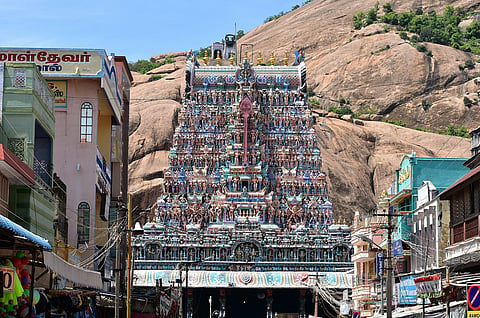
Karthigai is a Tamil month associated with the festival of Karthigai Deepam, symbolising light, devotion and the victory of knowledge over darkness. The Thirupparankundram Hill in Madurai is home to the Arulmigu Subramania Swamy Temple (located at the foot of the hill) and the Sikkandar Badhusah Dharga (located at the top).
Allowing the petitions, Justice GR Swaminathan quashed the proceedings of the executive officer of the Arulmigu Subramania Swamy Temple, who had earlier decided that the festival lamp would be lit only at the Dheepa Mandapam near the Uchipillaiyar temple. The court directed the temple management to light the Deepam at the Deepathoon also, apart from the usual places, and ordered the police to provide adequate protection to ensure compliance.
“The very purpose of having erected a Deepathoon is that a lamp should be lit thereon. Res ipsa loquitur — the thing speaks for itself,” the judge said, rejecting objections raised by the state, the temple administration, the dargah authorities and the Tamil Nadu Waqf Board.
The court underscored that the issue was not merely one of religious custom but also of legal right and property protection. “Even if it is not a matter of custom, asserting the title of the temple over the lower peak by lighting at the Deepathoon is imperative. The 1923 judgment has clarified who owns what. But that did not deter attempts to disturb the status quo,” Justice Swaminathan said, warning that failure to periodically assert rights could jeopardise temple property.
The controversy arose after Rama Ravikumar, state general secretary of the Hindu Makkal Katchi, and devotees challenged the executive officer’s November 3 decision to restrict the lighting of Karthigai Deepam to the mandapam near the Uchipillaiyar temple, citing proximity to the Sikandar Badhusha dargah located on the hill. While some petitioners opposed lighting at the Deepathoon, others, including representatives of the dargah and the Waqf Board, supported the executive officer’s stand.
Justice Swaminathan, however, held that the objections were untenable. Referring extensively to a landmark civil court decree of 1923, upheld by the Privy Council, the judge noted that Muslims have title only over three specific portions of the hill — the Nellithope burial area, the flight of steps leading to the mosque, and the actual site where the mosque stands. “The devasthanam has title and possession over the rest of the hill. The entire upper portion of the hill did not belong to the dargah,” he observed.
Clarifying the geography, the judge pointed out that Thiruparankundram hill has two peaks. “The mosque is at the highest peak, whereas the Deepathoon is at the lower peak, at least 50 metres away. It is not within the dargah campus and lies in the unoccupied portion, which belongs exclusively to the temple,” he said.
Dismissing the argument that the dispute should be resolved only through a fresh civil suit for demarcation, Justice Swaminathan said, “When Nellithope has already been demarcated and the site of lighting the lamp is not in that area, there is no need to go to civil court yet again.” He also rejected claims of res judicata based on earlier High Court orders, holding that earlier cases related to lighting the lamp at the highest peak, whereas the present petitions concerned the Deepathoon on the lower peak. Res judicata refers to a matter that has been adjudicated by a competent court and therefore does not require further litigation.
Drawing from Tamil literary traditions, the judge noted that lighting lamps on hilltops during the month of Karthigai has ancient roots, citing references from Sangam literature and classical epics, and comparing the practice to the annual Karthigai Deepam festival at Thiruvannamalai.
He also found fault with the decision-making process, holding that such an important issue should not have been decided by the executive officer. “A question of vital import could not have been decided by the executive officer. The impugned decision is quashed as lacking in jurisdiction,” the judge ruled.
Addressing concerns over communal harmony, Justice Swaminathan observed, “By lighting the lamp at Deepathoon, the rights of the dargah or the Muslims will not in any way be affected. On the other hand, if the lamp is not lit, there is always a possibility that the rights of the temple may be jeopardised.”
Crucially, the court also noted that peace committee meetings in the past had recorded no objection from the dargah management to lighting the lamp beyond 15 metres from the dargah precincts, and that the Deepathoon satisfies this requirement. The Commissioner of Police, Madurai City, was directed to ensure police protection for the enforcement of this order.
“With police protection ensured, lighting a lamp — a sacred act — cannot offend anyone’s sensibilities,” Justice Swaminathan concluded, directing the temple management to light the Karthigai Deepam at the Deepathoon from this year onwards.
Background
In an earlier round of litigation related to Thiruparankundram hill, a Division Bench of the Madurai Bench of the Madras High Court delivered a split verdict on a batch of petitions concerning religious practices and disputes between the temple and the dargah. The petitions, filed by Hindu, Muslim and Jain groups, raised issues ranging from animal sacrifice at the dargah to demands for renaming the hill and regulating religious activities on the protected hillock.
Justice J Nisha Banu upheld the status quo, refusing to interfere with established practices and stressing the need to preserve interfaith peace and secular coexistence, noting that civil courts had conclusively settled the rights of both communities as early as the 1920s, a view later affirmed by the Privy Council.
Justice S Srimathy, however, dissented on the question of animal sacrifice, holding that there was no credible historical evidence to show that the practice was carried out “from time immemorial” at the dargah. She expressed concern that permitting such practices without judicial scrutiny could disturb communal harmony and directed the dargah to approach the civil court to establish its claim. While both judges agreed that the hill should continue to be known as Thiruparankundram and not be renamed, the disagreement on core religious issues led to the matter being referred to the Chief Justice for the appointment of a third judge.
The present controversy over Thiruparankundram hill has its roots in early 2025, when disputes resurfaced around religious practices and control over portions of the hill, particularly following police restrictions on animal sacrifice during an annual festival at the Sikandar Badhusha dargah. The issue quickly escalated into a broader conflict over historical rights, land ownership and religious customs, with Hindu right-wing groups protesting alleged encroachments and seeking stricter enforcement of court rulings, while Muslim groups asserted long-standing practices and warned against communal polarisation. Political interventions, peace committee meetings and competing legal petitions followed, eventually drawing the judiciary into re-examining century-old decrees and contemporary claims, culminating in the latest High Court order on the lighting of Karthigai Deepam at the Deepathoon.
