
Subscribe
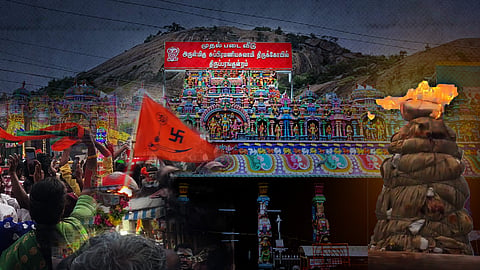
At 5 pm on Friday, November 28, as a lamp was lit at the disputed Deepathoon pillar atop Thiruparankundram hill, a roar rose from the foothills. Thousands gathered below erupted in cheers, with devotees celebrating alongside members and supporters of the Vishwa Hindu Parishad (VHP), the Rashtriya Swayamsevak Sangh (RSS), the Akhil Bharatiya Vidyarthi Parishad (ABVP), and various Murugan devotee organisations. Flags of Hindutva groups were visible in the crowd as slogans rang out and people broke into celebrations. Sweets were distributed, while a voice over the loudspeaker declared that a “160-year-old dream” had come true.
We were among the thousands gathered at the foothills, watching the moment unfold from below. Only around 50 devotees had been permitted to go up the hill for the lighting ceremony, with the rest of the public kept out amid heavy police and CRPF deployment. The crowd below had been building for hours, and the anticipation was palpable. Police personnel on duty told us that an estimated 10,000 to 15,000 people from across Tamil Nadu had mobilised at Thiruparankundram to witness the events of the day.
The event took place under tight security, with around 400 Central Reserve Police Force (CRPF) personnel deployed alongside local police. The total security presence was estimated at 600–700 personnel.
Two court-appointed receivers arrived in Madurai to oversee the arrangements, while the CRPF took charge of security on the hill, with access restricted to only authorised persons. The receivers visited the Thiruparankundram Murugan Temple and performed poojas before proceeding uphill. A temporary wooden scaffolding was erected around the disputed pillar to facilitate the installation of the lamp.
Meanwhile, special prayers were held at the nearby Sikandar Badusha Dargah, where Muslim devotees were allowed entry after security checks.
By around 4 pm, the streets around the temple were filling up. People stood in groups, craning their necks towards the hill, trying to find a vantage point from which they could see the disputed pillar. Soon, the air was filled with the repeated chant, “Vetrivel Muruganukku Arogara”. Groups broke into devotional songs, clapping in rhythm as others joined in. From atop a shop, a man played cymbals, adding to the growing chorus.
As the crowd swelled, announcements over the loudspeaker asked people to spread out, assuring them that the lamp would be visible from different parts of the foothills. The announcer appealed to people to make space, reminding them that children and elderly people, including those in their 60s and 70s, had also come to witness the lighting.
The announcements themselves became part of the spectacle. The man making the announcements, dressed in a saffron mundu and shawl, told the crowd at one point that the two judges appointed by the Supreme Court had been sent by Lord Murugan himself to go up the hill on behalf of the people. On another occasion, he urged those gathered to raise their Arogara chants louder, saying they were not singing “Hallelujah”.
Around 4.15 pm, the baanku vili (azaan), the evening prayer call of Muslims, began at the Sikandar Badusha Dargah, located barely 50 metres from the disputed pillar where the lamp was to be lit. As the call to prayer rang out, the Arogara chants grew louder. The cymbals continued to clang, more voices joined the chants, and the devotional songs grew louder, eventually drowning out the baanku.
At around 5 pm, the Karthigai Deepam was lit at the Deepathoon by temple priest Somaskandan, under the supervision of the two court-appointed receivers. The flame had been brought from the Deepa Mandapam near the Uchi Pillaiyar Temple, in keeping with the Supreme Court's direction.
The cheers from below were immediate and deafening. What followed was an outpouring of celebration that went beyond the religious ritual itself. Flags of the VHP and other Hindutva outfits were prominently displayed as people raised slogans, broke into call-and-response chants, and danced to peppy devotional songs as well as popular film music. Sweets were also distributed among the crowd. The lighting of the lamp at the disputed site had become a focal point of political mobilisation for Hindutva groups.
Amid the cheers and celebrations, we heard a middle-aged woman remark to her friend, "Ethana makkalude kanneer" — the tears of so many people. In her view, it was the years of struggles of Hindu devotees that had led to this moment.
That sense of vindication was evident among sections of the crowd. But the flags, slogans, and celebrations also pointed to how the dispute over the site has grown into a rallying point for Hindutva groups, making the lamp lighting more than a religious ritual.
The controversy over lighting the Karthigai Deepam at the disputed pillar in Thiruparankundram hill is rooted in a long-running dispute. The hill is home to the Arulmigu Subramaniya Swamy Temple, believed to be one of the six abodes of Lord Murugan, as well as the Hazrat Sultan Sikandar Badusha Auliya Dargah, a Sufi shrine near its summit. The hill also holds ancient Jain heritage, with rock-cut beds, caves, and Tamil-Brahmi inscriptions pointing to the presence of Jain monks in the region as early as the 2nd century BCE.
The immediate dispute concerns a stone pillar, located around 50 metres from the Dargah. Hindu petitioners refer to it as the Deepathoon, or lamp pillar, and have demanded that the Karthigai Deepam be lit there in addition to the customary spot near the Uchi Pillaiyar Temple.
However, a report released by the Tamil Nadu government on November 23 identified the disputed structure as a British-era marker belonging to the Great Trigonometrical Survey (GTS), a colonial-era mapping project. The report, titled Documentation of the Great Trigonometrical Survey Stations in Tamil Nadu, was jointly prepared by the state's Departments of Survey and Settlement and Archaeology.
For more than 150 years, the temple has followed the practice of lighting the Karthigai Maha Deepam at the Deepa Mandapam near the Uchi Pillaiyar Temple. The festival, observed during the Tamil month of Karthigai, marks the manifestation of Lord Shiva as an infinite column of light. The temple administration has maintained that there is no documented custom of lighting the lamp at the disputed pillar. Hindutva organisations, however, have argued that the ritual should also be performed there.
A century-old dispute over the hill
The competing claims over the hill date back to the colonial period. A civil court decree in 1923 broadly recognised the temple's ownership of the hill, while carving out specific areas for the Muslim community, including the Dargah, the steps leading to it, and a patch known as Nellithope. The Madras High Court subsequently reversed the decree, but the Judicial Committee of the Privy Council in London restored it in 1931, recognising the temple's rights over the hill while protecting the Dargah and the areas associated with it.
The Dargah's position has been that the hilltop area where the disputed pillar stands falls within its property. Hindu petitioners, meanwhile, have relied on the temple’s ownership of the larger share of the hill to argue that the lamp can be lit there.
Attempts to light the lamp at the pillar were reportedly made in 1862 and 1912, during British rule, but were stopped by the authorities, citing the absence of an established custom and the possibility of a breach of peace. The issue resurfaced in the early 1990s, when the RSS-affiliated Hindu Munnani began mobilising support for lighting the lamp at the disputed location.
A similar dispute reached the courts in 1996, when the Hindu Dharma Parishad sought permission, among other things, to keep a lamp burning at the pillar throughout the day and illuminate the hill during Karthigai Deepam. The Commissioner of the Hindu Religious & Charitable Endowments (HR&CE) Department opposed the demand, maintaining that the customary location for the festival lamp was the Deepa Mandapam near the Uchi Pillaiyar Temple.
How the dispute reached the Supreme Court
The current round of litigation gathered momentum in 2025. On December 1 that year, Justice GR Swaminathan of the Madras High Court's Madurai Bench allowed petitions seeking permission to light the Karthigai Deepam at the disputed pillar, in addition to the customary location. The judge held that performing the ritual there would not infringe upon the Dargah’s rights.
A Division Bench of the Madras High Court upheld the direction on January 6, 2026, with modifications. It allowed a small team authorised by the temple to perform the ritual, while also taking into account the hill's heritage status and the need to consult the relevant authorities.
The Tamil Nadu government challenged the orders in the Supreme Court in June 2026, citing the possibility of communal tension given the pillar’s proximity to the Dargah. The temple's priests, known as sthanikars, maintained that the ritual had traditionally been conducted at the Deepa Mandapam near the Uchi Pillaiyar Temple in accordance with Agama practices. The Dargah Committee also opposed the demand, questioning the identification of the pillar as a traditional lamp structure.
With the Karthigai Deepam festival approaching on November 24, the state sought urgent relief from the Supreme Court. A Bench of Justices Aravind Kumar and Vipul M Pancholi heard the matter over several days from November 17. The state argued that the customary practice should continue, citing the absence of evidence of a religious custom or right to light the lamp at the disputed pillar. It also warned that allowing the ritual there could disturb the existing boundary between the temple and the Dargah and trigger law-and-order problems.
On November 20, the Supreme Court stayed the Madras High Court's judgement but permitted the lamp to be lit at the Deepathoon on November 24 as a one-time arrangement. It clarified that this permission did not recognise or establish any customary, religious, or proprietary right at the location, and would not affect the final outcome of the pending case. The court directed that only authorised temple representatives and government officials be allowed to access the site, with the Madurai Collector responsible for coordinating the arrangements. Members of the public were not to be permitted to climb to the location.
However, on November 24, the day of the festival, the lamp was lit at around 6 pm at the customary Deepa Mandapam near the Uchi Pillaiyar Temple, while the disputed pillar remained unlit. This triggered protests by Hindu organisations and Bharatiya Janata Party (BJP) members, who accused the state government and temple administration of defying the Supreme Court's order. Police detained several protesters amid heightened security, while restrictions were imposed on access to the hill.
The BJP also launched a political attack on Chief Minister C Joseph Vijay and his Tamilaga Vetri Kazhagam (TVK)-led government, accusing it of disregarding Hindu religious sentiments.
The matter returned to the Supreme Court through contempt petitions alleging wilful disobedience of its November 20 order. On November 27, the Bench of Justices Aravind Kumar and Vipul M Pancholi took a strong view of the failure to implement its direction, observing that the sequence of events prima facie indicated that executive authorities had acted at the dictates of their political leaders.
In an unprecedented intervention in the temple's administration, the Supreme Court suspended its Board of Trustees and appointed two retired judges — Justice S Vaidyanathan, former Chief Justice of the Meghalaya High Court, and Justice V Parthiban, former judge of the Madras High Court — as joint receivers. They were tasked with taking charge of the temple's administration and ensuring that the lamp was lit at the disputed pillar.
The court also directed the CRPF to take over security of the temple and the entire hill, leaving the local police to manage the surrounding areas. It vacated its earlier stay on the High Court's findings concerning the pillar, while keeping the underlying appeals pending. The court reiterated that safeguards for the Dargah would continue, directed that lamps be lit at designated locations at least 50 metres away from the Dargah, and said Muslim devotees must not be obstructed from offering prayers.
The November 27 order drew criticism from civil liberties groups and political parties. The People’s Union for Civil Liberties (PUCL), Tamil Nadu and Puducherry, described the intervention as distressing, arguing that it effectively created a new religious practice in the absence of an established custom. It also questioned the court's intervention in a matter involving the powers of an elected state government and warned of its implications for religious harmony.
Viduthalai Chiruthaigal Katchi (VCK) leader and MP Thol Thirumavalavan questioned why the Supreme Court had taken up the contempt proceedings without first considering the state's review petition. He also questioned the urgency of the intervention, comparing the court’s response with its handling of the Sabarimala issue. The Communist Party of India (CPI) condemned the order and announced statewide protests.
