
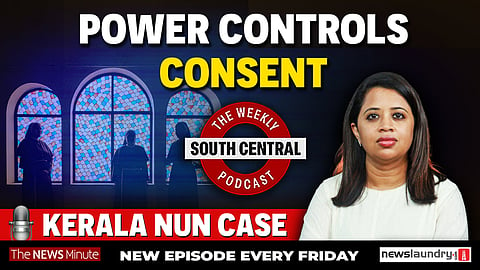
Franco to Rahul Mamkootathil, power rewrites consent | Karnataka's Stuck Govt | South Central Episode 58
In the first session of the episode, hosts Dhanya Rajendran and Pooja Prasanna discuss the intersection of consent, agency and institutional power in sexual assault cases, like in the cases of Kerala MLA Rahul Mamkootathi, acquitted Bishop Franco Mulakkal, ex-BJP MLA Kuldeep Sengar and more. The hosts are joined by senior journalist Nidhi Suresh, TNM Associate Editor and gender journalist Sukanya Shaji, and senior journalist Maya Sharma.
Dhanya starts the conversation by commenting on how several survivors have now been wanting to settle the issue out of court. Pooja says we need to break down the concept of consent, vis a vis sexual agency.
Tune in to the discussions here
Listen & follow on Apple
Listen & follow on Spotify
Listen & follow on YouTube
“This is a constant conversation we have been having since the #metoo movement. The crime happens in intimate spaces and the law mandates evidence, but the woman is often not able to produce it. Not only Sister Ranit, the survivor nun in the Franco case, but also when i went back to Hathras, the Dalit family of the victim said had they known this is how it would be, they would not have pushed the case. The only positive outcome so to say was in the Priya Ramani case, which was a defamation case. Discussing power and consent is also a theme in the Harvey Weinstein case, but it took nearly 99 women to take a stand to bring him down. Here, we are trying to prove te rape happened, despite grave bodily injuries and even death. So I think consent and its nuances seem like a faraway conversation,” says Nidhi.
She also refers to Sister Ranit’s recent television interview, where she says she ideally did not want to complain, but that it was the verdict in the 2017 actor assault case of Kerala that prompted her to reveal her face to the world. “She maintains that at least when we spoke to her, that if she had a choice and if the judge had taken her complaints immediately, she would not have gone public with this case. There's a very important line in that interview where the interviewer asked her, what would you say to other women who were abused? Would you, you know, tell them to come out and complain? And she pauses and she says, I'm not sure I would encourage them to complain. But I can't say don't complain either. So she said it was all these feelings that eventually pushed her to come out and speak in public,” she adds.
Sukanya says that consent must be understood as a product of circumstance and power and not an on or off switch. “I have heard several men’s rights activists and those lobbying for the accused men in sexual assault cases say that rape can happen only once. What they mean is that when women say they were raped by the same man over a long time period, and multiple times, thats a lie. The logic is that once you know you have been raped, why would you go back to the same man to be raped again. It is here that we need to understand consent as something that operates within a structure of power, and it depends on who holds more power in the relationship, be it gender power, political power like the ex BJP MLA Kuldeep Sengar in the Unnao case, or economic and workplace based upper hand like in the Kerala actor assault case. When the woman feels she has lesser bargaining power, consent becomes murky. We must also factor in the internalised pressure of women to be more forgiving. Many of them, who enter into consensual romantic and sexual relationships like Rahul’s case, may be told the man was in a bad mood or he may apologise profusely and beg them to forgive and promise to reform. So women go back again, to be assaulted. Only when this happens a few times do they realise this is sexual assault. So to understand consent, we need to look at who holds more bargaining capacity in the relationship and whether that was used against the other,” she adds.
Maya Sharma says that consent is also incident specific. “A woman giving consent for a coffee date is giving consent only for that date, not for sex. It cannot be implied from her behaviour that she agreed to everything the man wants after,” she says.
Sukanya adds further that distortion of consent also comes from a place of wanting to put women in check, with respect to their sexual agency. “It comes from an inherent, patriarchal desire to police women’s sexual agency. A lot this distortion of consent is pretence,” she says.
Dhanya says that judges not challenging stereotypes is also a big problem. “For example in the Franco case, the judge has given a verdict based on stereotypes. This sets a very wrong precedent in cases like Rahul Mamkootathil’s. The projection is of a virile young unmarried man who has many women lovers. But when we morally look at the overlaps of time, we see there is a promise of marriage and an insistence on having children. One woman says she wants to take contraception but he refuses and later forces her to have an abortion,” she says.
Pooja recalls how the before and after are important. “In the Prajwal Revanna cases, first it was reported as sex scandals. But we need to see what happened before and after the sexual assault as well to really contextualise what happened,” she says.
Nidhi explains what Bishop Franco told her when she met him. “He spoke a lot about women, asking if women should even exist. He said a righteous rapist would kill his victims after rape and anyone who come sup and alleges rape is lying. He even spoke about the banned two finger test, and has some extremely hard to swallow opinions on women,” she says.
The panel further discusses women’s agency, the responsibility of public servants, how courtrooms become places of psychological warfare, and so on.
In the second part of the discussion, the hosts and Maya delve into Karnataka’s so called ‘government on maintenance’ and allegations of the Congress squandering away its power.
Maya Sharma says there is so much discussion about a possible leadership change in the Congress, with Siddaramaiah and DSK pulling back and forth for power. “I also feel too much is being made of this. I don’t think a leadership change is going to change the people’s stance. It is wonderful for the media, but I think it is being played up more than should be. The Congress in Karnataka is definitely not pushing enough. But this is a question of why politicians come into power. Right now, the government seems to feel comfortable in the strength of their numbers and that has made them complacent,” she says.
Pooja recalls how Siddaramaiah has clung on to power. “All the things on the agenda have been put aside and they have just held on to staying in power,” she says.
Dhanya says the problem is not him continuing but if he will discontinue and let someone else take over. “Ministers sometimes do not want to take calls. If there is a powerful CM, ministers can just execute it. In another scenario, Siddaramaiah and DKS are very different in terms of leadership, so a lot of speculative lethargy happens because people think "why start something if it is going to change anyway?” she explains.
All this and more.
Once a month, we will invite one TNM subscriber to the show. Write to us on what you would like to speak about to southcentral@thenewsminute.com
Send your thoughts, suggestions, and criticism as well.
You can also let us know what you think by filling out our quick feedback form. Your suggestions help shape future episodes of South Central.
Audio Timecodes
00:00:00- Introduction
00:02:27 - Headlines
00:10:40 - Power rewrites consent
00:59:06 - Karnataka Govt
01:17:29- Recommendations
References
Decoding Zoho's Sridhar Vembu: The software czar who became the Sangh's Swadeshi mascot
Why Jose K Mani would want to jump ship | Powertrip #134
Against God’s men: A nun, a bishop, and the trial of India’s Catholic Church
Stealthing, forced pregnancy, and the myth of consent in the Rahul Mamkootathil cases
To stay or leave: Why it's not always an easy choice for women facing domestic violence
Recommendations
Maya Sharma
Sukanya Shaji
Nidhi Suresh
Pooja Prasanna
Karna's Wife: The Outcast's Queen
Dhanya Rajedran
Scroll Adda with Arvind Subramanian and Devesh Kapur
A Conversation Between Two Fathers of Remarkable Daughters
Contribute to our reporting fund. Click here.
To check out our other shows, Click here
To not miss any updates, join TNM's WhatsApp Channel! Click here
Produced by Bhuvan Malik, edited by Jaseem Ali, written by Sukanya Shaji.
Follow TNM's WhatsApp channel for news updates and story links.