Some of the residents in and around Govindaperi work in the school as canteen staff and in other jobs, while many more work on Sridhar’s land, which the villagers say he bought in 2009 and estimate to be over 400 acres. He lives in a house on the same premises as the school but set well away from the road, which multiple locals referred to as “agraharam.” The terminology is telling, since that is what the Brahmin quarter is traditionally called. While Sridhar is a Brahmin, the other residents of the village are from the intermediate Thevar and Nadar castes, with Scheduled Castes living in an adjoining village (like in many villages in Tamil Nadu).
The same Organiser article goes on about Sridhar’s “magnitude” and “uniqueness” before concluding: “Will the Nation notice this unique individual, his aggressive and down to earth ‘Aathmanirbhar’ implementation?”
The question was likely rhetorical.
By the time the article was published, the Narendra Modi government had already awarded Sridhar the Padma Shri. In the years since, he has come to occupy a unique and increasingly influential position at the intersection of business, technology, and the politics and policies of the ruling Bharatiya Janata Party (BJP) and its fountainhead, the RSS.
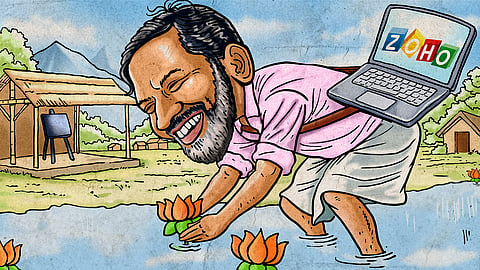
As a successful tech entrepreneur who swapped California for Tenkasi, who runs a global firm out of Chennai, and speaks of building for rural India and the ‘Swadeshi’ model, the BJP could not have asked for a better poster boy. And unlike some of his more extravagant peers in India’s wealthiest lists, Sridhar projects an image of simplicity. Photographs of the veshti-clad tech leader cycling through villages or sitting by paddy fields are now familiar, images reinforced by his comments like “I don’t need more money, my tastes are simple” and “I am a capitalist and I don’t care about net worth.”
Much of this suggests an exemplar, a role model whose star in the Sangh Parivar constellation is in the ascendant.
Yet, a wider mirror held up to Sridhar’s life catches other reflections.
One perspective, offered by a former Zoho executive who worked in the company for about a decade, and echoed by several others interviewed for this profile, is: “I see him as a great marketer, internally and externally. He can spin a great story.” Another Chennai-based entrepreneur who has known Sridhar for two decades describes him as someone who makes a virtue out of a necessity and who now paints his actions in the colours of patriotism.
While these statements indicate nothing worse than hypocrisy, far graver sentiments have been expressed in a California court hearing his divorce petition. Sridhar, the court said, was not transparent about certain financial transactions and acted “without regard to the law,” ordering him to post a bond of $1.7 billion, as reported first by The News Minute and Newslaundry. His ex-wife, Pramila Srinivasan, has accused Sridhar of abandoning her and their son with special needs.
All of these, too, are parts of the whole that make up Sridhar Vembu.
His positioning takes on increasing importance when you consider that he is based in Tamil Nadu, an election-bound state where the BJP is obsessively trying to make inroads, and the renewed emphasis the Union government is placing on an ‘Aatmanirbhar Bharat’. As a prominent BJP leader told us, his support for the party is important for longer-term goals, more than short-term electoral gains.
Across eight chapters, this profile delves into the many constructs around Sridhar Vembu. It traces how the engineer from Chennai built a globally successful software company and transitioned from someone quoting Buddhist philosophies to a figure growing increasingly closer to the Sangh and the BJP’s political project.
It also examines the multiple allegations raised by his ex-wife and the damning findings of a court in California, as his divorce case makes its way through the US legal system.
Chapter 1: The early years
Sridhar’s journey began in Chennai. The eldest of five children born to Sambamurthy and Janaki Vembu, who hailed from villages in Thanjavur in south Tamil Nadu, he grew up in the city, where he attended a Tamil medium school. The family of seven depended on Sambamurthy’s income as a stenographer in the Madras High Court, while Janaki was a homemaker. After finishing school, Sridhar cracked the national entrance exam for Indian Institute of Technology (IIT)s, joining IIT Madras with a rank of 27 in 1985.
TT Narendran, a retired IIT Madras professor who headed counselling and guidance on campus when Sridhar joined, recalls shortlisting his profile to include in the list of students who might need additional income to meet campus expenses. “We noticed that Sridhar was from a low-income family. We would typically arrange for such students to take tuition for schoolchildren who can afford to pay well, and we roped him in,” he told TNM on the phone from Chennai.
The faculty also noticed a rebellious streak. “It was not so much in academics as against typical Brahmin middle-class values or hypocrisy and his parents. Any society will have some amount of hypocrisy – some children notice that and want to rebel,” Narendran says with a chuckle. As an act of protest against his father, Sridhar removed the ritual thread Brahmins wear and left home, an incident he recounted in a lecture at his alma mater in 2014.
Two of Sridhar’s younger siblings, Sekar and Radha Vembu, also attended IIT-Madras. Radha graduated in industrial management, while Sekar completed a BTech in mechanical engineering. On campus, both kept a relatively low profile. “Sridhar outshone the rest when it came to academics,” says Narendran.