
Subscribe
TNM has followed this case from the start. For verified and timely updates and legal explanations, join our WhatsApp Channel.
It wasn’t an unexpected verdict. Anyone who had followed the trajectory of the Kerala actor assault case since February 17, 2017, knew that the possibility of a conviction for all the accused, especially the alleged chief conspirator, was low. But many of us were hopeful.
Hopeful that the court would see the survivor’s truth. Hopeful that the court would recognise the power dynamics within an industry that made 28 witnesses swallow their words and turn hostile. Hopeful that the court would give due credence to the testimony of a dying man who wanted to do right.
Hopeful that the court would vindicate the voice of a woman who refused to back down.
But, this isn’t a film where a righteous lawyer lambasts the accused, society and system in the climax to wring justice out of an impossible situation.
This is real life. A court case pertaining to the film industry where such optimistic films are made.
In real life, the wheels of justice turn slowly and when it comes to crimes against women, they turn so slowly that it might be imperceptible. It is natural to feel disappointed, disheartened and cynical. Because if this is the fate of a celebrity, what hope do ordinary women with far fewer resources have?
As accused No 8 Dileep walked out of the court and faced the camera triumphantly, he played the victim once again — a do-gooder unfairly targeted by a vindictive ex-wife and a shoddy police investigation.
The speed with which certain sections of the Malayalam film industry welcomed him back to the fold wasn’t in the least surprising. The online PR campaign to whitewash him is in motion as we speak, and the actor’s new film, Bha. Bha. Bha, will hit the screens on December 18.
But does this mean the survivor’s eight-year struggle was for nothing? Has the movement for gender justice been discredited because of the court’s verdict?
Far from it.
The Malayalam film industry has seen a seismic shift, transforming it from a space where unprofessional conduct and sexual harassment were treated like family squabbles to one where an IC is mandatory for every film organisation, production company and set.
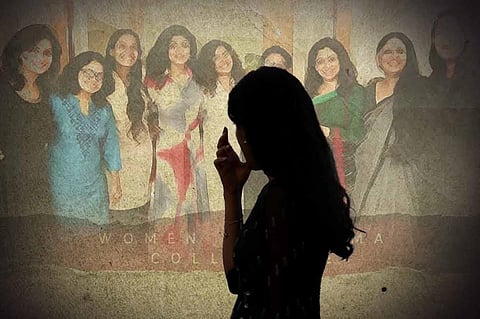
Through the formation of the Women in Cinema Collective (WCC) and its unwavering efforts towards creating a gender-just workspace, the industry has witnessed the Ambedkarite slogan ‘Educate, Agitate, Organise’ come alive.
There is more awareness about gender equality and rights; more survivors are speaking up and protesting the misogyny within the industry. Most of all, these efforts aren’t happening in isolation — they have led to a culture where systems of accountability are being put in place.
The Hema Committee report, despite the redacted names, is a powerful documentation of women from the Malayalam film industry coming together to speak up about the insensitivity, injustice and violence that they confront.
Not every case will lead to a conviction, but at least the facade that the film industry is one big happy family where such incidents are unheard of has been shattered.
The media, too, no longer views such stories as salacious gossip. For the most part, there is an understanding and acknowledgement that workplace sexual harassment is a crime.
These changes do not happen without consistent and concerted efforts. The accused, who assaulted the woman actor and filmed the crime, were confident that she wouldn’t speak up. After all, as prime accused Pulsar Suni told TNM’s reporter Nidhi Suresh in a chilling interview, he didn’t consider the crime to be such a “big deal”. They thought she would choose silence. She didn’t.
Those behind the crime probably did not expect so many from the film industry to stand up for her. That superstars would be shamed for their silence or support of the accused. That people in power would be questioned for their inaction in such cases and even resign from their posts. That other women would be willing to lose out on work in order to speak their truth. That they would find male allies. That a fierce sisterhood would form with the survivor as the fulcrum.
It showed that stardom doesn’t make anyone immune to public scrutiny and accountability.
Have you heard of Kintsugi? It is the Japanese art of repairing broken pottery. The cracks are mended with lacquer and dusted with powdered gold, silver or platinum, thus transforming flaws into stunning designs. The Japanese believe in finding beauty in resilience. What we are witnessing now is the Kintsugi of the Malayalam film industry. The cracks needed to be exposed because they were always there. They are now being mended by women whose greatest beauty is their resilience.
Still, this can be a confusing time for Kerala society. The news is full of Dileep or other sexual harassment cases that crop up every now and then. Often, there is an attempt to characterise these cases as false and motivated. Survivors may fear that if they speak up, they will have to suffer through such indignity.
But, if there’s anything the actor assault case has shown, it is that silence will not protect any of us. Not all battles end in victory, but it matters that someone steps into the battlefield to fight back. The survivor and those who united under the #Avalkoppam slogan are on the right side of history and they will be remembered for it.
Sowmya Rajendran writes on gender, culture and cinema. She has written over 25 books, including a nonfiction book on gender for adolescents. She was awarded the Sahitya Akademi’s Bal Sahitya Puraskar for her novel Mayil Will Not Be Quiet in 2015.
Read our detailed coverage of the Kerala actor assault case over the years here.
Follow TNM's WhatsApp channel for news updates and story links.
