
Subscribe
Follow TNM's WhatsApp channel for news updates and story links.
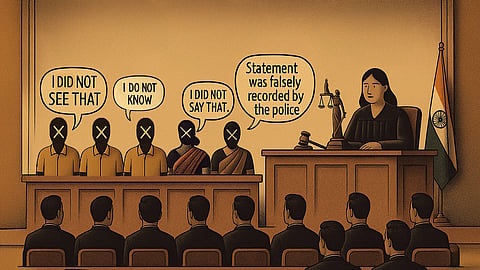
The most apparent and decisive power play in the 2017 Kerala actor assault case did not happen in secret, but in open court. Twenty-eight prosecution witnesses turned hostile during the trial, retreating into near-identical denials. “I don’t know”, “I didn’t see that”, “I did not say that”, “That statement was wrongly recorded by the police,” they said, leaving the fate of the case against one of Malayalam cinema’s most powerful men, actor Dileep, hanging in the balance.
As the eight-year-long wait for justice draws to a close with the verdict expected on December 8, the central question before the trial court is clear: can the prosecution prove that Dileep masterminded the abduction and sexual assault of a colleague despite these hostile witnesses?
According to the prosecution, Dileep held a vicious grudge against the survivor for intimating his then wife Manju Warrier of his extramarital relationship with his current wife, Kavya Madhavan. Manju herself had told the investigating team that she was aware of this grudge. The prosecution argued that his way of getting back at the survivor was by tasking a goonda, Pulsar Suni, to abduct and sexually assault her, and film the episode.
Among those who turned hostile were Malayalam film actors such as Bhama, Bindu Panicker, Sidhique, and Edavela Babu – figures whose initial statements had helped the prosecution sketch Dileep’s alleged animosity towards the survivor and establish the contours of the conspiracy. There were also the obvious hostile witnesses such as Kavya and members from both her and Dileep’s families.
For the survivor, some of these statements made the unkindest cuts, as close friends and long-time colleagues, along with persons previously unknown, all quietly shifted allegiances.
While the Malayalam film industry folks who turned hostile are well known, there are many unknown names in this list.
These include witnesses crucial to the prosecution’s chain of events, from doctors accused of fabricating hospital admission records for Dileep to hotel staff who had earlier placed Pulsar Suni in proximity to the actor.
Dr Hyder Ali and his brother Salim of the Anwar Memorial Hospital in Aluva are two such witnesses. Though the prosecution’s case was never that Dileep was present during the kidnapping, he presented records showing he was hospitalised on the night of February 17, 2017.
The police had found this to be false; a nurse who worked at the hospital had told the court that the documents had been forged to show that the actor was admitted there. Both Hyder Ali and Salim denied any role and turned hostile during the trial.
Another witness who initially turned hostile was Sagar Vincent, an employee of the clothing store Laksyah owned by Kavya. He had told the police that Pulsar Suni and another man had visited the store on February 22, five days after the crime, and handed over a package. During the trial, Sagar denied this. One of the voice clips later produced by Dileep’s whistleblower friend Balachandrakumar had said that Sagar was offered a bribe of Rs 5 lakh by Dileep’s lawyers to change his statement. Sagar later went to court and admitted that he had lied during his initial deposition. He is no longer a hostile witness.
Kavya Madhavan’s brother Mithun and his wife Ria, who are partners in her clothing brand Laksyah, too had initially told the police that Suni had come to their shop on February 22. They two later turned hostile and denied this in court.
Another example is that of Shirley Ajith, an employee at the Arcadia Hotel in Alappuzha, where Dileep, along with actor Mukesh, had stayed during the shooting of his film Sound Thoma. Shirley had said that Pulsar Suni had been there at the hotel at the same time that the actors stayed there. Suni was previously employed as Mukesh’s personal driver, and Mukesh has attested to this in court.
The investigating team was also given documents from the hotel confirming Dileep and Mukesh’s stay there. Denying any such knowledge during trial, Shirley said that she had neither handed over any hotel register to the police nor knew of anyone who had done so.
For the investigating team, the pattern was unmistakable. Individually, each retraction could be explained away or replaced by a witness who didn’t change their version. But when taken collectively, they suggested a systematic retreat from earlier versions that had once perfectly corroborated one another.
When the charge sheet was filed, Suni was listed as the prime accused, with Dileep named as the eighth accused for allegedly masterminding the crime. Central to this allegation was a meeting in 2013 during rehearsals for an Association of Malayalam Movie Artistes (A.M.M.A) cultural programme at Hotel Abad Plaza in Kochi, where the prosecution said Dileep first contacted Suni.
According to Kavya Madhavan’s initial statement to the police, the survivor had clicked a photo of her with Dileep at the Abad rehearsal venue and sent it to Manju, and this made Dileep furious. Unsurprisingly, Kavya denied this during the trial, sources told TNM.
Prior to Dileep’s angry outburst, Kavya had allegedly complained to Sidhique that the survivor was badmouthing her at the rehearsal camp. Sidhique had then warned the survivor against this, the prosecution argued.
Both Bhama and Sidhique had initially told the police that Dileep openly threatened the survivor at the venue, including remarks about setting her on fire. Both had also initially acknowledged Dileep’s simmering anger over the survivor’s role in exposing his relationship to Manju.
In court, however, they categorically denied seeing, hearing, or knowing any such thing.
During his almost four-decade-long career, Dileep had gone from a small-time mimicry artist to a superstar film actor, producer, theatre owner, distributor, and more. His sway over the industry was so large that at one point of time, there were many in the industry and the media who believed that his power and influence easily outweighed that of both Mammootty and Mohanlal, the two unmistakable giants in Malayalam cinema.
Dileep allegedly used this influence to directly and indirectly harass the survivor, even denying her work. As things got worse, she filed a complaint with A.M.M.A accusing Dileep of harassment and blocking her film opportunities.
Edavela Babu was the general secretary of A.M.M.A when the survivor complained against the harassment. His initial statement to the police in July 2017 acknowledged this and accepted that he believed in the veracity of her complaint. He had told the investigators that A.M.M.A does not keep a record of such complaints, but he had personally spoken to Dileep about the complaint and asked him not to “interfere in unnecessary things”.
However, during the case’s trial, he backtracked.
Babu said that the survivor had neither told him about being sidelined from movies nor filed a complaint. He told the court, “I have not given a police statement to the contrary.”
It is important to note here that Dileep held unquestionable influence in the association. In fact, A.M.M.A had relied on Dileep for a major fundraising project in 2008. That year saw the release of the star-studded film Twenty20, a Dileep production in which a host of stars acted without taking payment, in an effort to raise money for welfare programmes run by A.M.M.A. A fixed deposit of Rs 1 crore was made in the association’s name from the film’s profits and unspecified amounts were used for the medical treatment of a veteran actor and the construction of the house of another.
During the trial, Babu downplayed Dileep’s financial contributions to the association. “Dileep is only a minor financial source for A.M.M.A,” he said, adding that it is not true that he is giving false statements in court because of Dileep’s stature and power.
Also noteworthy is that Babu acted in a film with Dileep after the latter was named as an accused in the crime.
The survivor had confided in her colleagues about the anger Dileep harboured against her. She had also described to some her meeting with Manju, during which actors Geethu Mohandas and Samyuktha Varma were present, where she told Manju about the alleged extramarital relationship maintained by Dileep.
In her first statement to the investigating team, actor Bindu Panicker had said that she knew about the conflict between the survivor and Dileep, through conversations with both the survivor and Kavya. But in 2020, during the trial, she denied this.
Bindu further said, “I did not give a statement to the police that ‘X’ told Dileep’s wife (Manju) about Dileep and Kavya, and that Kavya is sad because of that.”
“If such a statement is recorded, then it is not correct,” she told the court, adding, “If you say that I’m giving false statements on Dileep’s direction, then it is incorrect.”
Notably, Bindu had starred as Dileep’s mother in the 2019 film Kodathi Samaksham Balan Vakkeel. The prosecution argued that this indicated that she had been influenced by Dileep.
The prosecution had listed several of Dileep and Kavya’s family members as witnesses. They were declared hostile when they refused to even acknowledge straightforward questions.
This includes Kavya’s parents, her brother Mithun, and sister-in-law Riya. Dileep’s friends Nadirsha and Baiju, brother Anoop, brother-in-law Suraj, his driver Appunni, and his guard Dasan also turned hostile.
A production manager named Shine who had initially told the police that he saw Pulsar Suni with Dileep too was declared hostile.
Ranjith, the husband of actor Chippi, was the programme executive of the Mazhavil Azhakil A.M.M.A event held in Sharjah and Kochi in 2013. The rehearsal for this was held between March 26 and April 7 in Kochi’s Abad Plaza Hotel. According to the prosecution, Dileep was assigned room 410 in the hotel, where he met Pulsar Suni as part of hatching the conspiracy to attack the survivor.
Ranjith, however, denied his earlier statement and said that Dileep did not stay at the hotel during the rehearsal.
Just as the prosecution appeared to be collapsing under the weight of hostile testimonies, a surprise intervention in December 2021 reshaped the trial’s trajectory. Filmmaker Balachandrakumar, who had been working with Dileep, released audio recordings he claimed captured the actor and his associates viewing visuals of the assault at Dileep’s residence.
The revelation prompted the reopening of the investigation and renewed focus on conspiracy and cover-up. Balachandrakumar told investigators that he had witnessed Dileep and his associates watching the video recording of the sexual assault, and released audio clips purportedly capturing conversations in which the assault footage, efforts to destroy evidence, and attempts to influence witnesses were discussed. He also alleged that Dileep had sought the recovery of the memory card used to film the crime, a claim that significantly strengthened the prosecution’s argument of a continuing conspiracy even after the assault.
The issue of witnesses turning hostile has not gone unnoticed by the higher judiciary. In the Gokulraj murder case, the Madras High Court warned that trial courts cannot remain passive spectators when crucial witnesses retract earlier statements in cases involving entrenched power. Observing that witness hostility has become a recurring feature in serious criminal trials, the court emphasised that justice risks collapse when silence is allowed to substitute scrutiny. “If the court deals with this easily, the public will lose trust in the judicial system. If any witness gives wrong testimony at the court, it is necessary to take action against them,” the court had said.
In the actor assault case, by the time arguments concluded, the prosecution’s case had come to rest on what remained unwithdrawn: phone data, documents, forensic material, and statements that withstood cross examination. Alongside them lay a parallel record of denials, contradictions, and retractions that had accumulated over years of trial. The judgement, expected on December 8, will be based on this fractured evidentiary landscape assembled after eight years of investigation, reversals, and reconsideration.
With inputs from Azeefa Fathima.
Follow TNM's WhatsApp channel for news updates and story links.
