
Subscribe
Follow TNM's WhatsApp channel for news updates and story links.
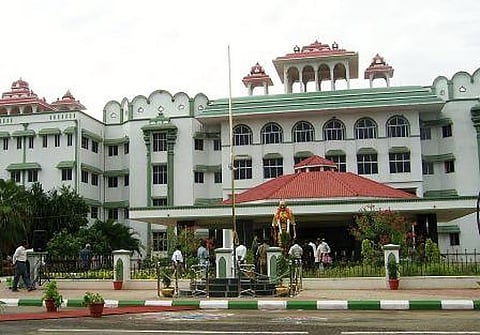
The Madurai Bench of the Madras High Court, on Thursday, December 4, dismissed a Letters Patent Appeal in the Thiruparankundram deepam row. The Appeal was filed by the Madurai District Collector and the Commissioner of Police, who had challenged a single judge’s December 3 contempt order permitting the petitioner to light the Karthigai Deepam at the Deepathoon on Thiruparankundram Hill with CISF protection.
A Letters Patent Appeal is an intra-court appeal filed before a Division Bench of the same High Court to challenge an order passed by a single judge.
A Division Bench of Justices G Jayachandran and KK Ramakrishnan held that the single judge’s directions were neither a modification of the earlier order dated December 1 nor an act of judicial overreach, but a necessary measure after the temple administration failed to comply with the order to light the lamp at the ancient stone lamp pillar.
The Bench noted that the writ petition filed by Rama Ravikumar sought enforcement of earlier High Court directions mandating the lighting of the Karthigai Deepam at the Deepathoon. The single judge had, on December 1, directed the Arulmigu Subramaniya Swamy Temple to light the lamp “at Deepathoon also apart from the usual places,” and held that “it is the duty of the jurisdictional police to ensure that the direction of this Court is complied with.”
However, on the evening of December 3, when the Deepam was to be lit at 6 pm on the full moon day, the Executive Officer allegedly failed to make arrangements, prompting the petitioner to move a contempt petition.
After hearing the Additional Advocate General at 5 pm, the single judge waited until 6.05 pm to confirm non-compliance and then permitted the petitioner and ten others to proceed to the hilltop with CISF protection.
The State, represented by Additional Advocate Generals J Ravindran and Veera Kathiravan, contended that the contempt petition was “in anticipation” of disobedience, that the single judge had acted beyond jurisdiction by directing CISF deployment, and that the temple authorities had the right to appeal within 30 days.
They further argued that CISF security was reserved solely for High Court premises.
The Division Bench rejected these claims, observing that “the subsequent order in the contempt petition… is not beyond the four corners of the main writ petition.” It added that when the designated authority – here, the temple administration – failed to carry out the order, the judge was justified in allowing the petitioner to light the Deepam to “give purposeful meaning” to the earlier order.
On the State’s objection to CISF involvement, the Bench held that the judge acted due to the “State Police refus[ing] to give protection,” and that “there is no illegality in taking assistance of central force… if the circumstances warrant.”
The Bench also recorded that the District Collector had invoked Section 163 of the BNSS (equivalent to Section 144 CrPC) around 6 pm on December 3, prohibiting entry to the hill. The judges questioned the timing and intent behind the order, noting, “Thus it is very obvious that Section 163 BNSS order is passed prior to the judicial order or the records are manipulated after this Court calls for the original file.”
The court also noted that the prohibitory order itself carried an exemption for religious ceremonies.
The Bench further stated, “We are clear in our mind that the subsequent order… is not an order modifying the earlier order… The learned Single Judge has permitted the petitioners to light the lamp… during the Megha Deepam Day… This appeal filed with ulterior motive to preempt contempt action is liable to be dismissed.”
Accordingly, the Division Bench dismissed the appeal and closed connected petitions.
Meanwhile, a single judge bench headed by Justice GR Swaminathan, which was hearing the contempt proceedings, quashed the curfew imposed by the district collector in Thiruparankundram and directed the police commissioner to provide security to the petitioner to go to the hill and light the Deepam at the Deepathoon near the Dargha.
The dispute over the lighting of the Deepathoon lamp is part of a long-running conflict over religious practices and land rights on Thiruparankundram Hill, which houses both the Arulmigu Subramania Swamy Temple and the Sikkandar Badhusha Dargah.
Earlier this week, a single judge had reiterated that lighting the lamp at the Deepathoon is a centuries-old Tamil tradition, citing historical decrees, including a 1923 judgment upheld by the Privy Council, affirming temple ownership over the lower peak.
The controversy escalated after temple authorities attempted to restrict the Deepam to the Uchipillaiyar Temple area, prompting protests and clashes on December 3, during which police imposed Section 144 in the region.
Follow TNM's WhatsApp channel for news updates and story links.
