
Subscribe
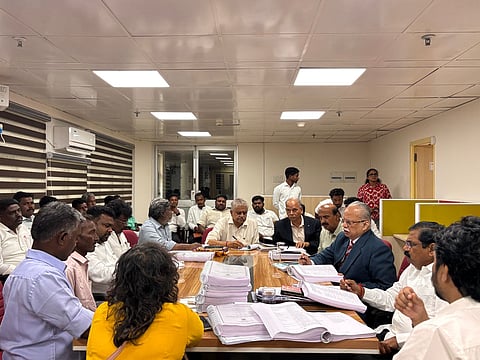
Reiterating their demand for a special state law to prevent honour killings, victims’ families deposed in front of the KN Basha Commission on June 25. A total of 28 cases have been brought to the Commission’s attention as proof of why a separate law is needed.
The Commission is meeting victims’ families on June 25 and June 26 in Chennai.
The Commission, headed by retired judge KN Basha, was set up in October 2025 and tasked with identifying measures to prevent honour killings in Tamil Nadu. At the time, the then Dravida Munnetra Kazhagam-led (DMK) state government also promised to bring in special legislation against such killings based on the Commission’s recommendations.
Now, it is time for Chief Minister C Joseph Vijay and the Tamilaga Vetri Kazhagam (TVK) to ensure that the long-awaited state law is passed, the families say.
The meeting was facilitated by Madurai-based rights organisation Evidence’s founder, Kathir. Cases presented to the Commission date between 2014 and 2026. The youngest victim among the cases presented was the 40-day-old child of an inter-caste couple.
Also present was anti-caste activist Kowsalya. In 2016, she and her husband, Shankar, a Dalit man, were brutally attacked in broad daylight by contract killers hired by her Kallar (OBC or DNT) family. Shankar succumbed to his injuries. Though Kowsalya testified against her own family, the Madras High Court acquitted accused 1, her father.
While deposing before the Commission, Kowsalya specifically highlighted the role of hired killers and caste-pride outfits in honour killing cases. She pointed out that not only has the A1 been freed, but he was felicitated by organisations that celebrate caste supremacy when he walked out of jail.
“The hired killers are serving time, but the ones who ordered the murder are not. How is that justice?” she asked.
Emphasising this concern about caste-supremacist organisations, Gokulraj’s brother Kalaichelvan appeared before the Commission. The 2015 case has grabbed the state's attention over the years. Gokulraj was beheaded for his relationship with a Gounder (OBC) woman, Swathi. The main accused is a man named Yuvaraj.
Yuvaraj has no relation to Swathi. Serving a life sentence now, he continues to lead the caste supremacist group Dheeran Chinnamalai Gounder Peravai from jail.
“Yuvaraj wanted to strengthen his caste group’s position. He may be imprisoned now. But he’s accomplished his goal. He’s celebrated as a caste leader. This is ‘inspiring’ others like Yuvaraj. They think that they can become a ‘mahaveeran’ (great hero) if they too kill a young Dalit man,” Kalaichelvan told the Commission.
Kalaichelvan and his family insist that the special law should ban caste pride groups.
In 2025, Yuvaraj was released on a day’s parole to attend a family function. He was met with garlands and cheers. In 2022, when Yuvaraj and the other accused challenged their conviction in the Madras High Court, caste supremacist organisations ran ‘fan pages’ for the killers on Instagram.
Speaking to the Commission, Kathir reiterated the wide influence such groups hold, including their ability to crowdfund on behalf of honour killing perpetrators: “A Thevar sangam in Kowsalya’s case collected Rs 3 crore to defend the accused. We were even warned by police that the sangam was particularly angry with us.”
‘SC/ST Act insufficient’
Families also highlighted how the Scheduled Castes and the Scheduled Tribes (Prevention of Atrocities) Act or PoA Act, is too often inapplicable in many cases.
In June 2024, 27-year-old Azhagendran was beheaded in Virududhunagar district. He was in a relationship with a woman from another caste. Azhagendran was from the Arundhathiyar community. The woman is from the Pallar community. Both are categorised as Scheduled Caste (SC).
Caste endogamy and class were allegedly the motivators. But the case could only be booked under then IPC section 302 — murder. As both are Dalit, the PoA Act couldn’t be invoked.
Speaking to TNM, Azhagendran’s mother, Mariamma, said she strongly believes that the new TVK-led government will pass special legislation against honour killings. She now sports a large tattoo of Azhagendran on her arm. Showing her tattoo to TNM, she observed, “Today (June 25) is his death anniversary.”
There are other policy-level hurdles that delay justice, families further told the Commission.
Christian and Muslim Dalits are still categorised as Backward Class (BC).
Though they face casteism, their religious identity is used to deny them recognition as SC. This means that caste-motivated crimes against them cannot be registered under the PoA Act.
One such case is the alleged honour killing of 22-year-old Devajessipriya, a Christian Dalit woman. Mere months after her marriage to a Vanniyar man, she was found dead in January 2026.
Her brother, Richard, told the Commission that her husband’s family initially tried to pass off her murder as a suicide. He also said that Devajessipriya had been assaulted on multiple occasions before her death and repeatedly faced caste slurs.
Again, her case could not be registered under the PoA Act.
Speaking to TNM, Richard said, “Hindu Dalits have some protection because of the PoA Act. We have no protection, freedom or justice. Dominant caste Christians don’t see us as other Christians. They only see us as Dalits. We are barred from entering churches because of our caste identity. That’s why we need a special law against honour killings. And that’s also why we need to be included in the SC list.”
Another case presented to the Commission to demonstrate why the PoA Act alone is insufficient was the 2014 murder of Bhavani, a Piramalai Kallar woman. She was allegedly murdered by her family after she married a man from the Paraiyar (SC) community.
Referring to these cases, Kathir told the Commission: “Dominant caste women are viewed only as a caste asset and means of propagating caste endogamy. Their bodies are seen as sites to maintain caste purity.”
He also explained to the Commission the trajectory that honour killing cases take when the victims are Dalit women.
“Their caste identities seem to bother dominant caste men only after marriage, not at the time of the relationship,” Kathir noted. After marriage, the men fall back on their own caste supremacy, he added. Dalit women victims married to dominant caste men routinely face caste slurs, humiliation, segregation and repeated assaults before they are murdered.
Judicial delays
Speaking to TNM, Kathir said, “It’s been close to 15 years since the National Law Commission proposed legislation to curb honour killings. A bill was tabled in the Rajya Sabha, but it came to a standstill. Rajasthan’s state bill is stuck.”
He added, “But in March this year, Karnataka passed special legislation. There are at least 75 Supreme Court and high court verdicts recommending special legislation. What we need to understand is that honour killings aren’t motivated by caste alone. Class, gender, faith, sexuality, and other intersections of marginalisation are also motivators.”
He believes that the three groups of people who are the most vulnerable to honour killings are youth, women and Dalits. He points out that a country with such a high population of young people should protect them. Restating the point regarding caste supremacy groups, he added that the special legislation can bring about a ban on such organisations.
Kathir also said that existing laws are not strong enough to ensure justice. That is why he insists special legislation in Tamil Nadu should include provisions for dedicated courts and public prosecutors. “There are cases presented here that are over ten years old. It reflects how slow the judicial process often is. But special legislation can ensure speedy trials.”
Watch: Tamil Nadu’s reality of rising honour killings
