
Subscribe
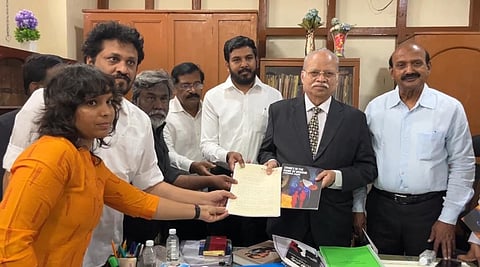
Anti-caste activists Evidence Kathir and Kowsalya submitted data on the prevalence of ‘honour’ killings in Tamil Nadu to the KN Basha Commission on March 18. According to their data, 59 people were murdered in 53 honour killing incidents between 2017 and 2025. Indicating this, they emphasised the need for a special state law against honour killings.
As per their data, 2023 witnessed 14 honour killings — the highest in this eight-year period. The second and third highest were in 2024 with 11 murders, and 2025 with seven murders.
They also submitted case-related documents, including FIRs, for all 53 crimes, at least 50 verdicts in other honour killing cases, details on national-level measures to stop such murders and a letter signed by Kathir, Kowsalya, Nagapattinam VCK MLA Mohamed Shanavas, activist and filmmaker Gopi Nainar and senior journalist Illangovan Rajasekaran.
The commission was announced in October 2025. It is headed by retired Supreme Court judge KN Basha. The state government has tasked the commission with identifying measures to prevent honour killings. The state has also promised to bring in special legislation against such murders based on the commission’s recommendations.
A Vincent Raj, popularly known as Evidence Kathir, runs the Madurai-based rights organisation Evidence.
Pointing out why the Scheduled Castes and the Scheduled Tribes (Prevention of Atrocities) Act is inadequate in many honour killing cases, Kathir told TNM, “The Act cannot be applied unless the victim is Dalit and the perpetrator is not. But honour killings also happen because the couple are from different Dalit communities or different Backward Classes (BC).”
He further added, “Honour killings aren’t always motivated by caste pride alone. Patriarchy, class, religion, status and borders are all motivators too. The mindset here is to consider a woman’s body the site of caste purity. This is maintained through caste endogamy. I don’t believe that only the PoA Act is enough to break down all of these systems.”
He also recalled submitting a people’s draft bill against honour killings to Chief Minister MK Stalin in 2022. The bill was drafted by the Dalit Human Rights Defenders Network — a coalition of anti-caste organisations headed by Evidence. A copy of this bill was submitted to the commission too on March 18.
This comprehensive draft bill is titled ‘The Freedom of Marriage and Association and Prohibition of Crimes in the Name of Honour Act 2022’. It seeks to “provide justice, compensation and rehabilitation in crimes committed in the name of honour vis-à-vis caste, faith, age, gender, sexual orientation, language, class, race, status and tradition.”
Kathir added, “Take Kowsalya’s case. If she had been murdered instead of Shankar, the PoA Act could not have been applied.”
Echoing Kathir’s point, Kowsalya added, “Even though Shankar’s murder was registered under the PoA Act, Accused 1 and others have been acquitted. Perhaps if there had been a law against honour killings at that time, they may not have been acquitted.”
Kowsalya survived a horrific attack on her and her late husband, Shankar. Shankar, a Dalit man, was brutally hacked to death in 2016 by killers hired by Kowsalya’s Kallar family.
Kallars are part of the politically powerful Thevar community and are categorised as Other Backward Class (OBC). Her plea in the Supreme Court against the Madras High Court’s acquittal of A1 (her father) and two others has been pending for five years now.
“Honour killings are the product of social engineering. Political pressure and casteism in the criminal justice system both play roles,” Kathir noted.
To break that, Kathir said, the draft bill recommends that Deputy Superintendents of Police (DSPs) investigate honour killings and the constitution of special courts for speedy trials.
