
Subscribe
At the foot of Thiruparankundram hill in Madurai, the morning of December 3 began with the usual movement of early pilgrims and shopkeepers setting up for the day. It was the day of the Karthigai Deepam, a festival of lights.
The hill is home to the Thiruparankundram Murugan temple and the Hazrat Sultan Sikandar Badshah Dargah.
Woven into the routine was something unusual, distinct signs of something more organised: vehicles with BJP flags lined up, men in saffron scarves waiting near tea stalls, and loudspeakers playing devotional songs along the road leading from the entrance to the temple. There is an arch on the sloped road leading up to the temple, around 300 m from which is the 16 kal mandapam. Police barricades were placed through the area.
Around 11.45 am, Tamil Nadu BJP youth wing president SG Suryah stopped near the 16 kaal mandapam (16 pillar hall) to address the media, while a short distance away party workers distributed sweets at the local office.
“This is every Hindu’s dream,” he declared.
The BJP and other right-wing organisations were enthused by a Madras High Court direction that allowed the HR&CE Department to light the lamp at the ‘deepathoon’, a stone pillar, on Karthigai deepam. For decades, the Karthigai deepam has been lit at the Uchchipillaiyar Temple situated on the lower peak, but right-wing groups had been demanding that it be lit at the pillar on the higher peak, which stands close to the dargah.
By 4 pm, the path leading up the hill reflected the scale of what had been building through the day. Bhajans played on loop from loudspeakers. “Vetrivel Veeravel, Vetri Vel Muruganuku Arohara” chants rose periodically from clusters of devotees and party workers.
Members of the BJP, RSS, Hindu Munnani, and Hindu Makkal Katchi gathered in significant numbers, many having travelled from districts across Tamil Nadu. A large mat surrounded by a semicircle of chairs had been spread out and the loudspeakers that had played devotional music were now being used to guide the crowd. A core group of activists sat closest to the microphones.

Local Sangh functionary Velmurugan, who was moving between groups of volunteers, described the extent of the mobilisation. People had arrived from Dindigul, Erode, Theni, and even Nagercoil, he said. “Across TN, Muruga bhaktas and BJP functionaries attended,” he explained.
He estimated that around a thousand people were present across the temple premises. He claimed that the Sangh Parivar has held protests around the festival for three decades. “Hindu Munnani usually protests three or four days before the deepam every year. For the first time, it happened on the day itself. We have been doing this since 1994,” he said.
This year, he insisted, the protest had been planned as usual, but the court order brought unusually large numbers of devotees. However, the Tamil Nadu government has been clear that allowing the journey to the deepathoon will lead to communal tensions.
Around 5.30 pm, Rama Srinivasan, BJP’s Madurai Lok Sabha candidate in the last Assembly elections, and other local leaders arrived and took their places at the front.
As 6 pm approached, the chanting grew louder and people were jubilant. From the arch, the deepathoon was visible. But as people realised that the lamp was not being lit at the deepathoon, the tone shifted. Anger crept in. The chanting and devotional music turned sharper after a round of ‘Bharat Mata ki Jai’ slogans.
At the time, officials of the TN government lit the lamp at the Uchchipillaiyar Temple. This further angered the activists, who started questioning why the court order was not being implemented.
Tensions rise
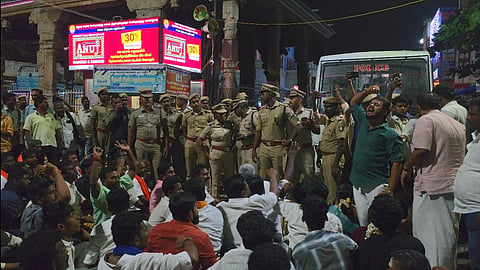
The crowd soon pushed past the barricades running up the path and had a confrontation with the police. A party functionary briefly restored calm, announcing through the microphone that the ceremonial lamp would be lit soon and asking the crowd to wait.
“Justice GR Swaminathan has given the order trusting us. We must not act hastily now. We have waited for 75 years, why not a few more hours,” the announcement said. The pause was brief.
Around 6.45 pm, Suryah moved towards the second arch and attempted to push through the police barricades, claiming his right to worship was being blocked. Police personnel moved swiftly to detain him. Organisers urged the crowd to sit down in protest while the police tried to arrest them. Shouting resumed quickly. Voices in the crowd accused authorities of targeting Hindus, with some asking whether this was India or Pakistan.
As the tension intensified near the foot of the hill, another drama played out in the Madurai Bench of the Madras High Court. Around 6.10 pm, Justice GR Swaminathan took up a contempt petition against the Tamil Nadu government and allowed six petitioners to go to the deepathoon.
By 7 pm, Suryah insisted he had a flight to catch and needed to complete his worship before leaving. A major confrontation unfolded at the same time that the petitioners arrived to light the lamp, escorted under CISF protection.
The petitioners arrived through a side road to the steps leading up the hill. The path itself as well as the steps were blocked by police barricades. Tension escalated when the police informed the petitioners that prohibitory orders had been invoked and that they would not be allowed up the hill. At this path too, party workers clashed with the police causing injury and the detainment of several people.
While the order passed in the contempt petition had set a limit to the number of people, on ground things looked different. Large groups were raring to march to the top of the hill and clashing with the police.
Prathap, a BJP functionary who had reached Thiruparankundram two days earlier, said he had been part of a group of 20 attempting to climb the hill during the earlier tension. “We were detained near Nellithoppu while trying to go up,” he said. Five people had come with him from Sivakasi, and around 15 participants had travelled from Virudhunagar.
On Karthigai deepam day, the temple chariot is normally taken in a procession around the area. On that evening, it emerged briefly, but was sent back from the 16 kaal mandapam as tensions had not fully reduced.
The right-wing activists waited at various spots till about 9.30 pm. With the police showing no signs of allowing them up the hill, the crowds dispersed.
A long-disputed issue
Not everyone present supported the mobilisation. Speaking to us two days after the incident, Sellapandi, a resident of Thiruparankundram, said, “I don’t know what’s happening. Seeing all this commotion, I feel like running away.”
He explained that the situation had brought needless strain to residents. “For the people here, it has caused unnecessary tension. We have never seen the lamp lit at the top the way they (right-wing activists) claim,” he said.
His family has lived in the area for generations, and he described the past two days as deeply disruptive. “We couldn’t open our shops or go out. The whole area feels tense. Both communities have always lived like brothers. I’ve eaten at the dargah so many times. It was always peaceful until Hindu Munnani started this ruckus.”
Raja, another resident, however, agreed with the version of the Hindutva outfits. He lives at the base of the hill.
Speaking while weaving through police barricades on his way home, he insisted that the lamp was traditionally lit at the deepathoon. “It’s only been about 20 years since they started lighting the lamp at the Uchchipillaiyar temple on top of the hill. That setup is temporary,” he said.
He claimed that the lamp was meant to be visible across 48 villages. “Our ancestors lived here. This is our right.”
The deepathoon itself is an object of contention. While right-wing outfits insist that the lamp has been lit on top of the hill since the Sangam era till 1947, things are not as clear.
“As per law, the person making an assertion must prove its validity. The petitioner Rama Ravikumar has not explained what the deepathoon is or given any document whatsoever to prove its existence or its use in the ceremony at any point in the hill’s history,” said Madurai-based human rights lawyer S Vanchinathan.
He also said that the counsel representing the Dargah had raised the issue in court.
“Instead of addressing the question of validity, the judge, without being accompanied by lawyers from either side, goes to the site, comes back, and decides that the lamp is to be lit there.”
He added that documents provided in court by the petitioner himself has evidence proving that the lamp was raised at the Uchchipillaiyar temple since the time of the Nayakkars in the 1500s.
Speaking to TNM, Balamurugan, a retired Thasildar who served in Rajapalayam in Virudhunagar district, said that what is being claimed as a deepathoon is nothing but a theodolite stone – used as a boundary or survey marker – and that the pillar at Thiruparankundram has a marking that identifies it as a theodolite stone.
“The Britishers had conducted surveys of the ghats and mountains and you can find these theodolite stones in many places. I have seen such stones during my inspection at various places. They are used for survey purposes. They can be seen in different measurements, starting from 30 cm to a maximum of 240 cm. The Thiruparankundram stone is 240 cm,” Balamurugan added.
Both sides plan next move
A day after the ruckus on December 3, the secular organisations as well as the right-wing outfits assembled – the secular side to ruminate and organise, and the right-wing to assert their demand again.
At 2 pm on December 4, members of the People’s Coalition for Communal Harmony gathered inside the Christian Lawyers’ Association office, about 300 m from the premises of the Madurai Bench of the Madras High Court. Chairs were arranged facing a whiteboard to follow updates on the contempt petition before the two-judge bench. Here, Mee Tha Pandian, the coalition’s main organiser, writer and intellectual, laid out the counter-narrative.
He said there was historical evidence from the time of the Nayakkar chieftains showing that the lamp was traditionally lit at the Uchchipillaiyar temple. “The HR&CE Department and the temple priests all affirm that it is lit at the correct spot,” he said.
He said that the Hindu Munnani began insisting on lighting the lamp at the dargah site only about 30 years ago. “They claim the lamp at Uchchipillaiyar is a ‘moksha deepam’. In earlier cases, including 2017, the court asked them for evidence, which they could not provide,” he said.
Accessing the deepathoon requires passing near the dargah compound, he added. “If the dargah refuses entry, there is a risk of it turning into a religious clash. That is precisely the goal of the Hindu Munnani.”
Pandian criticised the single-judge order delivered by Justice Swaminathan. “Conveniently, the Madurai High Court’s RSS-leaning judge gets the case. He visits the spot alone, without counsel from either side, and then declares the lamp can be lit there.”
He noted that the Coalition petitioned the Chief Justice arguing that a single judge cannot overrule a 2017 two-judge judgement. “The CJ did not respond,” he said. Ordering the CISF to enforce the ruling, he argued, amounted to pitting the Union against the state. “The CISF cannot handle law-and-order matters outside the court complex.”
Looking ahead, he said the group was preparing for the next Murugan festival, Thaipusam – which falls on February 1, 2026 – and planning a legal convention to examine recent judgements. “All the recent rulings are one-sided. There is a clear infiltration of the courts by the RSS,” he alleged.
Advocate Vanchinathan echoed these concerns. He described Justice Swaminathan’s order as per incuriam, saying it ignored binding precedent. “The earlier division bench of Justices Kalyanasundaram and Bhavani Subbarayan held on December 7, 2017 that the Uchchipillaiyar temple is the correct place to light the lamp,” he said.
A 2024 writ petition had also been dismissed on the grounds that peace and tranquillity should not be disturbed. “The principle of res judicata applies,” he said, adding that the government may need to take a firmer position. He pointed out that the title dispute had been settled as early as 1923, even if the boundaries were not clearly demarcated.
Later the same day, by 6.45 pm, a sit-in took shape at the second arch. The organising by the right-wing was clear. The slogans were more ideological than devotional. “Bharat Mata Ki Jai, Om Kali, and Indha Naadu Hindu Naadu (This land is Hindu land)” rose in a steady rhythm. BJP leaders attempting to reach the site were detained by police.
As police buses ferried detainees downhill, right-wing activists blocked them at multiple points. At the base of the hill, protesters sat directly in front of one bus, resuming their sloganeering. A representative negotiated with the police, requesting that detainees be housed in nearby halls since their vehicles were parked close by. When the buses finally moved, a convoy of vehicles with BJP flags followed closely.
Among those gathered was Gajendran, 49, who was standing near the 16 kaal mandapam. He estimated that nearly a thousand people had assembled there to welcome Tamil Nadu BJP president Nainar Nagendran, with another crowd positioned along the path leading uphill. He said he had arrived as part of a Tiruchendur padayatra group that makes the pilgrimage every year.
“I came by train this time,” he said, adding that around 50 people had travelled with him. An executive committee member of the BJP in Virudhunagar, he noted that the padayatra group coordinates through its own WhatsApp networks.
Two km from the temple, the buses stopped again. A few detainees stepped out and briefly disrupted traffic before being directed back inside by their own leaders. From inside the buses, some warned onlookers about the dangers of voting for the DMK, which is currently in power in the state. A vehicle bearing a BJP flag followed the buses to the detention halls. Its driver said a group from Erode had travelled together but been split up across centres. He was heading to the hall where the state BJP president was being held.
Inside the hall, coordination continued much as it had on the street. Seating was arranged, food was organised, and senior leaders, including district secretary Sivalingam and Nainar Nagendran, sat at the centre. Party functionaries moved through the room recording videos and taking photographs for social media.
Across both days, the defining characteristic of the mobilisation was its structure. The crowd responded quickly to instructions; slogans rose on cue. Sit-ins, convoys, and detention logistics all followed a clear pattern of direction. The chants mixed devotional elements with ideological messages associated with the Sangh Parivar, alongside repeated cries of ‘Jai Shri Ram’.
What began as a petition over a ceremonial lamp has widened into a broader contest involving ritual access, legal memory, and political assertion on the Thiruparankundram hill, ahead of the crucial 2026 Tamil Nadu Assembly elections.