
Subscribe
Every day, thousands of people step into Chennai Metro stations, buy tickets, tap vending machine screens, hold handrails and travel alongside strangers. In the process, they leave behind something they cannot see: microscopic organisms carried on their bodies and picked up from the surrounding environment.
Most of these microbes are harmless, and many are naturally present on human skin, in soil, water and the air. But what does this invisible microbial world look like inside a crowded public transport system? Does the city's coastal climate influence the microorganisms found on its surfaces? And could studying them help authorities detect emerging public-health threats, including the spread of antimicrobial resistance?
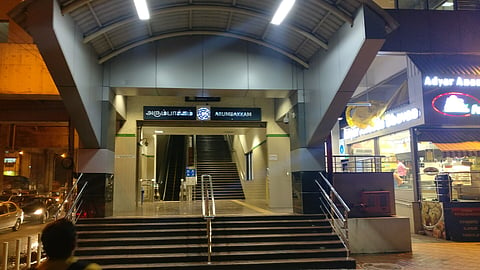
Researchers from the Indian Institute of Technology Madras (IIT Madras) have attempted to answer these questions by mapping the microbial communities on Chennai Metro surfaces. In the first study of its kind involving an Indian metro system, they found a distinct microbial fingerprint, with bacteria associated with human skin, soil, water and coastal environments.
The study also detected antibiotic-resistance-associated gene signatures in more than 80% of the samples analysed. While the finding does not establish that commuters are exposed to antibiotic-resistant bacteria, it offers an indication of how resistance-associated genetic material is distributed in shared urban environments.
The findings, published in the peer-reviewed journal mSphere (DOI: 10.1128/msphere.00433-26), are particularly relevant for a public transport network that carried more than 105 million passengers in 2024. The research paper was co-authored by Vijaya Yuvaram Singh, Veerendra PGadekar, Srijith Sasikumar, RM Rajeeva Lokshanan, V. Senthamizhan, Bharath Prithiviraj, Himanshu Sinha and Karthik Raman from IIT Madras.
"I would not want the public to be alarmed. Microbes are meant to be present everywhere, and what we found is a mix of microbes associated with people, such as skin bacteria, and microbes from the surrounding environment, such as soil, water and coastal habitats. Wherever humans go, we bring a large number of microbes with us. Even the International Space Station has a rich microbial community," Prof. Karthik Raman, one of the authors of the study from the Department of Data Science and AI, Wadhwani School of Data Science and AI, IIT Madras, told TNM.
The research, however, raises a larger question for cities: while authorities routinely monitor air quality, traffic and waste, should they also begin monitoring the microbial environments that people share every day?
The research team collected 96 swab samples from 12 Chennai Metro stations and trains operating on the Blue and Green Lines. The samples were collected in December 2021 and January 2022.
Four frequently touched surfaces were examined: station handrails, ticket vending machines, handrails inside trains and ticket counters. After quality checks, 41 samples met the requirements for detailed analysis.
The researchers used a technique called shotgun metagenomic sequencing, which examines the DNA present in a sample rather than relying only on conventional methods that require microorganisms to be grown in laboratories. This allowed them to investigate the composition of microbial communities and identify genetic material from a wider range of organisms.
They then compared the Chennai findings with 2,461 surface samples from 31 cities worldwide, collected through the global MetaSUB project, which studies urban microbial communities.
The comparison with 2,461 surface samples from 31 cities worldwide, collected through the global MetaSUB project, revealed nine types of bacteria that were present in nearly every Chennai sample but were uncommon in the other cities.
The researchers believe Chennai's tropical coastal environment may partly explain this distinct microbial signature. Some of the bacteria identified are associated with salty or coastal habitats and tropical air, while others are commonly found in soil and water.
"We found nine types of bacteria that were present in nearly every Chennai sample but were not common in any of the other 31 cities. Many of these bacteria are associated with sea air, salty soil, water and warm, humid weather, pointing to a distinctive microbial signature shaped by Chennai's coastal climate," Prof Karthik Raman told TNM.
Human activity also plays a role. One of the Chennai-associated species, Staphylococcus arlettae, is found on human skin, pointing to the contribution of passengers and urban density.
However, the researchers could not establish the relative influence of temperature, humidity, pollution, passenger density and other environmental conditions.
"The presence of Staphylococcus arlettae, which is found on human skin, points to the role of passengers and urban density," Prof Raman said.
An interesting finding concerns the differences between the surfaces people touch.
The study also found considerable differences in microbial diversity across the four types of metro surfaces examined. Ticket vending machines had the highest microbial diversity, while handrails inside trains had the lowest.
This may seem counterintuitive, given that handrails are touched repeatedly by passengers during their journeys. But the researchers suggest that the diversity of people interacting with a surface, rather than simply the frequency of contact, may influence the range of microbes found on it.
"Ticket vending machines are small surfaces that act as focal points of contact for a very large number of different people, and those contacts vary through the day and from station to station. Handrails cover larger areas and are touched constantly, which tends to favour a few well-adapted microbes and give a more uniform community. Consistent with this, the handrails inside trains showed the lowest diversity in our study,” Prof Raman said.
But the researchers did not measure cleaning frequency or intensity, so this remains a question for future work, Raman said.
The researchers also reconstructed 47 high-quality genomes of individual bacteria directly from the samples. The most common bacterium identified was Cutibacterium acnes, which normally lives on human skin.
However, greater microbial diversity does not necessarily mean greater health risk. A surface carrying a wider variety of microorganisms is not automatically more dangerous than one carrying fewer types.
One of the important public-health findings of the study concerns antimicrobial resistance (AMR), a growing global challenge that makes infections harder to treat.
Antimicrobial resistance occurs when bacteria and other microorganisms develop the ability to withstand medicines designed to kill them or stop their growth. It can make common infections more difficult to treat and increase the risk of complications.
The IIT Madras researchers identified 72 families of antibiotic-resistance-associated genes across the samples, linked to 31 drug groups and nine resistance mechanisms.
More than 80% of the analysed samples contained at least one resistance-associated gene signature. Genes linked to sulfonamide and rifamycin resistance were relatively more abundant than the others.
The finding raises an important question: if antibiotic-resistance-associated genes are present on surfaces used by thousands of people, could these shared spaces play a role in the wider environmental distribution of resistance?
Raman says the findings deserve attention, but they should be understood in the context of how antibiotics are used and misused in the city.
"We did find resistance-associated gene signatures in most samples, although at relatively low abundance, and that calls for some care with respect to AMR. However, I see this less as a comment on the metro environment and more as a reflection of how antibiotics are used, and misused, in the city as a whole," Raman told TNM.
The researchers, however, did not establish whether the genes were present in living bacteria capable of expressing antibiotic resistance.
This is an important distinction. The team used shotgun metagenomic sequencing, which detects DNA in a sample. It cannot distinguish between DNA from living and dead microbial cells, establish whether the detected genes are functioning, or confirm whether the organisms carrying them are resistant to antibiotics.
The researchers did not isolate bacteria carrying these genes and test their resistance to antibiotics.
"We did not establish whether the genes came from live, dividing bacteria, or whether those bacteria were actually resistant. Confirming this requires further studies designed specifically for that purpose," Raman said when asked whether the researchers could establish if the genes were present in live bacteria.
He also cautions against interpreting the finding as evidence that commuters face an infection risk simply by touching shared surfaces.
"As we state in the paper, detecting a microbe or a resistance gene does not by itself indicate viability, transmission potential or clinical risk. Whether a surface exposure could ever matter for a person's health would depend on factors our study did not examine, starting with whether live, resistant organisms are present at all," he told TNM.
Raman said the wider distribution of these genetic signatures was worth tracking, even though their overall abundance was relatively low.
"It tells us that resistance-associated gene signatures are widespread in the urban environment. Their overall abundance was low, but their wide distribution points to a latent resistance potential that is worth tracking. Genes linked to sulfonamide and rifamycin resistance were relatively more abundant than the others.
"It does not tell us that 80% of surfaces carry resistant bacteria, because we detected genes and did not confirm resistant organisms. To me, the main public-health message is that we currently have no routine way of tracking such signals. We monitor air quality through measures like the AQI, yet we do almost no biosurveillance of the microbes around us. This study provides a baseline for India from which such tracking can begin," Raman added.
In other words, the finding only means that resistance-associated genetic signatures were detected in more than 80% of the samples.
For commuters, Raman says there is no reason to be alarmed about touching metro surfaces. Ordinary hygiene remains important, as it is in any shared environment.
"Touching surfaces and picking up microbes is part of everyday life, whether on a metro train, at home or in an office. Our study detected microbial DNA and gene signatures. DNA-based methods cannot distinguish between live and dead cells, so what we detected tells us what is present on these surfaces. It does not tell us whether these microbes are viable, whether they can be transmitted, or whether they pose a clinical risk. Ordinary hygiene, such as washing hands, remains sensible, as it is anywhere," Raman said.
Beyond identifying the microorganisms on Chennai Metro surfaces, the researchers say the study highlights a gap in how cities monitor their environments.
While air pollution is measured through systems such as the Air Quality Index, there is little routine monitoring of the microbial communities present in public transport systems and other shared spaces.
Prof. Himanshu Sinha, another researcher involved in the study, said microbial monitoring could help authorities identify emerging pathogens, track antimicrobial resistance and improve cleaning practices.
"Cities monitor air, traffic and waste, but rarely the microbial environment commuters share. Our study gives Chennai a baseline, though only a snapshot. Routine environment microbial monitoring of public spaces and transport could support early pathogen detection, antimicrobial resistance tracking and targeted cleaning of high-diversity surfaces such as ticket vending machines. City policymakers can use it to move from a reactive response towards predictive, smart-city resilience, with routine seasonal and post-monsoon sampling and benchmark against other cities in India and the world," Sinha said.
The suggestion is to make microbial surveillance a part of routine urban environmental monitoring, rather than limiting it to occasional research projects.
For instance, periodic sampling could help authorities understand whether the microbial composition of metro surfaces changes during the monsoon, after flooding or during periods of high passenger movement. It could also help identify surfaces where cleaning practices may need to be reviewed.
The researchers point out that the ticket vending machines, which showed the highest microbial diversity in the study, could be among the surfaces considered for targeted monitoring and cleaning.
Dr. Bharath Prithiviraj, a co-author of the study and a Fellow of the Royal Society for Public Health, said urban transport networks could offer important insights into the public-health conditions of cities.
"By mapping the ‘microbial fingerprint’ of the Chennai Metro, we are establishing a critical baseline for an urban immunological observatory," Prithiviraj said.
He said the research goes beyond identifying bacteria and could contribute to environmental surveillance that helps detect emerging pathogens and monitor antimicrobial resistance in shared spaces.
"As urbanisation accelerates, decoding these microbial intersections empowers us to shift our public health paradigm from reactive outbreak response to predictive, smart-city resilience," Prithiviraj added.
For the study 96 samples were collected in December 2021 and January 2022, and only 41 met the quality standards for detailed analysis. The findings therefore represent a snapshot of the microbial communities present on the sampled surfaces during that two-month period.
They cannot establish what the microbial environment inside Chennai Metro looks like today or how it changes across seasons.
Rainfall, flooding, humidity, temperature, passenger numbers and cleaning practices could all influence the microbial composition of public spaces. The researchers did not measure cleaning frequency or intensity, nor did they establish the individual contribution of different climatic and human factors.
According to them routine sampling across different seasons and years would be necessary to understand how these communities evolve.
The study was led by researchers from the Wadhwani School of Data Science and Artificial Intelligence and the Bhupat and Jyoti Mehta School of Biosciences at IIT Madras, with funding support from the Robert Bosch Centre for Data Science and AI and WSAI. The research team also worked with Chennai Metro Rail Limited, which facilitated sample collection.
Follow TNM's WhatsApp channel for news updates and story links.
