
Subscribe
An image doing the rounds on social media shows a massive flex board in Kerala’s famous temple town, Guruvayur. At the centre is Bharatiya Janata Party (BJP) candidate, lawyer B Gopalakrishnan. Beside him is a list of MLAs from 1977 to 2021, all Muslims, accompanied by the question: “Are you not seeing this?” Citing “50 years of neglect,” the board urges voters to elect the NDA candidate, effectively calling on them to choose a “Hindu MLA.” It is the same line that has already sparked controversy in this election, leading to an FIR against Gopalakrishnan for violating the Model Code of Conduct, now amplified visually and circulated widely.
In Kerala, where the BJP has long struggled to gain ground, its political messaging has often been more restrained than in states like Assam or West Bengal.
But this election season began differently. Even before campaign issues could take shape, the party was already in the headlines — for Gopalakrishnan repeatedly asking why Guruvayur, home to the famous Sree Krishna temple, does not have a “Hindu MLA”. In campaign speeches and videos, Gopalakrishnan framed this as a question of representation, constantly invoking religious imagery. He said he had been “called upon” by Guruvayurappan, and described the constituency as needing to be “rescued.”
As the remarks drew criticism, he did not step back. Instead, he doubled down, invoking past statements by Muslim leaders and expanding his argument into one about “appeasement”. The BJP, despite the risk of backlash in a state like Kerala, stood by him.
The controversy led to a case being registered under provisions related to promoting enmity during elections. At the same time, interestingly, Gopalakrishnan’s campaign continued to foreground civic issues — drinking water, sanitation, infrastructure, and corruption.
When my colleague Haritha John and I met him at his house near Vadakkekad in Guruvayur on a hot afternoon, the interview was meant to do two things: examine the basis of his claims, and ask why a campaign built on development concerns had taken a distinctly religious turn. But as we sat down with him, it quickly became clear that this would not be a straightforward exchange.

Answering without answering
Guruvayur is one of Kerala’s most politically watched constituencies, centred around the Sree Krishna temple and a large pilgrim economy. The seat has alternated between the LDF and UDF, with Muslim candidates repeatedly elected since the 1980s. The current MLA, CPI(M)’s NK Akbar, is among them. It is this pattern that Gopalakrishnan has foregrounded as a question of religious representation.
The first question we posed was simple: what made him confident of winning Guruvayur?
Gopalakrishnan responded at length, laying out his campaign pitch covering contaminated drinking water, dysfunctional crematoriums, closed health centres, and alleged corruption. These are real concerns, and he spoke about them with urgency.
But when asked why, despite these issues, he had framed his campaign around the absence of a “Hindu MLA”, the tone shifted. “Why are you people not highlighting these real issues? Why did you come here? Because of the controversy,” he said.
“I held a press conference and showed contaminated water. Many media outlets were present, but no one reported it — except one. Why don’t you highlight these issues even today?”
When we pointed out that both development concerns and communal framing were important to question, he pressed on. “Let me finish. Development is the primary issue. But yes, I will address your question,” he said.
“Those elected here have no faith in the Guruvayur temple. That is the problem. Some candidates have openly said that lighting lamps is ‘haram’ and that idol worship is against their beliefs. If someone contests in a place like Guruvayur, they should at least respect the temple.”
From that point on, the pattern held. Questions were rarely answered directly. They were reframed, redirected, or absorbed into longer arguments.
When asked to substantiate his claim about the sitting MLA’s views on lighting lamps, he did not provide a specific instance or verifiable quote.
For clarity, there is no publicly documented instance of Guruvayur MLA NK Akbar stating that lighting a lamp in a temple is “haram”. While Islamic theology discourages idol worship for adherents, that does not translate into opposition to the religious practices of others. Gopalakrishnan too offered no evidence during the interview to show that Akbar, in his role as MLA, had interfered with temple rituals or practices.
When asked whether this was an assumption rather than a documented fact, the conversation drifted again, this time to broader assertions about “minority appeasement” by political parties and the alleged influence of Islamic outfits over governance. The original question remained unanswered.
“What is happening here is appeasement politics. Political parties are giving benefits to a particular community to secure their vote bank,” he said.
He cited a recent example. A large rally led by Kanthapuram AP Aboobacker Musliyar in nearby Chavakkad, he said, saw the presence of MLAs and leaders from multiple parties, some of whom waited for the cleric to arrive. “I have no issue with that, it is their freedom,” he added. “But just two kilometres away, there was the Kumbha Mela, which was a Hindu religious gathering. If these leaders are truly democratic and secular, they should attend that as well. But they didn’t. They refused to go.”
“Why? For appeasing a particular community? Why avoid Hindu events? If you are truly secular, you should engage with all communities equally,” he said.
This was a familiar shift. Faced with a question about a specific claim, the BJP leader’s response was evasive, instead expanding into a broader narrative about selective secularism and political bias.
He went on to argue that those elected in Guruvayur lacked “faith” in the temple, and that this explained governance failures, once again stated with furious conviction but little evidence.
Throughout the interview, Gopalakrishnan repeatedly returned to the theme of development, citing Union government schemes, local infrastructure failures, and corruption. But this sat alongside his identity-based framing, as is so often seen with the positions taken by BJP leaders in front of the media.
The argument, in effect, became circular. “Development is lacking in Guruvayur, and it’s because those in power lack ‘faith,’ and therefore, those who represent the people must change.” In other words, “Hindu MLAs” must be in power.
A new kind of messaging in Kerala
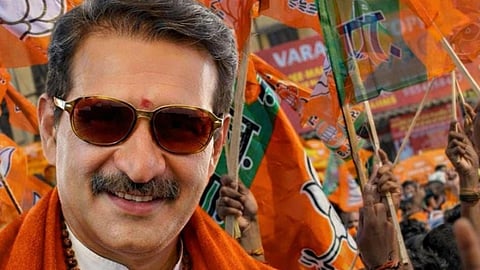
Senior journalist Sreejan Balakrishnan points out that what makes Gopalakrishnan’s campaign notable is not just what he said, but how he has chosen to present himself. “This is a very aggressive positioning,” he says, referring not just to the remarks but also to campaign visuals. “Even his posters, with his rudraksha beads and saffron attire, sitting on a jeep — it’s very much in the style of a Yogi Adityanath-type projection.”
This kind of overt Hindu symbolic campaigning is not typical of the BJP in Kerala, Sreejan says. “Given Kerala’s demography, the party had moved towards a more moderate, secular approach, including Christian outreach. Visible Hindu symbolism in campaigns has reduced.”
But that is also what makes Gopalakrishnan’s approach stand out, and potentially significant, he says. More importantly, the response to such messaging suggests it is not without resonance. “I had put up a Facebook post on this, and most of the comments were asking ‘what is wrong in saying Guruvayur should have a Hindu MLA?’” he says. “Even people who are otherwise moderate had no issue with that idea.” He adds that while this kind of rhetoric existed earlier as well, no one said it openly. “This feels like a beginning.”
According to Sreejan, Gopalakrishnan’s stance also needs to be understood within the BJP’s internal dynamics in Kerala. “At present, most visible BJP leadership here is relatively moderate,” he says. “But there is a section within the party that feels the original ideological edge is being diluted.”
In that context, Gopalakrishnan appears to be strategically positioning himself. “There is no strong hardline Hindu leader right now. He seems to have identified that gap and is stepping into it,” Sreejan says.
Even electorally, this may not be about immediate victory. “Even if he loses, that may not matter. In future, whenever there is an issue related to temples or communal tensions, he could emerge as a go-to leader.” In other words, the constituency he is building may not just be Guruvayur, but a broader political space.
At one point during our interview, Gopalakrishnan sought to recast the premise of the controversy itself. “You are questioning the term ‘Hindu MLA’. First, understand what ‘Hindu’ means. Hindu is not a religion. Even the Supreme Court said that it is a way of life and not just a religion,” he said. The implication was that if “Hindu” is not a religion, then invoking a “Hindu MLA” is not a religious appeal.
When we reiterated the original point and asked whether, now that a case had been registered, he believed he had violated the model code of conduct, he responded: “No, I have not violated anything. If there is a complaint, let them go to court. I will face it. This controversy is politically motivated. I stand by my statement.”
What this achieves
Gopalakrishnan’s remarks have drawn criticism, including from political opponents and sections of the public. But they have also done something else: they have set the terms of the conversation. The question is no longer just about drinking water or infrastructure in Guruvayur. It is also about representation, religion, and who gets to claim legitimacy in a temple town.
This shift has also played out beyond the campaign trail. On social media, his remarks have been amplified by several right-wing accounts, often accompanied by communal messaging, selective clips of political speeches, and, in some cases, misinformation targeting minority communities. Multiple pages and accounts have circulated similar posts backing his statement, framing it as a matter of “Hindu representation” and calling for consolidation.
Even after the Election Commission’s intervention, the online conversation did not recede. If anything, it expanded, with digital spaces becoming a second arena where the narrative was reinforced.
This is not unfamiliar territory in Indian politics. Even when such rhetoric invites backlash, it can shift public discourse and consolidate support.
By the end of the interview, after multiple attempts to steer the conversation back to specific questions, we began to wrap up. Gopalakrishnan suggested that we meet again after the elections, and that next time, we should answer his questions too.
We responded, half in jest, that we were there to ask questions, not answer them. He laughed. “That is my tactic,” he said.
Inputs from Haritha John.
Follow TNM's WhatsApp channel for news updates and story links.