
Subscribe
Follow TNM's WhatsApp channel for news updates and story links.
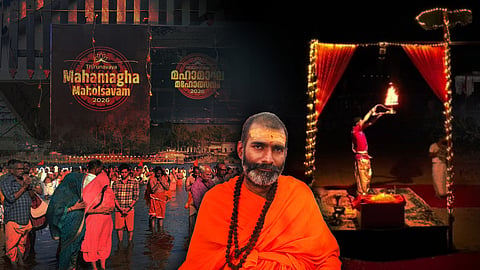
As dusk settles over Bharathapuzha in Thirunavaya, the historic sandbanks where the festival of Mamankam was once held, a spectacle it has never experienced before begins to unfold. A Kashi ghat-style river aarti. Flames blur into ribbons of light as priests standing on specially raised platforms swing multi-tiered brass lamps in sweeping arcs. A soundscape of bells, Sanskrit chants and drums builds in layers, turning the crowds ecstatic.
For a visitor, the ritual held as part of ‘Maha Magha Mahotsavam’, which began on January 19, momentarily dissolves the distinction between the Bharathapuzha and the Ganga. Branded as ‘Kumbh Mela of Kerala’ by the organisers – Varanasi’s Juna Akhada and Mata Amritanandamayi – the festival seems to be far removed from the Mamankam of the history books.

The Sri Panch Dasnam Juna Akhada is the oldest and the most influential Shaivite monastic order from north India, which plays a significant role in Kumbh Mela.
The Mamankam festival, held once every 12 years in Thirunavaya, now in Kerala’s Malappuram district, too had a religious character, but it was inseparable from statecraft. A high-stakes 'Game of Thrones’, Mamankam was the ultimate political arena for asserting regional hegemony in medieval Malabar, according to historians.
The festival was originally presided over by the Chera Perumals. After the decline of the Chera Empire (circa 12th century), the right to be the Rakshapurusha or protector of the festival, became a symbol of who holds the sovereign authority over Kerala.
This right of presidency belonged to Valluvakonathiri, the ruler of Valluvanadu in north-central Kerala. Over time, this symbolic supremacy was forcibly appropriated by the Zamorin of Kozhikode, and this led to the banks of the river witnessing the free flow of blood as suicide squads from Valluvanad attempted the Zamorin's assassination during the Mamankam assembly.
The last Mamankam was held in 1755 and the Mysorean invasion of Malabar in 1766 by Hyder Ali is widely considered to be the reason why it ended.
History views the original Mamankam as a multicultural, political, and martial assembly rather than a purely religious event.
The name Mamankam (literally Maha Ankam or great fight) is a Malayalam derivative of several interpretations that reveal the festival's multifaceted history. While some historians link it to the auspicious Magha month (Maha Magham), others consider it Maha-Makam (the month's specific star, Makam). This is because the name of the festival in historical records appears as Mamakam. William Logan, District Collector of Malabar under the British government, in the Malabar Manual interpreted it as Maha-Makham, or 'Great Sacrifice.' Large festivals in Kerala are often referred to as Maha Maham. For the sake of avoiding confusion, this article would use the word Mamankam, except in quotes.
The revival of the Mamankam festival as Kumbh Mela by the Sri Panch Dasnam Juna Akhada as a prehistoric spiritual event with its attendant mythology has come as a surprise to historians.
For the organisers and supporters, the festival is a reclamation of a lost heritage and an exercise in fostering Hindu unity. Mahamandaleshwar Swami Anandavanam Bharati of the Juna Akhada, who presides as the event's Sabhapati, rejects the allegation that they are inventing something new. For him it’s merely a restoration of a dormant tradition, prevalent since the time of Parasurama, a mythological warrior sage who created Kerala by throwing his axe into the sea.
Historians TNM spoke to said Kerala has no tradition of the Kumbh Mela and that Mamankam cannot be reinterpreted solely through the lens of a Hindu river ritual.
This raises the question of whether the reinvention of Mamankam as Kerala’s Kumbh Mela, a Hindutva-driven enterprise designed to overwrite a complex regional history with a standardised pan-Indian religious narrative ahead of the Assembly polls in Kerala.
Thirunavaya and Mamankam
Situated along the banks of the Bharathapuzha, also known as Nila, Thirunavaya is a tiny town criss-crossed by narrow roads. Hardly around seven square kilometres in area, it has a population count of around 25,000 as per the 2011 census. More than three-fourths of the population of the town are Muslim. Malappuram, the district in which Thirunavaya is situated, is a Muslim-majority district, an identity that continues to be a target of communally polarising narratives.
The riverbank at Thirunavaya has been a crucible for Kerala’s culture, inspiring legendary literary figures from Thunchath Ezhuthachan, the father of Malayalam language, to modern poets who view the Nila as a symbol of Kerala’s collective memory.