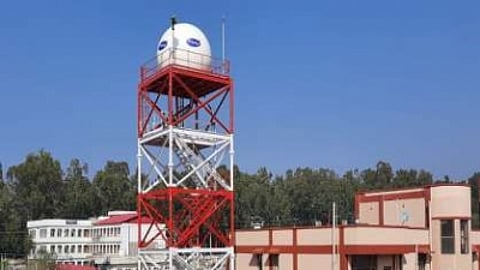

In a major boost to weather forecasting and disaster preparedness, Tamil Nadu is set to receive five new Doppler Weather Radars (DWRs) aimed at strengthening cyclone tracking, rainfall monitoring, and early warning systems across the state.
The new radars will be installed at Kanyakumari, Tiruchirappalli, Coimbatore, Yercaud, and Ramanathapuram.
Of the five proposed radars, three will be established under the Central government’s flagship "Mission Mausam" programme, while the remaining two will be installed through a special initiative of the Tamil Nadu Disaster Risk Reduction Agency.
The expansion is expected to significantly enhance weather monitoring, especially in regions that currently remain vulnerable due to limited radar coverage.
At present, Tamil Nadu is covered by eight Doppler weather radars, some located within the state and others in neighbouring regions.
These include two radars in Chennai — an ageing S-band radar at the Chennai Port and an X-band radar at the National Institute of Ocean Technology (NIOT).
Coastal monitoring is supported by an S-band radar at Sriharikota, a C-band radar at Kalpakkam, and another S-band radar at Karaikal.
Interior areas receive coverage from radars located in Thiruvananthapuram, Kochi, and Sulur.
However, officials pointed out that large parts of central Tamil Nadu, including Tiruchirappalli, and southern districts such as Kanyakumari, remain inadequately covered.
These regions are particularly vulnerable as they experience rainfall from both the southwest and northeast monsoons and are frequently exposed to cyclonic systems forming over the Bay of Bengal.
Explaining the rationale behind the selection of new radar locations, officials said the decision was based on several factors, including the need for round-the-clock weather monitoring, higher radar density in coastal and hilly regions, and enhanced coverage in disaster-prone and densely populated areas.
Replacement of ageing equipment and ensuring redundancy in vulnerable zones were also key considerations.
With the addition of these five radars, Tamil Nadu’s weather surveillance network is expected to become significantly stronger, improving the accuracy of forecasts, enhancing early warning capabilities, and helping authorities respond more effectively to cyclones, heavy rainfall, and extreme weather events.