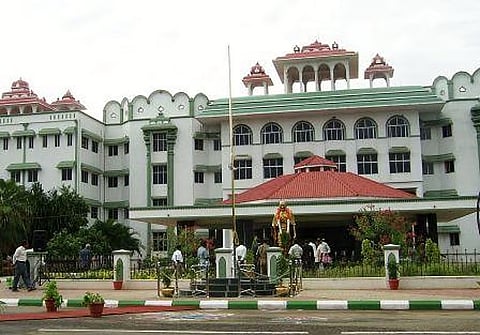

The Tamil Nadu government has told the Madras High Court that there is no evidence on the origin of the stone pillar called the deepathoon on Thursday, December 19.
Justices G Jayachandran and KK Ramakrishnan of the Madurai bench of the Madras High Court were hearing the appeals against the single bench order by Justice GR Swaminathan allowing the lighting of the Karthigai deepam ceremonial lamp at a stone pillar on top of the Thiruparankundram hill.
The appellants, including the state government and the Sultan Sikandar Badushah Auliya Dargah, had raised the question of origin of the stone pillar, which the petitioner Rama Ravikumar of the Hindu Munnani claims to be a deepathoon (ceremonial lamp pillar).
“On materials available either before the single judge or this judge, there is no empirical data or proof available regarding the origin of the structure that is called a deepathoon,” Advocate General (AG) PS Raman told the court.
The Hindu Religious and Charitable Endowments Board (HR&CE) had submitted before the court earlier that there was scholarly evidence to suggest that the pillar was in fact a Jain structure and presented a 1981 book by theologian Venkataswami.
Meanwhile, the origin of the pillar remains contested. The AG told the court that there was an order by a judge in 1920 after he inspected the entire hill, and the only structure on top of the hill is the dargah.
The AG further said that, as per the HR&CE Act, it was the jurisdiction of the Joint Commissioner or Assistant Commissioner of HR&CE to decide established usage of a religious institution. He said that the only matter before the court was whether the use of a writ direction to compel the lighting was maintainable.
Senior advocate S Sriman, appearing for the petitioner, however, maintained that the lighting of the lamp at the Uchipillaiyar temple was only a temporary arrangement. “The lighting of the lamp at the Uchipillaiyar temple was a concessional retreat by the temple to protect itself in the face of circumstances that have been discussed in the 1920 order,” he said. The 1920s,order had decided on the territorial dispute between the Dargah and the temple. This judgement had recorded that, the flight of steps from Nellithope, the summit of the hill, and its adjuncts, including a mandapam, belonged to the dargah “The stone pillar/deepathoon was accessible from the dargah,” The Dargah lawyer had earlier argued that since the only way to access the pillar was through Dargah property, it required separate mediation.
Thiruparankundram is a hill on the outskirts of Madurai city, home to the Arulmigu Subramaniya Swami Templeat the base of the hill, Uchippilliyar kovil at the lower peak of the hill, as well as the Sikandar Badusha Dargah at the higher peak.
The case concerns demands by Hindutva outfits, including the Hindu Makkal Katchi and Hindu Munnani, to light the Karthigai deepam on a deepathoon, less than 15 metres away from the Hazrat Sultan Sikandar Badshah Dargah. The ceremonial Karthigai deepam was usually lit at the Uchippilliyar kovil on the hill’s lower peak in the Tamil festival of Karthigai.