

“Jai Bhim, Jai Bhim…”
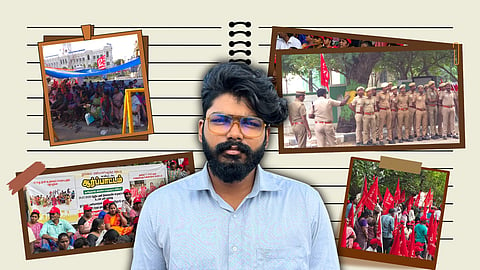
In the early hours of August 14, 2025, at around 1 am, police switched on their loudspeakers and ordered sanitation workers to disperse from in front of the historic Ripon building in Chennai. “Jai Bhim” was more than a slogan that night. It bound the workers together, drowning out the commands blaring through the speakers. It felt like a community holding its ground.
This moment marked the end of a 13-day protest outside the Greater Chennai Corporation (GCC) building in the heart of Chennai. The workers were protesting the GCC's decision to privatise sanitation work in zones 5 (Royapuram) and 6 (Thiru Vi Ka Nagar). What stood out was the worker’s clarity. “This is makkal pani” – ‘people’s work’, they said. “Why should it be handed over to private contractors?”
That night, amid allegations of violence and abuse, police arrested nearly 2000 workers within an hour. They tore down tarpaulin sheets the workers used for shelter, dismantled hoardings and pulled down flags.
There is a photograph I took that day.
Earlier that evening, my editor, Shabbir Ahmed, had asked Hindu Religious and Charitable Endowments Minister Sekar Babu, “Do you think it is right to arrest sanitation workers in the middle of the night?”
The minister turned away, and left without responding.
The next major development came as a blow – a court verdict allowing the GCC to proceed with privatisation, with the condition that workers’ salaries could not be reduced.
Over the following months, I continued to follow protests across the city. With growing unease, I noticed how a movement that ignited such righteous anger across civil society during those 13 days in August was slowly fading away from public attention. It became a footnote – something many assumed would quietly die down. So everyone could move on.
But it did not.
The workers' spirit remained remarkable. By then, I had become familiar with many of them. Each time we met, they greeted me with wide smiles. And without fail, they offered tea. Not once did I leave the place without them asking, “Tea saptingala?” – did you have tea?
They spoke at length about their families, their loans, their struggles and their dreams. Torn between despair and anger at what they saw as betrayal by the Chief Minister – whom they repeatedly called “Appa,” father – and an unyielding hope, they knocked on every door., They waded into the Bay of Bengal, jumped into the Cooum, petitioned at the Kalaignar Samadhi, and undertook a hunger strike that lasted two months.
On January 12, just two days ahead of Pongal – the Tamil agrarian festival celebrated across the state – Minister Sekar Babu quoted Anna, DMK’s founder and a Dravidian stalwart: "Nadanthathu Nadanthu thaaga irukattum, ini nadapavai nallathaaga irukattum." Meaning, let bygones be bygones; may what happens next be good.
He congratulated the workers on the strength of their protest and officially included them into the Dravidian fold.
The powerful minister sat with the workers and fed them fruit juice to end the hunger strike, addressing the many festivals they had missed over the past months. “He said Deepavali is Naragasuran’s festival, then Jesus was put to the cross, and New Year in January is a Western festival,” adding, “Pongal is the true festival. Celebrate it happily.”
From the birth of an issue, through thinning crowds and retreating cameras, to the final close of a protest, this story stands as a milestone. It is a testament to the strength of a workers' movement that endured long after the lights were switched off. For a journalist, it is also a reminder of the responsibility to persist even when the spotlight fades.
Today, the workers danced to the song Poradada, oru Vaalenthada –a call to fight—saying they were dancing away their exhaustion., Before they left, they asked me, as always:
“Tea saptingala?”