
Subscribe
Follow TNM's WhatsApp channel for news updates and story links.
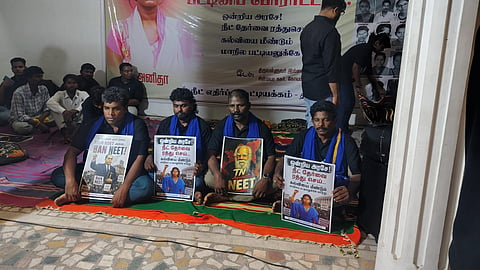
An indefinite hunger strike against the National Eligibility cum Entrance Test (NEET) entered its fourth day in Chennai’s Koyambedu on August 4. The four persons on strike – Dhanasekhar, Jeeva, Puliyanthopp Mohan, and Ravi – are part of the Ban NEET Movement of the Anti-NEET Federation in Tamil Nadu, led by S Manirathinam, the brother of Tamil Nadu’s first NEET victim S Anitha.
This protest follows more than a month of demonstrations by the Cockroach Janata Party (CJP) in Delhi's Jantar Mantar, seeking accountability for the NEET paper leaks in the country. Following mounting outrage, on July 25, Union Education Minister Dharmendra Pradhan resigned.
The Anti-NEET Federation views Dharmendra Pradhan’s resignation as a hopeful step, but emphasises that it does not guarantee any changes to the education system.
Hence, while the CJP halted their protest after the resignation, the Ban NEET Movement continued demonstrations against the medical entrance examination, as they believe the solution is “not fair NEET, but to ban NEET.”
But the Anti-NEET Federation’s initial request for a place to protest was allegedly turned down by the state government, forcing them to stage the protest in Thiruvallur Illam, a private location in Koyambedu.
In addition to a ban on NEET, the Anti-NEET Federation’s demands include freedom for states to evaluate medical college entrances based on Plus Two (class 12) marks. They also demand that the Union government move education from the Concurrent list to the State list, allowing states to shape their own education policy.
“The strike will continue until these demands are met,” the Federation said in a press note.
Anitha’s legacy
Tamil Nadu has always been against NEET, with the state seeing protests against for almost a decade, Manirathinam told TNM. “My sister went to the Supreme Court seeking justice, but she was not able to secure a favourable judgement and later died by suicide. Protests began in Tamil Nadu back then itself,” he said.
Seventeen-year-old Anitha was a student from an economically disadvantaged background. She achieved a medical cut-off score of 196.75 out of 200. Under Tamil Nadu's previous merit system, this score would have assured her admission to top government medical colleges.
However, in 2017, the Union government made NEET mandatory for all states. Since the exam format heavily favoured the CBSE syllabus over the State Board curriculum, she was unable to secure a competitive rank. She died by suicide on September 1, 2017, triggering the switch of the state's educational debate into a mass social justice movement.
‘NEET discriminates’
Manirathinam pointed out that before NEET was implemented, Tamil Nadu produced excellent doctors. However, since the introduction of NEET, access to medical education has been denied to many students.
"Those advocating for a fair NEET are often the ones who can afford to spend two or three years preparing for it and pay for coaching. What about the people who cannot afford these resources?" he asked.
The Federation said that although the minister’s resignation is a substantial achievement, it does not guarantee any concrete change in the lives of the country’s students, who continue to face a highly discriminatory education system. They believe that discrimination can only be alleviated by concrete policy changes.
The unfairness of the NEET exam resulted in the deaths by suicide of almost 100 young Indians, most of them belonging to Dalit communities, the Federation alleged.
“NEET excludes students based on class and caste. It stands in violation of the right to education, the principle of equal opportunity, and the spirit of democracy itself. It prevents states of the Indian Union from deciding how their own educational institutions are run and therefore stands in violation of the principle of federalism,” their press note read.
