
Subscribe
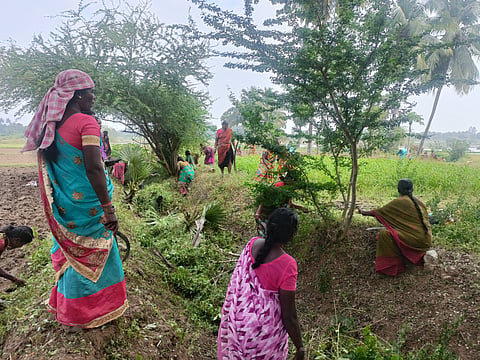
On the morning of December 22, 2025, 48 women gathered in Ayagoundanoor village of Tamil Nadu’s Vellore district to seek work under the Mahatma Gandhi National Rural Employment Guarantee Act (MGNREGA).
Thenmozi, a 39-year-old MGNREGA supervisor, had a busy morning as she took attendance for the assembled women.
These women were unaware that barely 24 hours ago, on December 21, President Droupadi Murmu gave her assent to the Viksit Bharat–Guarantee for Rozgar and Ajeevika Mission (Gramin), or the VB–G RAM G Bill, replacing MGNREGA with a new scheme.
Their understanding of the new scheme was limited to a mere name change.
The task of the day was to clear an irrigation canal that will carry rainwater from the nearby hills to the village tank. Thenmozi used the MGNREGA Mobile Monitoring System (NMMS) app to record attendance. This involved taking photographs of the women and uploading them to a government server, if all went well, that is.
The app often crashes. Digital attendance doesn’t get recorded for some workers if the internet is patchy, often leading to loss of pay despite the work. The attendance process took at least an hour. Thenmozi also recorded the attendance manually.
“No work has been done under MGNREGA in our gram panchayat this year. This is the first week of work. Today is the second day,” she says.
A year of work compressed into December
Official data from the MGNREGA website confirms this. Of the 606 entries recorded for Kandipedu gram panchayat in FY 2025-26, nearly a quarter (147 entries, 24.3%) were concentrated in December 2025 alone.
The irrigation canal work that the women were assembled for was set to start only on December 13, according to these records.
Most of the work allotted under MGNREGA was heavily concentrated in the last quarter — October 2025 to January 2026 — accounting for 60.6% of all work under this gram panchayat.
The women TNM spoke to didn’t have faith that they will be able to avail all 100 days of employment guaranteed under the scheme. To them it was a mathematical impossibility.
Statewide decline
Across Tamil Nadu, MGNREGA implementation saw a sharp drop in 2025. As of January 14, 2026, state data shows that only 9,600 households have completed the guaranteed 100 days of work. The figure stood at 1.18 lakh households in 2024 — a 91.9% decline. The average household received just 25.48 days of employment in 2025, which is less than half of the previous year's 46.86 days.
The Union government released Rs 6,523.87 crore to Tamil Nadu for MGNREGA work, but the state has utilised only 75.95% of those funds. This is the lowest utilisation rate of MGNREGA funds in five years for the state. Previous years saw 100 to 125% utilisation, often requiring additional allocations.
A Parliamentary Standing Committee report released in August 2025 pointed out that at the national level, the MGNREGA scheme's budget of Rs 86,000 crore had been "kept static" for three years. Meanwhile, Rs 23,466 crore, more than one-fourth of the annual allocation, went towards clearing past dues rather than providing current employment.
The report pointed out a funding dysfunction, with an actual working budget of only Rs 62,533 crore after clearing old liabilities, and “weakness in fiscal planning” creating unspent balances even as workers went unpaid.
The standing committee found that MGNREGA implementation had become “severely hampered”, which is a bureaucratic term for what Thenmozi described as no work being done under the scheme.
Thenmozi said that the demand for work had been high this year. “Another 20 people were supposed to arrive, but there was a death in the neighbouring village. There would have been more than 80 people showing up for work today,” she added.
Most of the women at work were well above their 40s; some were even 60 years old. Thenmozi directed the women to get into the canal and begin work. Some of the older women stagger. A few chose to sit quietly under the shade.
Thenmozi was the youngest of the group and had completed Class 10 before dropping out of school. She was the most educated among this group of workers. “The younger people are more educated, and so they won’t come for this work. Most of the younger women prefer tailoring jobs. The younger men earn better in the cities, so they leave,” said Thenmozi.
What the new law changes
At Ayagoundanoor, the news is a little slow to reach. The women were unaware of the MGNREGA scheme’s replacement by the VB-G RAM-G. Some knew that the number of workdays had been raised to 125, and most were curious to know more about what the 60-day pause in the scheme meant for them.
Under the VB-G RAM G scheme, no work can be carried out during notified peak agricultural seasons. State governments now have to notify in advance, a period aggregating to 60 days per financial year covering sowing and harvesting. Notifications may vary by district, block, gram panchayat, agroclimatic zone and crop pattern. The state authorities are now legally bound to ensure work occurs only outside these periods.
MGNREGA was demand-driven. The demand rose mainly during lean agricultural seasons, particularly from December to May or June, when farm activities slow after the rabi harvest and before kharif sowing.
Chakradhar Bhudda, Senior Researcher at LibTech India, says that the inclusion of a 60-day pause in work is a conscious effort by the Union government to reach out to farming communities and to reinforce its claim that MGNREGA is anti-farmer.
“That is why they have decided to suspend the scheme during the peak agricultural season. But this works only at a rhetorical level, because the Union government decides where the implementation will take place, and it is highly unlikely that the new scheme will be rolled out across the country. Even if it is notified nationwide, the cost burden will fall largely on the states, so they are unlikely to be interested,” Chakradhar said.
The timing of the VB-G RAM G's 60-day agricultural pause is noteworthy. Just months before the law passed, the Parliament's Standing Committee had recommended expanding guaranteed workdays from 100 to 150. It cited “changing times and emerging challenges”. The new law has instead introduced a suspension of the scheme, which can reduce available workdays – the opposite of what the committee asked for.
Not everyone knows how to farm
“How can they put a 60-day period saying they won’t give work during peak agricultural season?” asked Thenmozi.
“There are people who don’t know farming who also apply for work under the MGNREGA scheme. What will happen to them? They can help clean a canal if they don’t know how to sow seeds. Some of the older women know farm work, but many of us don’t,” Thenmozi added. She also said that she will be forced to learn tailoring to supplement her income if no work comes her way.
Going for farm work is lucrative for the women, but it's never an easy choice, said Shoba, one of the women workers.
“For farm work, you will have to get there really early in the morning and work the whole day to earn Rs 700. Sure, the money is good enough, but you have to spend your whole day at the farm to earn that. For half a day the pay is only Rs 150, which isn't much.”
She pointed out that not everyone can work a whole day at a farm. “There are children at home and our cattle to take care of,” Shoba added.
Shanti, another worker, is a little more combative. “If they are going to make it hard to get the work, then why give us 100 days of work in the first place? This new scheme is being pushed too suddenly. Without MGNREGA work, most of us women will be forced to sit idle at home.”
Shanti added, “They say Tamil Nadu is a rich state. If that were so, we would all have been sitting at home and relaxing. Why would we be here, working under the sun?” She and her family do not know farm work either.
Shanti has reasons for her frustration. Her earnings from MGNREGA work in 2024 helped fund her daughter's nursing college application fees. She has three children. Her daughter now studies in Chennai. Both her younger sons will soon finish schooling and want to study further. Her husband is a painter earning Rs 500 a day, if he manages to find work.
“In 2025, there was no work. My family managed our expenses by selling milk for Rs 30 to Rs 40 per litre. The quality of the milk and the price that it fetches, however, depend on the quality of the food we feed the cattle, and the fodder is expensive.”
Shanti added that had she had access to education, life would have been easier. But she had to drop out of school in Class 8.
Parliament's rural development committee had condemned the MGNREGA wage rates, calling them "inadequate and not in consonance with rising inflation".
In response, the Union government merely restated that wages are indexed to the Consumer Price Index for Agricultural Labour (CPI-AL). They insisted that “state governments can provide wages over and above the wage rate notified by the Union government.”
The committee rejected the government's defence as a "stereotypical reply" that failed to address how nominal wages discourage workers and "propel them to migrate." For women like Shanti, this would mean remaining trapped between inadequate MGNREGA wages and limited alternatives.
Women constitute 86.34% of the MGNREGA workforce in Tamil Nadu. A decline in the scheme affects them the most. With 54.17 lakh households provided work this year compared to 65.32 lakh last year, women like Shanti and Prema face increasingly uncertain times ahead for their livelihood.
However, Uma (46), another worker, said that the 60 days of work at farms is a good idea and that it would benefit landowning farmers like her family.
“We will be able to work under the scheme and also earn from farm work for 60 days. That's good, right? I often have to hire farm labour from other villages, and the cost for their travel and other expenses increases the cost of farming.” Uma added. Her family owns a large tract of land in the village. They had to mortgage their gold to purchase pulses for farming but faced heavy losses.
“Agriculture is not economical. We farmers often operate at a loss,” said Uma.“Last year our harvest was delayed because we couldn’t find workers on time. Our crops were attacked by wild boars, deer and pigs. Since most of the crops were damaged, we just left them to rot. Some of us mortgage gold or even the land and just suffer the pain in silence when we don’t get any returns from farming,” she added.
Adding that it was middlemen and not farmers who profit from agriculture, Uma said that the 60-day provision for farm work could help reduce labour costs for farmers.
But Uma’s stance was contested by her fellow workers: “What will the old people do? How will they get down into the field and work?” asked Rena from the neighbouring Kandipedu village.
“In this village there is land for farming, and there is even access to water, but not in my village. I know how to dig ditches and clear canals. I don’t know farm work. What am I supposed to do for those 60 days?” Rena asked.
“Anyone who owns 3 and 4 acres of land can afford to pay farm workers. But farming isn’t sustainable for those who own just 40 cents of land or less. It just doesn’t add up,” said another woman.
A shrinking work calendar
The timing of the VB-G RAM-G scheme couldn't have been worse, as the statewide data shows that person days have already fallen by 54.9 % this year, from 306.11 lakh to 138.02 lakh. Person days are the basic unit for measuring work done under MGNREGA, representing one person working for one day.
The new scheme's 60-day agricultural pause threatens to further compress an already shrinking work calendar. This makes the 125-day promise as hollow as the current 100-day guarantee has proven to be.
An official with the Vellore District Rural Development Agency told TNM that with three months remaining in the financial year, they are hopeful workers will still be able to avail the full 100 days of guaranteed employment under the scheme.
“Only in March will we know how many actually completed 100 days. The bill has been passed, but we have not yet received any instructions from the Union government on the implementation of VB-GRAM-G. Once the guidelines arrive, we will convene a special gram sabha and conduct awareness programmes,” the official added.
Responding to concerns over the relatively low volume of work in the initial months of the financial year, the official maintained that work has been ongoing since April and that all workers who formally demanded employment were provided work.
“We issue work within a week of receiving an application. If work is not allotted within seven days, workers are entitled to an unemployment allowance under the scheme.” the official added.
63-year-old Prema, one of the oldest workers in the group, expressed doubts that the 125 days of work would truly be guaranteed as promised.
“We weren’t getting 100 days of work under MGNREGA. Now they are promising 125 days? Some of us old people depend on MGNREGA for our dignity. Children these days don't take care of their parents anymore,” she said.
Mithun MK is an independent journalist from Hyderabad.
