
Subscribe
Follow TNM's WhatsApp channel for news updates and story links.
After years of official and political neglect, Perambur has, this election season, become impossible to ignore. The spotlight returned to the constituency after a lull last May, when a fire swept through around 20 households (estimates range between 18 and 24) in Vyasarpadi. Just months later, Bahujan Samaj Party (BSP) leader K Armstrong was murdered in neighbouring Sembium, in the Kolathur constituency. Since then, attention has only intensified, peaking when Tamilaga Vettri Kazhagam (TVK) president and actor-turned-politician Vijay announced his candidature on March 29 and addressed voters here the very next day.
Perambur, a densely populated north Chennai constituency with a largely working-class population, now has 2,22,792 voters after the Special Intensive Revision (SIR), including 24,142 newly added voters — the highest increase among constituencies in Chennai. It has historically been a stronghold of the Dravida Munnetra Kazhagam (DMK). Located adjacent to Kolathur, from where Chief Minister MK Stalin is contesting for the fourth consecutive time, Perambur has remained politically significant but rarely high-profile.
Unlike constituencies such as RK Nagar, once represented by former Chief Minister J Jayalalithaa, or Saidapet, which saw former Chief Minister M Karunanidhi contest, Perambur has never attracted a “star” candidate — until now.
With Vijay’s entry, the constituency itself has come under renewed scrutiny. Long-standing social issues — including substance abuse and child marriage — and civic concerns such as poor solid waste management, crumbling housing board tenements, and deteriorating air quality have resurfaced sharply. TNM was on the ground from March 31 to April 6, speaking to residents, party cadre, candidates, elected representatives, police officials, advocates, citizen groups, and survivors of social injustices.
If Vijay’s candidature has jolted some voters awake, the broader mood is unmistakable. Disillusionment hangs heavy, and anger simmers over unfulfilled promises and unmet basic needs.
A populous seat with a familiar mandate
The Perambur Assembly constituency excludes parts of what is traditionally considered Perambur, including the railway station, but includes areas such as Vyasarpadi and Kodungaiyur — the latter home to one of Chennai’s major dumpyards — along with parts of the larger Perambur region.
The constituency is socially diverse, with Hindus (including Vanniyars and Adi Tamilars, a term often used for Scheduled Castes such as Paraiyars and Arunthathiyars), as well as Christians and Muslims.
Electorally, the DMK has dominated the seat since the late 1960s, with only brief interruptions by the All India Anna Dravida Munnetra Kazhagam (AIADMK) and the Communist Party of India (Marxist) [CPI(M)]. Most elections here have delivered clear mandates, often crossing 50% vote share, barring years like 2016, 2006, and 1977.
This year, the main candidates are incumbent MLA RD Sekar (DMK), M Thilagabama of the Pattali Makkal Katchi (PMK), S Vetri Thamizhan of the Naam Tamilar Katchi (NTK), and C Joseph Vijay of the TVK, with much of the attention centred on Vijay.
The constituency also has several Tamil Nadu Housing Board colonies built for working-class residents. Many of these are now in poor condition, marked by ageing infrastructure and inadequate maintenance.

Substance abuse, child marriage and blurred accountability
On the morning of March 31, inside a narrow housing board lane in Debar Nagar 7th Street, Vyasarpadi, vegetable vendor Selvi M spoke matter-of-factly about drug use around her.
“I haven’t finished schooling, but spend a day here and you’ll see men, from 10-year-olds to those in their thirties, either inhaling, consuming, or worse, injecting something. But is this knowledge of any use?” she asked.
Saraswati V, who was buying vegetables from her, interjected. “It gets worse in the evening. I don’t step out beyond 7 pm. The other day, an inebriated man swung a broken alcohol bottle from his terrace, two blocks away. It fell on a child, who was taken to a government hospital.”
Autorickshaw driver S Iyappan said safety concerns extend beyond women. Pointing to a half-healed scar on his palm from an altercation with intoxicated men three weeks ago, he added that he now limits rides to areas such as Kodungaiyur after 8 pm.
Some residents pointed out that substance abuse has cascading effects, straining families, contributing to early marriages, and leaving women abandoned. “I was pregnant as a teenager and later abandoned. I’m a survivor of child marriage. Four years later, I was alone, penniless, with my son. No amount of poll promises or freebies could fix my life or drive sense into my husband, who succumbed to ganja and drugs,” said Regina*, a resident of Mosque Street.
Police at P5 MKB Nagar station report seven to eight substance abuse cases in the last three months and 40 to 50 child marriages annually, though residents call it an underestimation. Opposition party members attribute the problem to affordability and population density. “A bottle of beer may cost Rs 160 for one person. Drugs cost Rs 100 and are enough for four,” said TVK’s north Chennai district secretary V Siva.
Police officials cited staff shortages as a reason for their inability to curb such practices. “The sanctioned strength of sub-inspectors is 24, but we are only two. There’s only so much we can do,” said Sub-Inspector C Arjun.
Lawyers, however, reject this explanation. “Under Section 173 of BNSS, or Section 154 of the old CrPC, an FIR can be filed based on any credible information, even suo motu by the police. Drug use here is so visible that even a stranger can spot it within hours. What stops the police from acting?” asked advocate Pulianthope Mohan, who practises at the Madras High Court.
“Police and elected representatives must not just address crime but prevent it,” he added, noting that while high population density and lack of a conducive environment to study can contribute to both problems, they cannot be justifications under the claim of social issues.
Where governance falls short, citizens step in
In several areas of the constituency, even basic civic infrastructure is in disrepair. At SM Nagar, a damaged street name board had become an unsafe seating spot. “There are no adequate seating facilities in the neighbourhood either, so if we use the slab beneath it to sit, we’re afraid it may fall on us,” said resident Nirmala V.
Dharshini R, another resident, said she didn’t know who her ward councillor or MLA was. “I’ve never seen them here. I need to know their faces before I can ask them to fix something.”
Women in the area said many of them are employed as cleaning staff at nearby government hospitals, domestic workers, and sanitation staff, pointing to the irony of maintaining hygiene elsewhere while living in unclean surroundings. “Many of us clean houses and roads every day in other parts of the city, only to return to our own, which looks dirty. This is the reality of life here,” added Regina, a domestic worker herself.
In the absence of sustained government intervention, citizen groups had stepped in. The Ever Vigilant Citizens Welfare Association — led by 91-year-old N S Ramachandra Rao, a former Port Trust employee — had pursued legal action against encroachments. “But one issue we haven’t been able to resolve is the dumpyard in Kodungaiyur, which contributes to poor air quality. Though parts of it were meant for educational use under CMDA master plans, the Corporation continues to use it,” Ramachandra Rao said.
Another group, Vyasai Thozhargal (Friends of Vyasarpadi), worked with children. “We engage children aged five to 18 in multiple ways. Through modules like Uzhaippali, we invite parents to speak about their struggles, and through Padam Paadam, we screen films like Maamannan to teach social values,” said founder Sarath Kumar, advocate and resident. Maamannan, directed by Mari Selvaraj and starring Udhayanidhi Stalin, son of Chief Minister MK Stalin and a DMK minister, explores caste hierarchies and political powerplays in Tamil Nadu.
Ramachandra Rao, however, warned that such civic momentum can only be sustained with the support of the political party in power. “The state introduced the Societies Registration Act in 1975 so that associations could help address civic issues. Elected representatives and councillors should not evade their responsibilities,” he said.
Four candidates, competing promises
The contest in Perambur appears to be shaping up as a four-cornered fight.
Debutants PMK’s Thilagabama M, part of the the BJP-led National Democratic Alliance (NDA), and TVK’s Vijay have been foregrounding emerging social issues in their campaign promises, proposing newer interventions. Meanwhile, established contenders — DMK’s RD Sekar, the incumbent MLA in the Secular Progressive Alliance (SPA), and NTK’s S Vetri Thamizhan — leaned on more conventional approaches. Their focus has remained largely on infrastructural fixes, banking on their local roots while mostly overlooking social issues.
Thilagabama has proposed the creation of women’s self-help groups to address issues like child marriage. “Women-led self-help groups in India and globally have helped tackle stigma, increase household income, and protect natural resources. I plan to start such groups here and support them. Avoiding such topics means evading responsibility,” she told TNM.
TVK cadre Renuka Devi, a pink auto driver and mother of three, suggested a helpline model. “I couldn’t publicly hold the coming-of-age ceremony of my teenage daughter this year because of prying neighbours and men trying to get her married. TVK’s first step would be to share our phone numbers, like a helpline, with schoolgirls facing such pressure. That way, they won’t feel isolated and can fight back.”
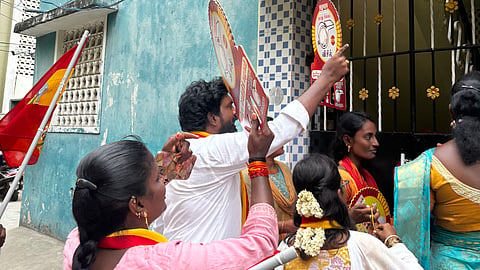
This was among the proposals discussed during a TVK door-to-door campaign on a rainy morning of March 6 in Amudham Nagar, Kodungaiyur, amid whistle squeaks, party flags, calendars, and chants of “Vote for TVK, hail the victorious whistle symbol” by cadre. TVK leader V Siva is confident of a win. “Among over two lakh voters in Perambur, our cadre alone is 50,000 strong, half of them women. This election will be an easy win for us,” he said. “However, while other parties have permission to use speakers in campaigns, we are still waiting for ours, which makes it a bit difficult,” he laughed.
The previous night, March 5, NTK’s Vetri Thamizhan had walked through SA Ammiyar Colony with an auto blaring the party anthem and leader Seeman’s speech on eliminating substance abuse. He adopted a low-key approach, making no lavish promises. “Many here don’t know the PMK candidate, and feel the DMK and TVK candidates are out of reach. I’ve been reaching out to a few people on each street and simply asking them to listen to me. That works in my favour,” he said.
Meanwhile, DMK’s RD Sekar leaned on his record of infrastructure development. “We have opened burial grounds for Hindus, Muslims, and Christians in the area. I also plan to facilitate metro connectivity from Moolakadai to Mint Street and build an overhead bridge from Erukkanchery to Government Ambedkar Arts College. These were key demands during my previous tenure,” he said.
Voters weigh legacy loyalties against new political appeal
Voters, on the other hand, appeared to be influenced not only by past service delivery and promises, but also by legacy voting patterns and the influence of younger family members. Outside Our Lady of Lourdes Shrine in Perambur, S Mujeeb, an autorickshaw driver, said he would continue to support the incumbent MLA, calling it a matter of family tradition. He added that the Kalaignar Magalir Urimai Thittam of Rs 1,000 had benefited his wife.
G Mary, another resident, said that although she wanted to vote for NTK’s Vetri Thamazhan, her teenage daughter wanted her to choose TVK, believing it represented youth-centric politics. She said she might go along with her daughter’s choice.
Among younger voters, disillusioned is evident, but some expressed willingness to give TVK a chance. “During the rains last year, around November, I don’t remember the ward councillors or the MLA stepping in to help. But a few young TVK cadres gave us food and rescued people from inundated homes. I haven’t seen anyone act here after being voted to power, so I want to give this party a chance,” said 21-year-old Rahul Gandhi, who resides on Jega Jeevan Ram Nagar Main Road.
While NTK’s Vetri Thamizhan highlighted the party’s growing vote share over the years, and PMK’s Thilagabama pointed to increasing support among young women, voters in the constituency remained largely divided between DMK’s RD Sekar and TVK’s Vijay.
As daily life hangs in the balance, Perambur reflects a clear dichotomy between sudden, visible bursts of political activity and the persistent, quieter efforts of citizens. There is a renewed urgency among elected representatives, including the MLA, to push and quantify infrastructure projects, while party workers, men and women, young and old, compete creatively to sell their promises.
At the same time, volunteer groups and residents continue their steady work to sustain hope in a constituency grappling with severe social issues. As geopolitical tensions strain fuel supply and climate change intensifies the heat, daily life here grows harder. Vegetable vendors struggle to protect their produce in the sweltering conditions, while some tea shops remain shut due to gas shortages.
For many voters in Perambur, the burden is twofold — longstanding local issues and external crises beyond their control. In a constituency where even something as basic as a street board wavers, that uncertainty extends to electoral choices as well.
One thing is clear: irrespective of who takes the MLA seat, the people of Perambur were no longer willing to accept mixed signals.
* Name changed to protect identity.
Ramyasre N is a journalist based in Chennai. She was earlier with the Times of India, covering health, transport, and civic issues. She is an alumna of the Asian College of Journalism.
Follow TNM's WhatsApp channel for news updates and story links.