
Subscribe
Follow TNM's WhatsApp channel for news updates and story links.
TW: Mention of police violence and brutality.
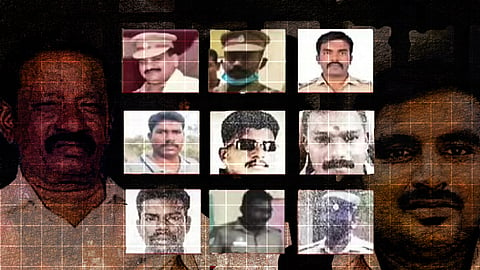
“Shocking the conscience of justice and the conscience of society,” a special court said while sentencing nine Sathankulam police personnel to death for the custodial murders of P Jeyaraj and J Benniks. Observing that there is a vast difference between an ordinary individual committing a wrong and a person in authority doing so, the court emphasised that the right to life and dignity under Article 21 cannot be ignored, and noted that the father and son were stripped, humiliated, and brutally tortured in custody. The father and son were beaten to death inside a locked police station over a petty lockdown dispute in June 2020.
Echoing the Supreme Court’s warning that when custodians of the law themselves commit such crimes no one can feel safe, Judge K Muthukumaran invoked the “rarest of rare” doctrine to hold that life imprisonment would be wholly inadequate and would fail to meet the ends of justice.
The nine convicted are inspector S Sridhar (67), sub-inspector K Balakrishnan (42), sub-inspector P Raguganesh (50), head constable S Murugan (51), head constable A Samathurai (51), constable M Muthuraja (36), constable S Chellathurai (45), constable S Thomas Francis (38), and constable S Veyilumuthu (42). The case against a tenth accused, sub-inspector A Baladurai, was closed following his death, as per a trial court order in August 2020.
The total fine across all nine accused amounts to Rs 1 crore, awarded entirely as compensation to A Selvarani, the wife of Jeyaraj and mother of Benniks. All rigorous imprisonment sentences for related sections are ordered to run concurrently.
The arrest and the crime
On the night of June 19, 2020, Jeyaraj, a mobile phone shop owner in Sathankulam, and his son Benniks, were taken into custody by personnel of the Sathankulam Police Station, on the false premise that they had kept their shop open past permitted hours during the COVID-19 lockdown. What followed inside the locked walls of the station was, in the court's assessment, a systematic and multi-hour process of dehumanisation and physical destruction.
Both victims were confined within the locked premises of the police station. Upon arrival, they were stripped of their shirts and lungis and forced to remain in their undergarments, vests and briefs, throughout the torture. They were then stripped naked and forced to lie face down on a large wooden table located in the station hall, identified during the trial as the "torture bench" by head constable Revathi.
Inspector Sridhar had instigated the other officers, shouting, "Keep beating! Let the screams be heard even on the upper floor!" and SI Balakrishnan had allegedly told the bleeding victims during the torture, "I don't care if you die, I will sell my property and come out."
Multiple officers pinned the victims' hands and legs to the table to prevent them from moving, while others carried out the beating. The weapons used included wooden lathis, bamboo sticks, a silambam stick, and even a pipe. The beatings were concentrated on the victims' buttocks, thighs, knees, palms, and the soles of their feet.
The assault was not continuous but carried out in intervals. Witnesses testified to hearing beating sounds and screams in 10-minute windows from approximately 8.30 pm to 3 am, that is, a duration of over six hours.
The court noted a particularly harrowing dimension to the torture: the father was beaten in front of the son, and the son in front of the father, while both were completely helpless and vulnerable. The judge remarked that the medical reports and autopsy videos detailing the extensive skin peeling and deep trauma were so gruesome that they would "shake the human conscience".
SI Raguganesh was found to have beaten the victims again before they were produced in court, after Benniks indicated he would inform the magistrate about the assault. Raguganesh then threatened them, warning that if they told the judge the truth, "Your legs would be broken and you would be brought back to the station."
In addition to the beatings, head constables Murugan and Samathurai allegedly used their feet to walk over or slide across the victims' thighs while they were pinned to the table. SI Balakrishnan also used a lathi to brutally beat the soles of Benniks' feet while he was forced to sit on the floor.
After the prolonged assault, the victims were taken to the station toilet and forced to apply coconut oil to their own bleeding buttocks, allegedly to ease the pain enough for them to stand, or to attempt to mask the severity of the wounds before being taken to a doctor.
Relatives who saw them briefly noted that they were unable to walk, were limping severely, and had blood-soaked clothes.
A fellow prisoner had also testified that Benniks confided in him that they had each been subjected to over 200 blows during the night, and that when Benniks showed him his injuries, his buttocks looked as though the flesh had been "cut or torn away".
‘Injuries from rolling on the ground’
On the morning of June 20, 2020, the victims were taken for a pre-remand medical examination. Despite presenting with 18 injuries each, high blood pressure, and diabetes, a fitness certificate was obtained under police influence. The police falsely told the doctor that the victims had sustained their injuries by "rolling and rolling while making trouble".
However, CCTV footage from cameras near the victims' shop and the Kamaraj statue showed that Jeyaraj was taken into custody peacefully, with no scuffle or chase.
The court dismissed this narrative as "an absolute fabrication," and observed that the creation of this story was a calculated attempt to destroy evidence and misdirect the investigation, which further pointed toward the guilt and common criminal intention of the accused.
Both Jeyaraj and Benniks subsequently died — Jeyaraj on June 22 and Benniks on June 23, 2020 — while in judicial custody at Kovilpatti Government Hospital.
The Multi-Institutional Medical Board (MIMB), led by Dr Adarsh Kumar, confirmed the cause of death as delayed complications of haemorrhage shock resulting from multiple blunt force injuries. The board said that the injuries sustained by both victims were consistent with repeated blows from the specific blunt objects — lathis, bamboo sticks, and a pipe — seized during the judicial inquiry.
The cover-up
The court observed a calculated and systematic attempt by the accused to destroy evidence and fabricate a defence from the moment the torture ended.
To pre-empt legal action by the victims' families and lawyers, Sridhar and Samathurai registered a false FIR against Jeyaraj and Benniks relating to lockdown violations, spreading infection, obscene behaviour, assault on a public servant, and criminal intimidation. Investigations, including CCTV analysis, proved the victims had not violated lockdown rules or quarrelled with the police. Evidence from the District Collector confirmed that the victims' arrest was purely a pretext for retaliation.
During the torture, the victims were forced to use their own blood-soaked garments to wipe blood off the station floor. A station cleaning worker testified that the station smelled of blood and he was ordered by inspector Sridhar to clean the walls with antiseptic to destroy evidence. Blood-soaked clothes belonging to the victims — white shirts, lungis, and a towel — were found discarded in the station's trash bins by investigating officers.
Since the victims' original clothes were entirely soaked in blood, the police forced them to change into dark-coloured garments before being produced before the magistrate. A private vehicle was used to transport the victims to the jail specifically to avoid leaving bloodstains in official government vehicles, which would have served as further evidence.
The prosecution examined 52 witnesses to establish the motive, the illegal arrest, the sounds of torture heard from the station, the medical condition of the victims, and the subsequent deaths. Numerous material objects were marked, including the wooden torture table, lathis used for the beating, blood-stained clothes found in the trash bins, and the CCTV DVR from the station. Records marked included the station's Daily Situation Report, duty registers, medical fitness certificates, and post-mortem reports.
Woman head constable Revathi, described by the court as a pivotal eyewitness, testified that she saw the victims being beaten on the wooden table, heard their screams, and saw blood stains across the station floor and furniture. She testified to seeing blood splashing onto the station's walls while Benniks was being beaten. The court noted that witnesses were initially terrified to speak against senior officers due to "ties of brotherhood" in the police force.
Forensic DNA analysis also provided what the court described as "unimpeachable" proof.
Call detail records (CDR) and cell tower data were used to place the accused officers at or near the Sathankulam Police Station during the torture window, effectively dismantling their alibis. The court noted that just because a person is not visible in a specific CCTV frame does not mean they were not at the location, particularly when eyewitnesses had explicitly placed the accused at the scene.
The accused denied all charges, claiming innocence or alleging that the evidence had been fabricated.
Inspector Sridhar claimed he was falsely implicated due to political and media pressure, and denied any knowledge of the victims being brought to the station or beaten until after their deaths were reported. The court rejected this, as CDR data and cell tower evidence placed him at the station during the relevant period, and witnesses testified to his presence.
SI Raguganesh suggested the victims had died of COVID-19 or pre-existing medical conditions — kidney stones, diabetes, and fatty liver — rather than from injuries. He argued that injuries to the buttocks do not constitute murder.
Constable Thomas Francis stated that as a member of the same community and a friend of Benniks, he would never have attacked him. He claimed he was performing computer work on the first floor and was unaware of the assault happening downstairs.
The court found the explanations of all the nine policemen "not believable". It systematically rejected each alibi on the basis of CDR data, eyewitness testimony, forensic evidence, and DNA matches.
On the question of intention, the court ruled that all nine accused acted with common intention, adding that some officers carried out the beating while others held the victims down — making all of them equally liable for murder. The court ruled that the accused could not be distinguished based on the number of blows each struck. "They all acted with a common intention and were equally responsible for the deaths," the court held, concluding that only a death sentence would serve as a "necessity of justice."
The court also observed that senior officers Sridhar, Balakrishnan, and Raguganesh were "habitually involved" in using brutal torture methods on suspects in their custody, and that this was not an isolated incident but reflected a pattern of conduct.
Sentencing: ‘Rarest of Rare’
Citing Bhagwan Singh v State of Punjab, the court described custodial torture by law enforcement as "more heinous than a game-keeper becoming a poacher". Bhagwan Singh v State of Punjab concerned the custodial death of a person due to police torture, with the Court condemning such abuse of power and affirming that it violates fundamental rights.
Socio-economic reports compiled for each accused noted that they were between the ages of 30 and 56, with monthly incomes ranging from approximately Rs 24,000 to Rs 61,000, and were primary breadwinners for their families. Medical assessments confirmed that none of the accused suffered from any primary psychiatric illness at the time of sentencing.
Citing Bachan Singh v State of Punjab and Macchi Singh v State of Punjab, the court emphasised that the death penalty should only be awarded in the "gravest cases of extreme culpability," and that it is warranted only when life imprisonment is "altogether inadequate". Bachan Singh v State of Punjab upheld the constitutionality of the death penalty but limited its use to the “rarest of rare” cases where life imprisonment is inadequate, while Macchi Singh v State of Punjab further clarified this doctrine by outlining categories of exceptionally brutal crimes where such extreme punishment may be justified.
The court identified the aggravating circumstances as decisively outweighing any mitigating factors. On motive, it ruled that the accused had acted out of pure retaliation for a petty verbal altercation, using their authority and the cover of the police station to "teach a lesson" through illegal detention and torture. The judge characterised it as a horrific betrayal of duty in which the "custodians of law" became perpetrators of extreme violence.
The court took note of the devastating impact on the victims' family, observing that the police had effectively "uprooted" the family by simultaneously killing both a father and his only son. The court noted that the victims were unarmed, stripped to their undergarments, and pinned down while being brutally assaulted with lathis for hours inside a locked police station — a place where citizens are supposed to be safe.
The court further reasoned that life imprisonment would not be sufficient to deter other police officers who might feel they could abuse their authority and later escape with a 14-year sentence. Citing Mehboob Batcha v State, the court held that custodial murders by law enforcement officers shock the conscience of society and must be met with the harshest possible punishment. Mehboob Batcha v State involved a custodial death caused by police torture, where the Court condemned such abuse of authority and held that custodial killings by law enforcement are among the gravest crimes deserving the harshest punishment.
The court also remarked that if the custodians of the law themselves commit such grave crimes, "no member of society can feel safe or secure".
The sentence
All nine convicted police personnel were sentenced to death on two counts of murder, along with additional terms of rigorous and simple imprisonment for offences including wrongful confinement, destruction and fabrication of evidence, and framing false records, with all prison sentences ordered to run concurrently; fines imposed on each accused ranged from Rs 3.3 lakh to Rs 24.1 lakh, cumulatively exceeding Rs 1 crore, which the court directed be paid entirely as compensation to A Selvarani, the wife of P Jeyaraj and mother of J Benniks.

Follow TNM's WhatsApp channel for news updates and story links.