
Subscribe
Follow TNM’s WhatsApp channel for news updates and story links.
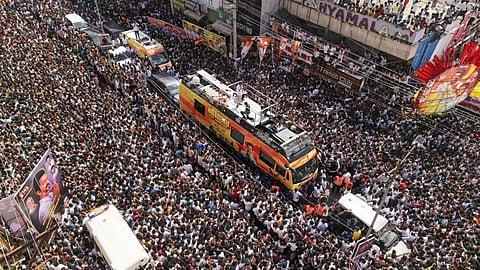
Months after the Karur stampede that claimed 41 lives and left several injured at actor-politician Vijay's Tamilaga Vettri Kazhagam (TVK) rally in September last year, the Tamil Nadu government on Monday, January 5, issued a comprehensive Standard Operating Procedure (SOP) to regulate large public gatherings across the state.
The SOP will apply to all public meetings, political rallies, processions, road shows, demonstrations, protests, cultural and religious events, and any other public gathering where the anticipated turnout is above 5,000.
Existing procedures will continue for smaller events. However, religious gatherings that are a part of customary rituals within places of worship, or where routes and venues are fixed by long-standing practice, have been exempted.
The guidelines were issued followed by the directions from the Madras High Court to issue the SOP for the public meetings.
Permission timelines and application norms
Anyone seeking to organise a gathering must apply to the jurisdictional police station or Sub-Divisional Police Officer (SDPO), specifying the venue, date and duration of the event, anticipated crowd size, key leaders attending, number of speakers, expected vehicles, and parking capacity.
Applications must be submitted between 10 to 21 days in advance for designated venues. For non-designated venues, applications must be submitted between 15 to 30 days in advance. For gatherings exceeding 50,000 people, applications must be filed at least 30 days in advance.
In exceptional cases such as urgent protest triggered by sudden developments, applications may be permitted if the triggering incident occurred within the previous three days.
If multiple applications are received for the same venue and date, they will be considered on a first-come, first-served basis, with priority for recognised political parties.
Applications will be scrutinised by the Sub-Divisional Police Officer, who may seek additional information through a questionnaire if required. Rejections must be reasoned and communicated promptly in writing.
Designated venues and crowd capacity checks
District Collectors will notify designated venues for public events after consulting jurisdictional police authorities. In Chennai, the Greater Chennai Police Commissioner will finalise venues in consultation with Additional Commissioners (Law and Order).
Inputs from recognised political parties must also be considered before final notification.
Each venue will be assessed by Public Works Department (PWD) engineers to determine its maximum crowd holding capacity by taking into account seating and standing space, entry and exit routes, parking availability, and emergency access.
These determined capacities, along with the venue list, will be reviewed at least once a year.
Safety responsibilities placed on organisers
Organisers must submit a written undertaking and are responsible for providing toilets, drinking water facilities, medical aid, and volunteers.
At least one volunteer per 100 attendees is mandatory, while road shows require one volunteer for every 50 people.
Special care must be taken to ensure elderly persons, children, pregnant women, and persons with disabilities are not pushed into high-density crowd parts.
CCTV surveillance must be installed with real-time access provided to police and district authorities.
If the crowd turnout exceeds the declared expected strength by more than 50%, it will be treated as a serious violation.
Restrictions on road shows
Road shows must be completed within three hours, and organisers cannot make audiences wait more than two hours before the event begins. Public speeches can only be delivered at the approved location and not en route.
Vehicle convoys cannot exceed the number permitted. Organisers must ensure that emergency vehicles have an unobstructed movement throughout the event.
At the event, authorities will assess damages to public and private property, and organisers may be held liable for the recovery of losses.
Monitoring committees and enforcement
District and taluk-level event safety monitoring committees will be constituted with officials from multiple departments to oversee the rules whether followed.
While an earlier draft had brought collecting a security deposit from organisers, the final notification has declined the proposal.
Follow TNM's WhatsApp channel for news updates and story links.
