
Subscribe
Follow TNM’s WhatsApp channel for news updates and story links.
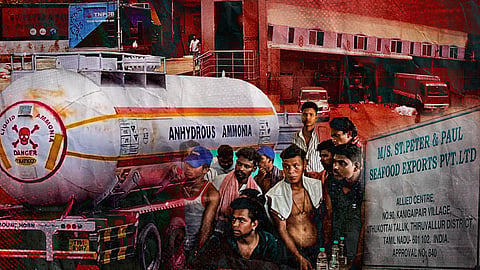
The ammonia leak that killed nine workers, all of them women, at a seafood processing factory in Tamil Nadu’s Tiruvallur district on Sunday, June 21, has triggered allegations of repeated safety lapses. Workers of the factory, most of whom are migrants from Orissa, Assam, and Jharkhand, say that leaks had occurred earlier at the unit, and that complaints raised by them were not acted upon.
The gas leakage at St Peter & Paul Sea Foods Exports in Kannigaipair near Periyapalayam has so far claimed eight women’s lives, and the life of a 15-year-old girl. Eight of the deceased belonged to the Scheduled Tribe community from Odisha’s Kendujhar district. The other deceased was from Assam.
Ammonia is commonly used as a refrigerant in seafood processing units because of its thermodynamic efficiency and relatively low cost. It can be life-threatening when inhaled in high concentrations. According to a Health Department bulletin issued on Tuesday morning, 80 workers were affected by the leak. Of them, 69 remain under treatment at hospitals across Chennai and two were discharged.
At a marriage hall located around 15 kilometres from the factory, where more than 120 workers with mild gas exposure were shifted after the incident, survivors recounted the scenes of panic that unfolded.
According to them, the factory was shut on Sunday, as part of a weekly off day. Many employees who had completed a 12-hour night shift were resting in their rooms, located within the factory premises, when the leak occurred at approximately 11:30 am.
Workers say the ammonia leak came from the processing section on the ground floor and spread towards accommodation areas, including the women's resting space.
Saurav (name changed), a 34-year-old worker from Assam, employed in the packaging department, said he was in a room about 50 metres away from the section where the leak originated. “The leak happened in the operational department. I experienced severe eye irritation and stepped outside. That's when I saw a white-coloured gas covering the area,” he told TNM.
According to him, around 40 women workers from the night shift were present at the time.
“There was no siren or warning. We came to know about the leak only after seeing the gas and feeling its effects,” he added.
Nishanth (name changed), another migrant worker from Assam, alleged that factory workers had repeatedly raised concerns about ammonia leaks before Sunday’s incident. “They said they would fix it, but nothing changed,” he said. Nishanth explained that the workers experienced severe symptoms after inhaling the gas on Sunday.
“We had severe eye irritation and could not speak properly. Some people had bleeding from the nose and mouth. Many workers were evacuated by supervisors, and fellow workers covered their faces with plastic covers before entering the affected area,” he said.
The workers say that such ammonia leaks are a recurring threat. Saurav recalled a leak had occurred around two months ago, but nothing untoward happened.
They allege that despite this, there were no safety precautions, training, or alarm system to alert them of such leaks.
Reports suggest that an ammonia leak was reported at the same unit in 2014, in which a worker later died of complications, and a case relating to his death is currently being heard by the Tiruvallur court.
“Leaks occur two or three times every month, and we were asked to continue working despite the smell,” Nishanth told TNM.

‘No safety, unsure about going back to work’
An official who is closely associated with the migrant workers at the factory alleged that workers had not been given any safety training to deal with hazardous gas leaks.“There was no siren or warning system. Workers realised there was a leak only after they started feeling its effects. No safety training was given to workers to handle such emergencies,” he said.
The official said that nearly 200 migrant workers were employed at the factory across two shifts and were engaged in packaging, production and housekeeping work. Reports say a large section of the workforce comprised young women between 18 and 26 years of age, who travelled to Tamil Nadu for employment.
"Processed seafood has to be stored at sub-zero temperatures, which is why ammonia is used as a coolant in cold storage facilities. However, such facilities should be adequately ventilated and equipped with leak detection and alarm systems," said environmental activist Sundarrajan.
He said the incident should make authorities review safety measures in industries handling hazardous chemicals across north Chennai and its surrounding industrial belt, including Manali, Thiruvottiyur and Ennore.
He stressed the need for mandatory safety training for workers and adequate emergency medical facilities near industrial units.
"Resting rooms for workers need not be located inside factory premises. Housing workers away from hazardous industrial operations can reduce their exposure during accidents, including on holidays and off-days," he said.
The recent incident has now left many workers uncertain about returning to the factory.
“We want proper compensation from the government and the company. Many of us are planning to return to our native places and look for work there. We do not want to continue here because the system is not good,” Saurav said.
A National Disaster Response Force (NDRF) medical team comprising two doctors and six nurses has been stationed at the premises, while police personnel continue to stand guard.
But the impact of the leak was also felt beyond the factory premises.
A long-standing concern with no recourse
Kamatchi, a 26-year-old homemaker living about a kilometre away from the factory, said residents felt a strong smell around 11.30 am.
“We experienced excessive sweating around the nose area and a pungent smell. Soon after, we saw several women workers of the factory rushing towards a nearby private hospital,” she said.
Alamelu, a 34-year-old tailor living in the same locality, said the effects were immediate.
“Within 30 to 40 seconds of inhaling the gas, we experienced suffocation, rapid heartbeat and difficulty moving our hands and legs normally,” she said.
Local activists said concerns regarding the factory had been raised repeatedly over the years.
MJ Sudesh Kumar, State Deputy President of the New Democratic Labour Front, said that residents had sought action against the factory through grama sabha meetings and complaints submitted to authorities.
“For the past 15 years, we have raised concerns about this unit through gram sabha meetings and multiple petitions to the district administration. We even sought its closure through a complaint submitted in February this year, but no action was taken,” he alleged.
Sudesh Kumar also called for awareness programmes in villages located near hazardous industrial units.
“People living near such factories should be educated about emergency response and safety measures. The cost of such awareness programmes should be managed by the industries themselves,” he said.
The factory management declined to comment when TNM reached out.
What the govt says
Labour Welfare and Skill Development Minister J Mohamed Parvas, on Monday, June 22, told the Assembly that the leak occurred due to an unexpected fault in a valve connected to a pipeline leading to an ice flakes generator machine at the unit.
Workers from Odisha accounted for the highest number of affected persons at 29, followed by Assam (18), Jharkhand (8), Tamil Nadu (8), Kerala (3), and West Bengal (1). The native states of two workers are yet to be ascertained.
The Periyapalayam police have arrested two of the factory’s owners, M Joseph Jegan and M Mohan, along with manager R Daniel, under sections 105 (culpable homicide not amounting to murder) and 125 (a) (endangering life or personal safety causing hurt) of the Bharatiya Nyaya Sanhita (BNS).
Since one of the deceased was a 15-year-old girl, police have also added provisions of the Child and Adolescent Labour (Protection and Regulation) Act. A three-member committee appointed by the state government is investigating the circumstances that led to the tragedy.
Three ammonia cylinders from the factory were removed and transported to another location as part of safety measures.