
Subscribe
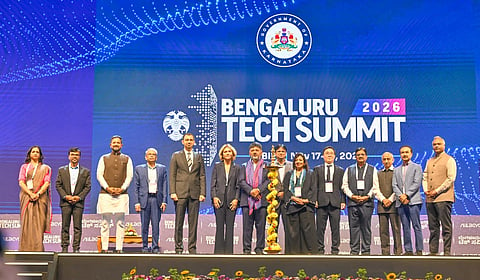
Artificial intelligence (AI), semiconductor manufacturing and India’s efforts to strengthen its position in the global technology ecosystem were in focus on the opening day of the 29th Bengaluru Tech Summit 2026 on Tuesday, November 17.
At a panel discussion titled ‘AI & Beyond: The Emerging India’, Karnataka IT and BT Minister Priyank Kharge, Biocon founder Kiran Mazumdar-Shaw, Infosys co-founder Kris Gopalakrishnan and venture capitalist Prashanth Prakash discussed the growing role of AI in governance, healthcare, industry and entrepreneurship. The session was moderated by Lingaraju Sawkar.
Priyank Kharge highlighted the Karnataka government's plans to use AI to improve public service delivery. He cited the use of AI chatbots in rural development to address public grievances and technology-based systems to assess water quality, including chemical and biological contamination.
He also spoke about the potential use of AI in the Home Department, particularly in cybersecurity, detecting narcotics and synthetic drugs, and improving policing. With around 5,000 police stations in Karnataka, he said technology could help monitor their performance and strengthen administrative efficiency.
The Minister also referred to the government’s Government First initiative, under which the state aims to become the first customer for startups developing solutions to governance challenges.
Speaking about the IT services industry, Kris Gopalakrishnan said AI was creating opportunities for established technology companies as well as startups. He said traditional IT services and consulting would continue to remain relevant, while AI would help companies develop new products and services.
On the impact of AI on software jobs, Gopalakrishnan observed that coding was among the first areas to be significantly affected. Software professionals would increasingly need to review, validate and certify AI-generated code, making a deeper understanding of programming and software systems important.
Kiran Mazumdar-Shaw highlighted AI's potential in biotechnology and healthcare, particularly in biological research, drug discovery, diagnostics and biomarker development. She said AI could help researchers analyse complex biological data and accelerate the development of treatments and diagnostic tools.
Prashanth Prakash called for a shift from incremental technological improvements to outcome-driven innovation. He highlighted how AI could help businesses improve services, reduce costs and develop new revenue models.
At a session titled “India’s Semiconductor Leap”, industry leaders discussed efforts to build domestic semiconductor manufacturing and strengthen India’s role in global supply chains. Speakers included India Electronics and Semiconductor Association president Ashok Chanda, Tata Electronics Chief Supply Chain Officer Srinivas Satya and Applied Materials India COO Radhika Viswanathan.
Ashok Chanda, president of the India Electronics and Semiconductor Association (IESA), said India had moved beyond treating semiconductor manufacturing as an aspiration, with policy support from the Centre and state governments helping attract investments.
"Do not undermine or underestimate the strength that we have today. Do not underestimate the foundation we have created now, with the help of policies, but also the industry," Chanda said.
He said the industry was witnessing greater participation from Indian companies, which were increasingly investing in electronics and semiconductor manufacturing. "Now, semiconductor manufacturing is considered commercially, financially and strategically viable. It is an industry now," he said.
He also highlighted the importance of developing the wider manufacturing ecosystem, including semiconductor design, fabrication, assembly, packaging, machinery, chemicals and materials.
Srinivas Satya, Chief Supply Chain Officer at Tata Electronics, said India had made progress but needed to strengthen its supply chain, develop specialised talent and collaborate with global technology companies to become competitive. "You cannot underestimate the talent gap between what we have and what the industry requires. But it is not an insurmountable challenge," he said.
Satya outlined Tata Electronics' plans to expand its manufacturing capabilities, including a semiconductor fabrication facility in Gujarat and a semiconductor assembly and packaging facility in Assam.
He said the company was working with global suppliers to develop local capabilities and establish training programmes. It was also sending young engineers to Taiwan for training and working with universities to build specialised skills.
On the use of AI in manufacturing, Satya said the company was looking at integrating the technology into its operations from the beginning to improve productivity and efficiency.
Radhika Viswanathan, COO of Applied Materials India, said India had a significant opportunity to participate in the global semiconductor industry, given its chip-design capabilities and engineering talent.
She said the challenge was to build expertise across the entire value chain, including design, materials, equipment, fabrication, advanced packaging and testing. "What took the world decades, India must do in one decade," Viswanathan said, stressing the need for the industry to work together to build domestic capabilities.
"Let's not take that as a pressure statement. Let's make sure that this is the mission. We absolutely have to deliver," she said.
She also highlighted the importance of collaboration between companies, research institutions, startups and academic institutions, noting that no single company could independently build the entire semiconductor ecosystem.
The summit will continue on November 18 and 19 at the Bangalore International Exhibition Centre (BIEC) in Bengaluru.
//
Follow TNM's WhatsApp channel for news updates and story links.
