
Subscribe
“I have honesty and courage in my heart. Above all, I have a crowd willing to give their lives for me.”
When 35-year-old Vijay delivered this line in 2010 Tamil film Sura, theatres erupted in applause. The moment crystallised a persona he would carefully refine over the next decade.
Fifteen years later, Vijay has turned a politician and is testing whether that roar can travel beyond the cinema hall and into electoral politics.
Founded in 2024, the Tamilaga Vettri Kazhagam (TVK) is not merely a political party; it is, in many ways, an extension of Vijay’s cinematic universe. And Vijay the politician is a continuation of the persona he crafted on screen.
Over the years, Vijay has built a cinematic image that seamlessly extends into real life. While most stars are seen simply as actors off screen, Vijay continues to be perceived as anna (elder brother), protector, leader, and vigilante – someone close, familiar, and deeply rooted in everyday life.
After Rajinikanth and Kamal Haasan, Vijay is perhaps the only contemporary actor to dominate the market with comparable consistency and scale. His immense popularity and on-screen presence led to his fans addressing him as Thalapathy, meaning ‘commander’.
This persona now forms the foundation of his political project.
Its earliest traces can be found as far back as 2009, when Vijay unveiled a flag for his fan clubs bearing the slogan Unnal Mudiyum, meaning ‘You can do it’. This, according to many fans, was a signal that his ambitions were bound to stretch beyond the silver screen.
For decades, Tamil Nadu’s politics has largely been shaped by a two-party contest: the Dravida Munnetra Kazhagam (DMK) and the All India Anna Dravida Munnetra Kazhagam (AIADMK) – both born from the Dravidian movement that foregrounded social justice, Tamil identity, and anti-Hindi imposition.
Power has alternated between them since the late 1960s, with smaller parties usually aligning with one side. The DMK currently governs under Chief Minister MK Stalin, while AIADMK remains the chief opposition.
It is into this entrenched bipolar space that Vijay has launched TVK, promising to disrupt a political order long dominated by Dravidian legacy parties.
Vijay’s entry into politics is less sudden than it appears. We spoke with Vijay’s friends, fans, political commentators, researchers, and film industry insiders to understand the actor and his turn to politics.
The question that remains is – can Vijay translate the frenzy around him into political capital in Tamil Nadu’s crowded and competitive political landscape?
In early 2021, wearing a blue shirt and jeans, Vijay cycled from his Chennai home to the nearest polling booth to vote in the state Assembly elections. Fans followed the actor along the way, causing a traffic jam and prompting police to step in.

Speculation quickly arose that Vijay’s choice of transport was a protest against rising fuel prices under the incumbent AIADMK government. His publicist, however, denied any political intent.
Yet the image of Vijay on his cycle had already taken on symbolic significance, with many viewing it as his de facto entry into politics.
Director Perarasu, who has known Vijay for over a decade, said that he never thought the actor would enter politics. “Now when I see him speak on stage, he is like a different Vijay. He’s developed the demeanour and oratory required of a politician. Another Vijay has been inside him the whole time.”
Some believe that his political journey began as early as 1994, when his father introduced a 20-year-old Vijay as Ilaya Thalapathy, meaning ‘young commander’, during a movie release. It took 23 years for the prefix ‘young’ to be dropped from his title and he simply became Thalapathy.
Others recall the flag release in 2009.
A few point to 2013, when the release of Vijay’s film Thalaiva (meaning ‘leader’), taglined ‘Time to Lead’, was disrupted by threat letters sent to theatre owners. There was widespread speculation that the then Chief Minister J Jayalalithaa, known for her authoritarian ways, was unhappy with the phrasing of the tagline.
However, in Vijay’s case, dates matter less than patterns. Across genres and decades, Vijay’s films repeatedly rehearsed his leadership, commitment to justice, and ability to mobilise.
His cousin Supriya B, who runs the consulting firm Glassbox, said that it was inevitable that Vijay would take the plunge into politics. “He was a fun-loving, easy-going boy, and his acting journey did not begin with instant success. But he always had a sense of purpose and a quiet determination to improve himself. Over the years, that sense of responsibility towards people has only grown deeper.”
Sangeetha Krish, a longtime friend of Vijay and a co-star in Varisu (2023), recalls an instance during the shoot when one of them asked him about the rumours that he was going to enter politics.
“There is nothing wrong with at least making an attempt,” was Vijay’s reply.
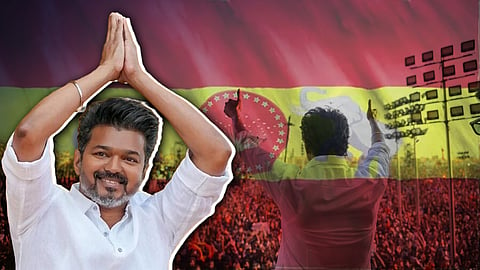
On October 27, 2024, this long arc found its clearest expression when Vijay walked up to the podium and delivered his first speech as a politician. Drawing a crowd of over five lakh people, it was one of the largest political gatherings in Tamil Nadu’s recent history.
“Isn’t it selfish to just think that only I should live well?” he asked. “Beyond a certain limit, what is one supposed to do with the money we earn? How am I going to repay the people who gave me life?”
It was these questions, he said, that led him to found TVK.
The speech drew heavily on a persona he has carefully cultivated over the years – that of a man shaped by, and devoted to, the women in his life. Referring to “my mothers, my sister, and my friends,” Vijay credited them with playing a foundational role in what he described as his political awakening.
Known to be fiercely private, Vijay made a rare personal confession – “When my own sister Vidhya died, it affected me a lot,” he said in his debut speech.
In the early 1980s, Vijay and his family was shaken by the death of his two-year-old younger sister. He has rarely spoken about the loss, though those close to him have often described it as a formative moment in his life. He is known to use the number ‘0277’ – Vidhya’s birthday – on his vehicles as a quiet tribute to her memory.
Vijay drew a direct parallel between that personal grief and the death of Anitha, a 17-year-old medical aspirant who died by suicide in September 2017 after failing to secure a seat through the National Eligibility-cum-Entrance Test (NEET).
Anitha’s death had sparked widespread protests across Tamil Nadu, with critics arguing that the centralised exam disproportionately disadvantaged rural and marginalised students.
“The death of another sister, Anitha, affected me just as much,” Vijay said, referring to his sister and invoking both losses to underline his political resolve.
He pledged to prioritise women’s safety and education, announcing that his party would be guided by women leaders.
“Don’t worry hereafter. Your son, your brother, your friend, your Vijay has come to the field,” he told the crowd.
Babu (51), a Vijay fan turned TVK functionary from Coimbatore, said that Vijay remembers not only his name but also that of family members and specific details about them. “Unlike other actors, his political entry does not feel abrupt because we have been doing groundwork in the form of social service for close to three decades.”
Among the thousands gathered, many were women – holding party flags, wearing ribbons across their foreheads and chanting Vijay’s name as he spoke.
Pavithra (29), a party worker in Tiruppur, later told TNM that her parents permitted her to work in politics only because it was for Vijay. “He is known for making women feel safe,” she said.
However, journalist Kavitha Muralidharan pointed out the irony of the online harassment unleashed by Vijay’s supporters on those with dissenting opinions, especially women. "While he claims to protect women, which is itself a problematic framing, his fans and cadres aggressively troll women on social media for criticising him. What about protecting women in digital spaces?”
On the night of his party launch, Vijay did not present himself as a radical challenger. Instead, he took on the role of a protector, invoking duty, gratitude, and kinship.