
Subscribe
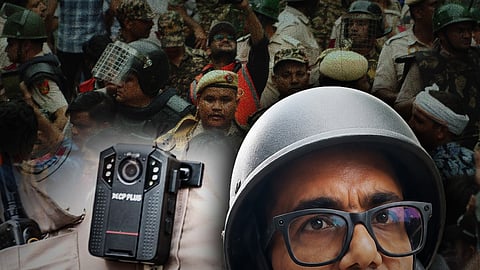
A camera on top of the metal detector near the entrance to the Jantar Mantar protest site. Multiple cameras inside, tied up on the trees. Camera drones circling the site at all times. Innumerable photographers hired by the Delhi Police, moving around to capture the faces of those who joined the protest. Well-equipped surveillance and monitoring vans deployed to gather real-time facial recognition data against the protesters. On top of all this, police officials face-to-face with the protesters, wearing Meta AI glasses. This was the height of surveillance and invasion of privacy an average protester at Jantar Mantar faced.
The aspirations of the National Democratic Alliance (NDA) government to become a ‘big brother’ is unchecked due to the absence of efficient data privacy and cyber security laws. Outdated laws and lack of specific legislation for regulating facial recognition technology (FRT) give the government a free ride with the citizens’ data.
On July 18, a group of men in civil clothes entered the protest site and forcibly removed activist Sonam Wangchuk, on the 20th day of his hunger strike. These men covered the scene in bedsheets, in order to avoid any capture of this brutality by the cameras. But the Delhi Police had already done something far more vicious, in preparation for the attack. Many activists present at the site reported being unable to unlock their phones for more than 2 hours.
“My mobile was suddenly locked for about 3 hours, displaying the system notification: ‘This device belongs to your organisation’. I was left entirely incommunicado during this period. I strongly suspect this communication blockade was a targeted intervention by law enforcement,” said Sohan Kumar Yadav, a student at the University of Delhi and member of the SFI Delhi State secretariat.
How did the police achieve this? What technology did they deploy? Who is keeping check?
Two days later, during the Sansad Chalo March, Delhi Police officials were captured on video using Meta AI glasses. The protesters took to social media platforms like X and Instagram to alert others and to call out Delhi Police. The protesters also accused the police officials of using real-time FRT against them. A Times of India report said that Delhi Police scanned AI camera footage to trace those involved in the Jantar Mantar protest; 10 FIRs were registered based on this. TNM reported that Delhi Police has at least 25,000 CCTV cameras integrated into the AI network.
Several social media handles were targeted as well. CJP’s X handle was withheld on May 21, only to be restored later by the Delhi High Court. At the peak of the protest, the Instagram handle of the Students’ Federation of India, Delhi State Committee was suspended by Meta without giving any clear reasons. Several activists reported shadow banning of their content. Videos critical of the government were flagged as “sensitive content” in order to reduce their reach.
In November last year, the Jawaharlal Nehru University Students’ Union (JNUSU) had protested against an FRT system installed for student access to the Ambedkar Central Library in the campus. When an ID card with a bar code was already in place to regulate access, the Union had pointed out the sheer overreach and absurdity of using FRT. All the four Union office bearers were rusticated for this action in February, for two whole semesters. However, they have been able to successfully resist the installation of the system to this day.
With FRT surveillance already in place in several universities in the country, under the pretext of library/laboratory access, the youth and students are placed at a higher risk of identification by law enforcement agencies. With facial data updated and stored everyday, in multiple angles, and no clear regulation regarding the sharing of this data with police or other law enforcement agencies, such technology can be used to intimidate and arm-twist students into compliance.
In politically charged campus spaces, the uncritical acceptance of FRT, under the guise of new access technology or safety/security, will sound the death knell for open expressions of dissent, debate, and discussion.
This introduction of new technology under the pretext of different purposes and its ultimate destination into the pockets of the police is not new.
In 2018, the Haryana CM went on a tour of Israel in order to improve strategic partnership with the country. An official source reportedly told The Tribune that Israel’s “intelligence-gathering expertise”, especially through its intelligence agency Mossad, could be useful for the Haryana Police in several ways. In 2023, the Haryana government launched its drone programme DRIISHYA (Drone Imaging and Information Service of Haryana Limited) for agricultural mapping and traffic control. However, today Haryana Police has become the first police force in India to use drones to launch tear gas.
In 2024, during the farmer protests, Haryana used intelligence equipped drones to create a database of the protesters and deploy tear gas against them, injuring 60 people. This strongarm tactic is straight out of the Israeli playbook in occupied Palestine. In April this year, Israel Aerospace Industries announced plans to invest Rs 3,000 crore in Haryana.
India under Narendra Modi and Israel under Benjamin Netanyahu have one thing in common: both governments, directly and indirectly, aim to create an ethno-state.
In March 2021, Israeli face intelligence technology company Corsight AI announced a Facial Recognition Center of Excellence (FR-COE) and development portfolio in Guwahati. However, how the data is stored and handled is opaque. The selection of Guwahati, Assam as a testing ground for this AI facility should ring alarm bells with regard to the ethnic tensions in the region and the otherisation of the local Muslim population already prevalent there.
In an interview with the Guardian, Amnesty International researcher Matt Mahmoudi explained how the IDF deploys facial recognition systems at checkpoints in Gaza to target anyone who are ‘deemed’ to be close to Hamas. Along with this, private players like Corsight AI are also being deployed in the West Bank and Gaza. According to Corsight AI, one of their key achievements is to identify a person with only a partial view of the face, that is when a mask or eyewear is used to cover the face partially. Since Israel’s ground invasion of Gaza in 2023, this technology has been used extensively to target Palestinians.
The foundation for the mass surveillance programme was laid down by the second United Progressive Alliance (UPA) government under Aadhaar enrollment in 2009. In 2016, Aadhaar received legal backing but was pushed back by various activist groups citing security concerns. Then the government announced that Aadhaar linking was not mandatory.
Despite this confusion, citizens were forced by the processes to link Aadhaar with their phone numbers, bank accounts, pension account, gas subsidy, etc. This exposed almost all Indian citizens who hold an Aadhaar card to the state’s security gaze. Delhi NGO Lokniti-CSDS reported in 2019 that a large number of respondents from low income groups were denied food grains either because they did not have an Aadhaar ID or due to technical glitches.
Our cyber security infrastructure has still not caught up with the technofascist aspirations of the NDA government. In 2018, the first report about Aadhaar leaks came out. The investigative report by The Tribune stated that Aadhaar details were sold by ‘agents’ for as low as Rs 500. In 2025, personal details of 81.5 crore Indian citizens, including Aadhaar and passport details, were up for sale on a dark web forum. All of these reports were duly denied by the Unique Identification Authority of India.
The most recent data breach came to light earlier this month in India’s largest nuclear plant in Kudankulam in Tamil Nadu. Even while sensitive nuclear information could have been compromised, there were no primetime discussions on the issue and Union Minister of State for Atomic Energy Jitendra Singh downplayed concerns around the breach.
Faces have become data. This data is being collected, stored, and compiled. This data can then be used to vilify one’s presence and participation. Yet there is no clear law or regulation to protect the right to privacy of protesters. Beware, Big Brother is always watching!
K Gopika Babu is Vice President, JNUSU and state committee member of SFI Delhi.
Vinayak Raj is an experience designer who has worked in the IT sector for more than 8 years.
Views expressed are the authors’ own.
