
Subscribe
A Public Interest Litigation before the Delhi High Court has put surveillance practices by the Delhi Police at Jantar Mantar, during the protest by the Cockroach Janata Party (CJP), under scrutiny.
Several protesters had alleged they were subjected to continuous filming and intimidation during the CJP’s "Sansad Chalo" protest.
The petition, filed by former Jawaharlal Nehru University Students' Union (JNUSU) president Aishe Ghosh, alleges that since June 20, Delhi Police has continuously photographed and videographed protesters through a permanent surveillance tower installed at the protest site. It alleges the recording extends beyond protest activities to routine actions such as eating, resting and seeking medical assistance, and that police personnel threatened to send photographs and videos of student protesters to their parents, guardians and educational institutions.
The plea also alleges that women protesters who remained at the site in rain-soaked clothing during heavy rainfall continued to be photographed and filmed.
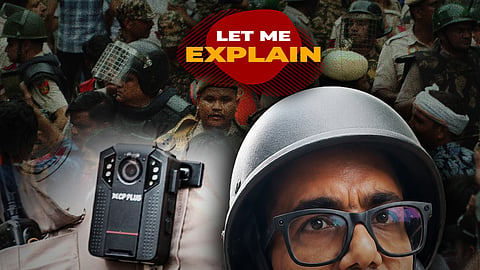
Visuals from the protest site show Delhi Police personnel wearing Meta smart glasses in addition to using phones and camcorders to record demonstrators.
Appearing for Delhi Police before a Division Bench of the Delhi High Court, Solicitor General Tushar Mehta rejected the characterisation of the recording as surveillance, telling the court that protests at Jantar Mantar are routinely recorded for law-and-order purposes and that hundreds of protesters themselves film and post videos from the site.
He described the petition as "luxury litigation."
The court has asked whether any Standard Operating Procedure exists to regulate policing at protest sites and has listed the matter for further hearing.
The Delhi Police is increasingly relying on its citywide AI-powered surveillance network for policing, according to reports.
Following clashes during a CJP protest march, police said footage from its AI-enabled cameras was being used to identify people allegedly involved in violence. Officials said the footage would be cross-checked against police criminal databases before arrests are made. Ten FIRs have been registered across multiple police stations for offences including rioting, assault on public servants and damage to public property.

Delhi Police today operates one of the country's largest AI-enabled public surveillance systems. According to the Internet Freedom Foundation (IFF), approximately 25,000 CCTV cameras are integrated into the network. They include cameras installed under the Safe City Project and those operated by the Delhi Metro Rail Corporation (DMRC) and the Indian Railways.
The latest phase of the project was inaugurated by Union Home Minister Amit Shah in February 2026. It is anchored by an Integrated Command, Control, Communication and Computer Centre (C4I) at Delhi Police Headquarters, which is connected to district and police station-level command centres across the city. At the time of launch, Delhi Police said 2,100 AI-enabled cameras had become operational. Under the first phase they planned to add 10,000 cameras to the network into which more than 15,000 older cameras were already integrated.
The system is equipped with AI-powered video analytics including facial detection, automatic number plate recognition, hand gesture recognition and crowd density monitoring. However, exactly who can be identified through these systems remains unclear because official accounts of the underlying facial recognition database have varied significantly over time.
In 2025, a senior Delhi Police official told The Economic Times that facial recognition cameras would match against a database of over 20,000 known criminals. Reporting around Independence Day security arrangements the same year placed the database at around 300,000 records. Trade publication Biometric Update later reported that the system contained approximately 350,000 criminal records and could process nearly one million records within 200 milliseconds.
A 2019 investigation by The Indian Express found that Delhi Police was operating facial recognition tools by running them on three separate datasets: one with more than 150,000 history-sheeters, another with 2,000 terror suspects and one described as containing "rabble-rousers and miscreants," compiled using images collected from protest footage.
Several concerns have been raised regarding how these databases are constructed, maintained and audited. Legal researchers argue that the lack of transparency creates the possibility of facial recognition extending beyond categories explicitly recognised under law to include broader groups such as protest participants without adequate statutory safeguards.
An investigation by The Wire for the Pulitzer Center revealed how Delhi Police relied solely on facial recognition technology to identify riot accused, raising concerns over accuracy, accountability and potential human rights violations.
The legal basis for Delhi Police's facial recognition programme is also limited. In response to a question from Rajya Sabha MP Saket Gokhale in 2025, the Ministry of Home Affairs said the system operates under a Delhi Police order issued on June 9, 2022. The order authorised the use of facial recognition technology to identify "suspected individuals or known criminals."
India does not have a dedicated law regulating facial recognition technology.
The Digital Personal Data Protection Act, 2023 provides a general framework for data protection but does not specifically regulate biometric surveillance in public spaces. It also contains broad exemptions allowing government agencies to process personal data without consent where necessary for functions authorised by law or in the interests of sovereignty, integrity and state security. As a result, individuals captured by public surveillance systems have limited ability to know how their biometric data is being used or to challenge its processing.
The principal constitutional safeguard therefore comes from the Supreme Court's judgment in Justice KS Puttaswamy v Union of India (2017), which held that any restriction on the right to privacy must have a legal basis, pursue a legitimate aim and satisfy the test of proportionality by using the least restrictive means available. The judgment also reaffirmed an earlier ruling in Malak Singh v State of Punjab and Haryana, which held that police surveillance cannot be arbitrary, cannot target people outside legally recognised categories and cannot be used to suppress fundamental freedoms.
Digital rights groups have argued that these safeguards have not been adequately considered in Delhi's surveillance rollout. The Internet Freedom Foundation has said responses obtained through the Right to Information Act show that Delhi Police did not undertake a privacy assessment before introducing facial recognition technology. According to the organisation, no Privacy Impact Assessment has been conducted for the Safe City Project either.
The European Union's AI Act, which came into force in February 2025, generally prohibits the use of live facial recognition by law enforcement in public spaces except under narrowly defined circumstances such as locating abducted persons or preventing imminent terrorist attacks.
Sweden permits real-time facial recognition only for serious crimes, terrorism investigations and missing persons cases, subject to prior prosecutorial authorisation and oversight by its privacy regulator. In contrast, regulation in the United States varies by jurisdiction, with several cities banning police use of facial recognition while others permit it under judicial oversight.
The United Kingdom is expanding police deployment of facial recognition technology, while China operates one of the world's largest facial recognition systems.
Follow TNM's WhatsApp channel for news updates and story links.