
Subscribe
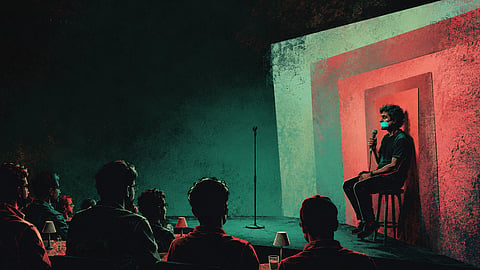
A stand-up comedy show is usually expected to need a stage, a microphone and an audience. But in Bengaluru this week, it also needed police protection.
As comedian Kunal Kamra took the stage amid tight security checks, the irony was hard to miss. In contemporary India, political satire has become a law-and-order issue, and punchlines require a defence lawyer.
The country is now familiar with the pattern: comedians getting arrested and protesting against cancelled shows, fighting long legal battles, and cartoonists getting blocking orders all because they made a joke, and it hurt someone in power.
A familiar script
For Kamra, the incident is not new. In March 2025, his Mumbai event became controversial after his satirical song allegedly targeted Maharashtra Deputy Chief Minister Eknath Shinde. A police complaint was filed against Kamra.
His recent Bengaluru show was held under tightened security measures after a Hindutva group called Hindu Rashtra Samanvaya Samiti objected to it.
The show was even shifted to a smaller venue. Around 50 police personnel were deployed for an audience of barely 60 to 70. The security checks were unusually stringent. Audiences were frisked. They and their ID proofs and wrist bands were photographed. Kamra opened the show apologising for the inconvenience and thanked police at the end.
It’s not just Kamra. Comedians like him have found themselves in the middle of legal battles many times.
In 2022, the right-wing group Hindu Janajagruti Samiti objected to comedian Vir Das’s show, accusing him of hurting religious sentiments. A police complaint was also filed against him.
In April this year, Hyderabad-based comic Sarat Uday’s show was disrupted by Telugu Desam Party (TDP) supporters in Bengaluru for jokes he made about Andhra Pradesh Chief Minister Chandrababu Naidu and his son, Minister Nara Lokesh, two years ago.
“There is constant monitoring on us now,” Sarat said, talking to TNM. “It is extremely visible that people are monitoring our YouTube videos and Instagram pages. I get too many notifications from Instagram saying that my video has been taken down. Every video I post now, I have to send it to a lawyer first,” he said.
The scrutiny is not confined to stand-up comedians. Political cartoonists too are navigating an uneasy climate.
Earlier this year, cartoonist Satish Acharya’s work was withheld on X, following government block orders. Several other parody accounts and satirical posts were also blocked in India, which prompts concerns over free speech and democratic dissent.
The challenge is not merely about the legal action but the overall climate it creates.
“There’s a serious effort to stop people from seeing political cartoons which criticise the government by putting pressure on newspaper owners or editors, by snatching the columns of cartoonists, and by terrorising cartoonists to stop showing Pradhan Sevak’s (prime server) face in cartoons,” said Satish Acharya, talking to TNM.
Several satirists TNM spoke to said that a significant change in the atmosphere came over the past decade.
“Before 2014, I used to make fun of Congress too,” said Rachita Taneja, who makes comics under the name Sanitary Panels. “Back then, there were institutions in place to protect you. One could look for media support or legal resources. Now, it feels like all of these institutions meant to protect the public have been compromised, overtaken by those in power,” she said.
She added that artists today face threats on multiple fronts, ranging from legal action to intimidation and physical threats. “For women there are rape threats and stalking, and if you are a Dalit or a Muslim creator, your identity is used against you as slurs.”
Stand-up comedian Manjeet Sarkar said that the consequences of political satire extend beyond the stage. He added that he has multiple cases filed against him and receives multiple threats.
“I don’t put any of my personal information like family or marital status online because of the fear about my loved ones,” he said.
He added, "When I started performing comedy, we had never heard of getting our material vetted by a lawyer. When I tell comedians from other countries that we send our jokes to lawyers before performing, they are shocked. But that is the reality India has come to at present,” he said.
The trend also extends beyond individual comedians and cartoonists. Last year, popular Tamil YouTube creators Gopi and Sudhakar, who run the channel Parithabangal, faced a police complaint over a satirical sketch mocking caste supremacy.
Satire as resistance
Political satire, in its most audacious form, is almost as old as politics itself. Across centuries and countries, satire served as one of the most powerful tools to question authorities. Humour, irony and ridicule worked as an effective medium to keep the power in check.
Satire in Europe can be traced back to Greek and Roman literature. Although it was meant to be humorous, it often offered constructive social criticism and addressed wider social issues.
In the 18th century Anglo-Irish writer Jonathan Swift published a satirical essay called A Modest Proposal that sarcastically suggested poor Irish families sell their children as food. He used outrageous irony to expose the brutality of English absentee landlords and England’s colonial occupation of Ireland. The essay is considered one of the defining works of political satire.
The tradition slowly transcended to modern democracies as well. In the United States, cartoons and television shows have made political comedy a part of everyday lives.
For over five decades now, Saturday Night Live has been one of the most famous satirical shows. It has impersonated almost every American president – from Gerald Ford to Barack Obama and Hillary Clinton to Donald Trump.
In Britain, the political satire show Spitting Image, which caricatures contemporary celebrities and political figures, is one of the most watched shows.
India has its own tradition of political satire too.
During the freedom struggle, newspapers had cartoons published mocking the British Raj. Humour was used to express dissent. Post independence, cartoonists like Shankar Pillai and RK Laxman brought satire into everyday conversation. Laxman’s iconic Common Man witnessed governments rise and fall, scandals unfold, and slowly became a symbol of an ordinary citizen witnessing power from the sidelines.
“Satire is a very important tool in any democracy,” Rachita said. “When you make fun of authority, you humanise them. You make them seem like a normal human being and not a godlike figure who cannot be questioned, who cannot be criticised. Through satire, you're making fun of authority, but you're doing it in a way that's meaningful,” she added.
Political satire shows have almost disappeared from mainstream media, says Nishanth, who hosts Malayalam satirical show Gham on Asianet.
“Satire is an essential part of democracy. It is another way of communicating what is happening around us. It also democratises news in many ways. Someone who can’t read a newspaper or can’t understand news might look at a cartoon or watch a satirical show and will be able to grasp the political context,” he said.
Nishanth also pointed to the recent Cockroach Janata Party (CJP) protest. “How cockroach was used as a satirical symbol for a movement, which eventually led to the resignation of a Union government minister, is something we haven’t seen in the past decade,” he added.
Over decades, political satire has survived monarchies, colonial rules and dictatorships. The question of whether it can continue to thrive in contemporary India also depends on the question of how much criticism a democracy is willing to tolerate.
Views expressed are the author’s own.
