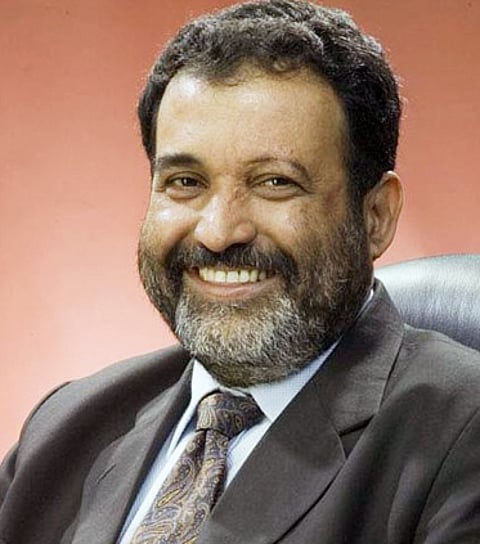

Chitra Subramaniam| The News Minute| October 28, 2014| 8.00 pm IST
It is difficult to place T.V. Mohandas Pai, former CFO and member of the board of Bangalore-based IT company Infosys into one mould. Entrepreneur, leader and teacher, he is currently Chairman of Manipal Global Education. He has also decided to invest in women entrepreneurs because the time he says is right. Pai who actively encourages people to take centre stage in civic and political activities is not known for mincing his words. In a wide-ranging interview with Chitra Subramaniam, Editor-in-Chief of The News Minute, Pai shared his views on Indians and leadership, corruption, education and reforms that India badly needs. Excerpts.
You speak on leadership fairly regularly. What does leadership mean to you?
To me leadership is the ability and strength of character to inspire others to follow your endeavours without expectations of great rewards.
How are leaders spotted and nurtured? What is the role of opportunity and talent in this process?
Most leaders are spotted in their interactions with others as they display certain characteristic traits, like conviction, commitment and most importantly, passion. Leaders also arise when great events happen as it gives an opportunity. Leadership traits can be taught and developed over a period of time but people need to have some urge or passion to be one. Leaders can be nurtured by mentoring and giving them opportunities to work alongside their seniors.
Opportunity is essential. Many will seize opportunities that present themselves and will rise as the occasion demands, other will wait for an opportune moment to showcase their talent. Talent is essential too - some people have leadership thrust on them but slip up due to the lack of innate talent.
Gandhiji is a great example of a leader who created many leaders and created opportunities for others to be leaders.
Is there a process of mentoring the next generation of leaders in India’s corporate culture?
Some companies do. In Infosys we had a robust method of mentoring and training the next generation of leaders. I had often said Infy has at least 100 people who could be CEOs of small, medium, large companies. I know at least 30 who are already CEOs. Most companies do not have a process as the leaders feel threatened or they are family dominated or do not feel the need.
In one of your speeches, you said we in India lack leadership. Can you share your thoughts on this?
Yes. Leadership requires us to put the community as a whole and the country ahead of us. Leadership is a lonely journey motivated by a great idea or passion. It needs people to walk the talk, follow the rules and lead by example. If we live in a feudal culture where leaders are not bound by the rules they set and are not accountable to the people who follow, then they cannot be called leaders. Across Indian society we have lost that idealism that fired our imagination during our freedom struggle. Today the motivation is not the greater common good or the creation of great companies or institutions that outlive you, but largely self aggrandisement. Those that defy this are aberrations, not the archetypes.
There is a widespread perception or view that Indians are not risk-takers. Do you agree?
No. Indians take great risk. In fact living in India itself is a great risk. In day to day life we take great risks, much more than in other parts of the world. Yet economically, we have always sought security over uncertain success. Thankfully, the younger generation is shedding this image and is challenging the old conventions to carve a niche for themselves.
Why does one Nadella become a media celebrity for weeks in a country of over a billion people? Are we star-struck?
Yes we suffer from insecurity and inadequacy as a nation. Nadella is, if I am right, an American citizen though of Indian origin. We should celebrate but not overdo it.
You seem interested in culture and history. What is culture for you?
Culture is the totality of the heritage of a people and the embodiment of the society as a whole. Some are very rich and some shallow. The diversity of thought, of creativity, cuisine and the immutable artifacts of an interwoven past and present reflects the richness of culture.
How can societies grow economically without stamping themselves out culturally?
It’s a delicate compromise to make, between the march of modernity and the songs of a vibrant culture. Rapid economic growth creates a rapacious system that promotes cultural assimilation intent on the uniformity of thought and action. These mono-cultures then forge a hegemony that’s channeled through their success, crippling diversity and differences. Cultural precedents such as this lead us to ape them to mimic their success, with coca-colanization or ‘americanization’ being a prime example.
As societies grow it becomes necessary to reinvest and document its culture, to preserve and grow it in all its diversity, so that we don’t lose our identities to our success. Our culture is a badge of pride, not a mark of shame. The French and the English are good examples.
Countries regularly revisit their history. 800-year old Switzerland, for example, revisited its Nazi past seriously only in the late nineties. Why are we so sensitive about challenging history and historians when we are such a young country?
Because we are still insecure and unsure of ourselves. India has been subject to so many invasions, so much of exploitation and abuse that we lack a firm view of ourselves and what and who we are. We are also very large and diverse and do not have a single thread across history as other countries have. Our insecurity sometimes makes us take refuge in a glorious past which we are unsure of, don the mantle of the west that conquered us or repudiate our inherited culture thoroughly out of the shame of being conquered over the last 1000 years. As a people we lack an authentic recorded history of ourselves. Our history is written by others, by ideologues and by revisionists. We do not seem to have done enough research based on authentic time bound sources or developed a grand narrative of ourselves. We seem to lack a need to document our society through the ages, yet we take as sacrosanct what has been written by others.
You are actively involved in education. What are some of the insights that you can share about this critical sector of economic development that needs attention and repair?
We have singularly destroyed our educational institutions by giving up merit, adopting mediocrity and by destroying their autonomy to think, to create and to innovate. We have consigned ourselves to centrally planned monstrosities that try to standardise universities instead of allowing them to seek their own destiny. Our need to increase access has dominated our need to enhance quality, although they are not mutually contradictory as Europe has shown. The biggest failure has been the failure in creating an open system in higher education and full autonomy for our Universities.
This government is profiling SMEs and skill development as a key pillar of economic development. What are your views on this?
I agree. The SMEs create the largest number of jobs and are the bedrock of any economy. They are true innovators. There is a dire need for better policy here. Skill development is needed to enhance Human productivity as higher income can only come from higher productivity.
You have also spoken out against corruption. If you were the Prime Minister of India, what are three things you would do immediately and why?
Enhance judicial capacity, enforce the rule of law and ensure justice within reasonable time. This will restore the faith of citizens in their country, punish wrong doers swiftly and clean up the system.
Reduce the need for citizens to depend on government by doing away with unnecessary rules and regulations and by using technology to create a distance between citizens and govt.
Incentivise good behaviour by removing government discretion, removing controls, improving policies, eliminating monopolies and enhancing competition.
If you were the Chief Minister of Karnataka, what is the one thing you would do immediately?
Enhance judicial capacity, ensure justice to all and enforce rule of law.
Why is Bangalore unable to handle its civic issues – roads, water supply, garbage disposal, public transport – everything needs attention. Does anybody care?
Bangalore is a classic example of a country which cannot handle prosperity, but can only handle poverty by rationing and controls. It is the richest city in India in per capita terms yet the poorest when it comes to civic amenities. It suffers because we have not improved its governance to create the building blocks to handle rapid growth. We are about 15/20 years behind our need. Its governance has been enfeebled by this rampant corruption. On top of that, the state government does not care because political power in terms of MLA's comes from rural areas, so its economic output is used to subsidise the rural areas, thereby starving the city of resources it needs.
Why should a young Indian who has an opportunity to leave the country stay back in India?
He should not! He should go where he gets the best opportunity. India does not care for him or bother about him.