
Subscribe
Delhi Police is beating protesters after detaining them.
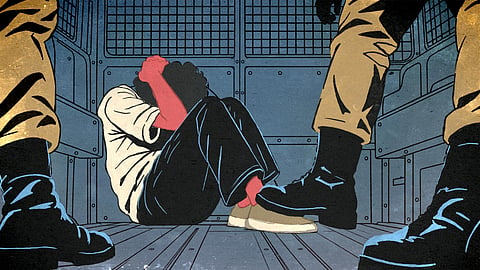
I saw this firsthand while sitting inside the blue, mesh-windowed van the police usually uses to ferry prisoners and undertrials between prisons and courts.
Detained on Sunday evening (October 11), I saw three policemen pummel almost everyone who boarded after me: two stood at the van’s door at the back, and the third inside the corridor, which opened into mesh-covered, cage-like enclosures. Once each citizen entered the corridor, they were hit in the abdomen, elbowed hard in the back, kicked and worse. One youngster was pushed to the floor and beaten there. Another was viciously stamped on. These assaults were systematic, seemed to last roughly similar lengths of time for each person being detained, and served as the prologue to the shove into the cages.
Earlier that evening, at around 4 pm, while sloganeering against Chief Election Commissioner Gyanesh Kumar, Prime Minister Narendra Modi and Home Minister Amit Shah, a small group of student protesters from Disha Student's Organisation (Disha Chhatra Sangathan) was intercepted by Delhi Police at the junction of Panchkuian Road and Outer Circle at Connaught Place in central Delhi. Thereafter, while photographing the ensuing mayhem as Delhi Police bundled protesters into DTC buses and a convict van, I was picked up as well.
What follows is an eyewitness account of what happened.
We were first taken to Regal Cinema, where Delhi Police had used barricades to corral off half the width of Sansad Marg, along a stretch that seemed to run the length of Regal Building. Cops were stationed at its mouth on Outer Circle. Once inside, it was impossible to escape.
Once off the bus, men and women were separated. We were told to sit on the road where some protesters were already squatting. The women were taken deeper into the corral, and I lost sight of them. Our group would swell further. A slim 23-year-old who kept asking the police to let him go – “Papa naraaz ho jayenge (My father will get angry),” he told me repeatedly – came next. Then came a young man in a blue t-shirt. He said he was not at the protest, and that he sells tea. Yet others, as I would find, were not at the protest or were photographing it.
We sat there from about 4.30 pm. Around 5.15 pm, a senior police officer with half his shirt untucked announced we were being detained; that there was nothing to worry about; that we would be taken to a police station for some time, and then let off. This work, he said, would go smoothly if everyone cooperated. “Get into that van as we call you and we will get on our way as quickly as we can,” he said.
What we saw next, however, were selections. Of the 40 or so of us, the cops selected people seemingly at random. Instead of transferring us into the van row by row, they pointed at specific people. When asked about a youngster in his early twenties who, as he later told me in the van, had been coming to protests every day, a policeman said, “We will take Bhagat Singh in later.” Amongst the first to be selected were the march’s leaders and those who had argued with the police. “Some of them are trying to become netas,” said one policeman. “We will teach them a lesson.”

The van, incidentally, had to be boarded from the back. On either side of this door were two seats for police staff. Beyond the seat on the left, a barred metal door led into a passage that opened into four (as I counted in the dark) thickly meshed enclosures, each with two benches, and a smaller one with a single bench. These were cramped spaces. The corridor was no more than shoulder-wide; the larger enclosures were barely a metre long and appeared just a bit wider.
As the first set of youngsters climbed in, we first saw, from our vantage point about five metres from the door, the policeman to the right of the door put his hand on their necks, pushing them into the van. Thereafter, we could see the back of the policeman on the left moving as he did something that looked strenuous. “In the prison van, we were slapped, our private parts were kicked, we were thrashed,” Arjun Unnikrishnan, an activist and lawyer who was amongst the first to be taken into the van, subsequently told Scroll. “We were brutally, brutally assaulted in the bus where there was no place to run.” They were, he said, beaten by five policemen once inside the van.
As a cry went up that police personnel were beating detainees inside the van, the senior police officer intervened, telling his staff not to beat anyone. As we would find, that was performative, meant more to keep the group trusting (and, ergo, easier to control) than anything else. My turn to board the bus came once the first three enclosures had been filled – with about seven or eight people in each. I wasn’t beaten, but pushed into the fourth enclosure.
From there, I saw five of the next six who entered my enclosure get pummelled. This is how, a student sitting next to me said later, girls were beaten as well. Once seated across from me, the youngster called ‘Bhagat Singh’ by the cops said they had asked him why, despite being a Hindu, he was against Modi. “It will get worse once the van starts moving,” warned a 23-year-old law student with us. “That is when the beating gets worse.” The kid, afraid of angering his father, shushed them, saying: “Don’t talk! Or they will beat us again.”
Before we reached Regal, says this testimony, the police had already inspected several group members’ phones and deleted photos and videos, and even slapped a kid who resisted. Then, as we boarded, they took phones and put them in a bag by the door. This too, however, was subjective and erratic. Just as some had been made to board before others, phones were taken from most but not all. The reasons for collecting phones seemed twofold – to ensure the beatings wouldn’t get filmed; and, as we would figure later, to create additional harassment.
Around 5.45 pm, the van left the corral and, switching on its siren, moved rapidly.
As it crossed Dhaula Kuan and headed towards the airport, it began to look like we were heading for Dwarka. The van, however, hauled left just after the expressway and, after 10 or so minutes, we found ourselves outside the police station at the village of Chawala. It was 6.45 pm. After 10 minutes, the van fired up again and, after briefly retracing its route, took a right and headed deeper into the hinterland. It seemed to me our guards changed at Chawala.
Our new watchers were more humane. They stopped the bus on the roadside when some students needed to pee. By 7.35 pm, we were at a community centre in Pandwalan Khurd, about eight kilometres from Najafgarh and about 40 kilometres from Connaught Place. As though announcing its status as a detention centre, another saffron-coloured DTC bus stood there.
We got off in a queue and began waiting after giving our name, address, and phone number to police staffers who wrote them down. Detention can last as long as 24 hours, but usually ends in three to four hours. For the group, the initial moments were laced with apprehension. As I walked past the van, a voice called out, “If you know Kavita Srivastava, please tell her I am in this van.”
Over the next hour, that apprehension gave way to outrage. One of the detainees had a broken arm. He had been beaten with sticks inside the van, he told Indian Express.
There were others with injuries. One had blood on his nose. A Sikh boy’s chest was hurting, making him wonder if he had a fractured rib.
Additionally, after getting off the van, the group asked for its phones only to be told they were not in the van. Phones, said people detained earlier, are handed back at the detention centre. This time, though, the bag wasn’t there and no one was taking responsibility. “If the police in CP (Connaught Place) took your phones, why are you asking me?” said the officer in charge at the community centre. “Delhi Police took our phones,” the youngsters countered. As night fell, this became the primary flashpoint.
Without phones, the group said, they could not get home. Pandwalan Khurd is about six kilometres from the Dwarka Expressway. At 10 at night, there would be no local transport. Even if there were, in this age of UPI, few had hard cash to pay for the journey back home. The cops were unsympathetic, saying that, on getting back to Delhi, the group would have to go to the police station that had detained them.
This was harassment. Delhi Police had taken the phones without handing out any receipts. It also had no way of knowing which phone belonged to whom. Such hurdles were surmountable at the detention centre where no more than 30 or so phones had to be handed back, but the new ask – that the group check at Connaught Place – was callous. “They won’t help,” said one youngster. “They will just make us run around from one police station to another.” Connaught Place, incidentally, has multiple police stations: at Parliament Street, Barakhamba Road, Baba Kharak Singh Marg, Jai Singh Road, and elsewhere. It wasn’t clear at which of them the phones would be, or whether they might have been jumbled with other phones.
Around this time, the community centre suffered a power cut, which resulted in the police, perhaps fearing an escape, pointing two vehicles at us, pinning us in their headlights. It was that light the group used to photograph two of the injured – the one with the broken arm and the one with the blood on his nose. The police officer in charge had been told about these injuries but medical help had not arrived till then. If this delay was due to the distance between the community centre and the rest of Delhi, why had Delhi Police, despite knowing detainees were being beaten, sent them to a place where medical facilities were not easily accessible?
We walked around, sat quietly, or chatted with each other, all wondering when we would be allowed to leave. Phones were borrowed for quick calls to reassure folks back home. Some, like the minors, were petrified.
By 9 pm, lawyers from Dwarka were standing outside the gate — two lawyers in the group had reached out to the local Bar, PUCL had got involved, as had social media. By 9.30 pm, the group and the lawyers were shouting over the police to each other – and at the police. “One of us has a broken arm, and there is no medical treatment,” said the group. “Nor have we received food.” “Can you tell us why you have minors locked up inside?” shouted a lawyer from the gate. “Open this gate so that I can come inside to check how they are.” Negotiations started. To lift detention, could the group promise the police not to attend further protests, asked a lawyer negotiating with the cops. This was rejected by the lawyers in the group.
In the minutes that followed, as others in the group have said as well, the police took a more conciliatory line. Medical aid came. Apart from ushering us inside the hall, they first said food was being arranged and that the phones would come soon. We were next told all minors could leave. Then they added that anyone who wanted to leave could do so. Their reasons were understandable. The brunt of the protests was falling on the ground staff. “Our shift starts at 6 am,” one guard told me. “And I live 90 minutes away.” Complicating matters, we were not at a police station but a panchayat building pressed into work as a detention centre. In other words, the police could not leave till the detainees did. The catch: without their phones, most of the group was unwilling to leave.
Three of us – a middle-aged man from North Delhi picked up by the cops as he went about his business in Connaught Place; a coder from Kerala who was photographing protests after lunch at Kerala House; and me – left at 10 pm. The rest stayed back, demanding their phones and insisting Delhi Police drop them back at Connaught Place. We initially got into a police minibus – then into a cab arranged by lawyers – to drop us at the nearest metro station. Inching out of the gate, we saw lawyers, both from Dwarka and elsewhere, berating the police. All of them had roused themselves to help strangers.
Few of us see State violence – it is too structural and too hidden. Even those of us who get to see overt State violence usually catch only its aftermath. That evening, though, the group saw it unfold and heard the justifications in sync. “Police ki maar ka bura nahin maante (you shouldn’t get upset over this beating),” said one of the policemen after the van had filled up. This was police beating for moral improvement.
Working on this report, we asked Delhi Police to comment on the principal charges raised in it – detainees being beaten; female protesters saying they were beaten as well; bystanders being detained; phones being taken without paperwork and thereafter not returned; despite the beatings, the group being taken to a remote part of Delhi where medical care was not easy to find. We also shared what police staff had said to us, seeking its comment.
"Detention is a very old practice,” a legal scholar told me the next morning.
“They will take you very far away and keep you there for a while so that the day becomes futile.” What we have here, in essence, is an attempt at crowd dispersal and intimidation to discourage further civic action. This, after all, is the State flexing its muscle, showing you that it can, whenever it wishes, have your life dangling at its whim.
Last weekend, this wasn’t the only muscle the Modi Sarkar flexed. It also shuttered 45 metro stations, a climbdown from the 57 it had wanted to close; stopped all trains coming into two major train stations; and barred bus travel into Delhi. On Saturday morning, travelling down Mathura Road beyond Faridabad till KMP Expressway – a road chosen at random – I was struck by the absence of buses. That morning, over an hour and 50-odd kilometres, I saw a total of three buses heading towards Delhi.
“We drivers have a WhatsApp group,” said the cab driver who took me from Ballabhgarh to KMP. “That is how I know the police are stopping buses 50/70 kilometres well outside Delhi. They are also checking buses at barricades.”
Later that morning, employees of Haryana Roadways at Ballabhgarh also said they had been told not to sell tickets to Delhi. “This is astonishing,” said a Haryana Roadways employee. “People travel for many reasons, some of them very urgent. How can they stop people from moving around in their own country?” He then showed me the instructions they had received on WhatsApp.
Later that day, travelling on the Delhi-Kundli road in the north, I saw this pattern repeat itself. Hardly any buses were plying towards Delhi.
With detention too, Modi Sarkar and Delhi Police have doubled down. Even though protest is a democratic right, protesters – and even parliamentarians – have been beaten up. One also saw arbitrariness. As has been reported, several of those picked up were not even protesting. “This is an angry State lashing out,” the scholar said.
The million-dollar question is whether this intimidation is working. The people I met in Ballabhgarh, Palwal, and elsewhere did not blame protesters for inconvenience. Instead, they puzzled over the government’s over-reaction. “What is wrong if people protest?” I asked the cab driver, a 26-year-old who, given non-existent social safety nets in India, had to drop out of school at 16 to start supporting his family. “Why is the government so afraid of protest?” he asked.
At Pandwalan Khurd too, anger over beatings and the missing phones trumped fear. What developed there, over the three hours we spent there, was not intimidation but solidarity. There was a collective loss of fear about the police – as evidenced by youngsters arguing, around 10 that night, with the police officer in charge, demanding their phones. The police themselves were split. While policemen at Connaught Place were brutish, the ones at Pandwalan weren’t, even though their hours were as gruelling. “It was never like this,” a policeman muttered to me. “Things have got worse under the BJP.”
On the whole, India is now seeing a double movement.
On one hand, Modi Sarkar is quelling protests with rising ferocity to project normalcy/popularity. Its forms of suppression are evolving. In Connaught Place on Sunday, more right-wing goons were walking around. In addition, over the last month, Delhi Police has moved from pellet guns and nail-tipped lathis to more unobtrusive beatings inside its vans. As this too comes under the limelight, one wonders what happens next. “Length of detention is not likely to increase,” said the legal scholar. “They will then have to arrange for toilets and food. If they do not provide these, it will become an even bigger scandal. In this period, though, some people will become clear targets. They want to teach people coming out [to protest] a lesson.”
On the other hand, India is re-legitimising protest. As I saw in Ballabhgarh, Pandwalan Khurd, and elsewhere, media narratives trying to paint protest as anarchy are not finding takers. Instead, the idea that protest is a democratic right, coupled with anger over the expropriation of voting rights, is spreading in the regions I travelled through.
Modi Sarkar’s fear of protest – and Delhi Police’s ensuing brutal crackdowns – is merely adding to already deepening grievances.
We emailed Delhi Police a detailed list of questions on the beatings, the seized phones and the detention of bystanders. By the time this article was finalised, a day later, we had not heard from them. This report will be updated once we receive a response.
Follow TNM's WhatsApp channel for news updates and story links.