
Subscribe
More than the sheer exhaustion of the days and nights of poring over unending documents, what must worry a writer of any history has to be the presentation of it, the question of how to put it all in a book that will convey the excitement of discovering parts of a past no one had given much attention to.
Writer and journalist Josy Joseph appears to have managed that with his first two books—A Feast of Vultures on democracy and corruption in modern India, and The Silent Coup on India’s deep state. In his third, Birth of a Nation, Josy attempts to capture the enormity of the task that fell upon a nation forced to put itself together in those tumultuous weeks preceding August 15, 1947, when the British colonisers went away, leaving behind two new countries to grapple with the chaos of partition.
Not an easy endeavour for a writer of non-fiction, who cannot rely only on anecdotes. Facts and archival letters must be brought to the table and every line needs to be validated, making it hard for a writer to keep up the flow. Josy’s writing is beautiful, with alluring titles for chapters and little known facts that surprise you. Best of all, he keeps it short, the book itself and the chapters too.
In 227 pages, Josy manages to weave an engaging narrative around the birthpangs of a nation. The idea of India and Pakistan and how they would be governed had come through after a lot of back and forth between the states and the Congress and the British.
A year before India attained independence, in 1946, there was a Cabinet Mission Plan that proposed a weak Union government, to which the states need to submit only under the three areas of defence, external affairs and communication. We also learn about a plan to have a third dominion, apart from India and Pakistan, to be composed of the princely states that wished to remain independent. Some British officials were in favour of this, wanting a direct means to deal with the states, especially Travancore with its supply of thorium.
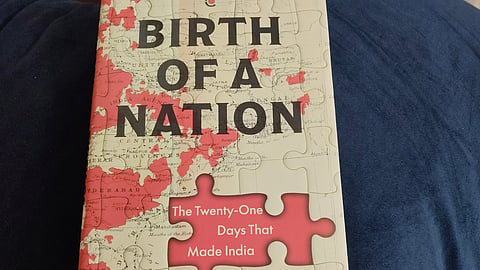
‘The twenty-one days that made India,’ says the book’s subtitle. Promptly, Josy begins on July 25, the day on which CP Ramaswami Iyer, the dictatorial dewan of the princely state of Travancore was attacked. The British had advanced their date of departure by several months, forcing the leaders of Indian independence to reach a hasty decision about parting into India and Pakistan, and getting the states ruled by monarchies to join either of the two dominions.
CP Ramaswami Iyer, known as Sir CP, was against joining either dominion, as had been a number of other princely states, Hyderabad, Bhopal, Junagadh and Kashmir foremost among them. They wanted to remain independent and carry on with the monarchies. The letters exchanged between them convey the sense of leadership CP had and the respect and faith the other rebel states placed in him.
The attack by KCS Mani on CP was widely perceived as an expression of a collective desire to end monarchy and usher in democracy. The Congress party, helmed by the likes of Jawaharlal Nehru and Sardar Vallabhai Patel, pulls out every trick to coerce the 565 states – so used to royal power – into submitting to a democracy. One one side were the proponents of a federal republic, and on the other dissident states, in favour of balkanisation.
Instead of dwelling on known figures like Louis Mountbatten, Nehru, Gandhi and Jinnah, the author guides the readers towards lesser known players, whose roles mattered a great deal. Conrad Corfield, who favoured the princely states and was instrumental in destroying years of documentation about them, gets a whole chapter.
The book informs us about the ‘spy’ in Hyderabad, a princely state ruled by Nizam, who kept iron man Sardar Vallabhbhai Patel, informed of his ruler’s every move. It also reveals the duplicity of another ruler who claimed he’d be the first to accede to the Indian Union but had other plans all the while.
Every one of these revelations makes the reader realise that bringing together hundreds of small kingdoms by convincing them to give up their powers was a humongous undertaking. In Josy’s own words it was about “creating the largest democracy in human history by forcing hundreds of ruling families to give up centuries of independent existence.”
What’s not quite clear in these pages is what the commoners thought—the ‘subjects’ as they were called. Did they want to remain independent in princely states, in the hope that monarchy may soon crumble without support, or did they want to join either of the unions in haste? Documentations dwell mostly on the communication of those that ruled, the people in power, not the person on the street. British Prime Minister Clement Attlee echoes this thought in a letter to Mountbatten: “Your broadcast seems to me suited to the Indian intelligentsia rather than the common people.”
You also wonder what the author’s thoughts are on this, while some of his adjectives may clearly point to a silent rebuke of the rebelling leaders and a rooting for the Indian Union. Aren’t there always hindsights when you imagine alternate histories—the what-ifs, that the recalling of history can’t help bring up. Josy, however, stays clear of these wild speculations.
