
Subscribe
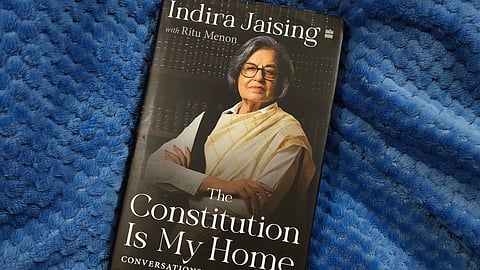
Every day she has entered a court, Indira Jaising has held on to the Constitution, finding herself at home in the little red book, decade after decade. True love, you think, as you turn the pages of her new memoir, The Constitution is My Home, and realise how the beloved veteran of a lawyer never ceased to pluck out elements from the Constitution to continue fighting for human rights, well into her 80s. In every chapter, she reiterates her faith in India’s Constitution, the one document she believes still holds power over the most powerful of people.
“When I say the Constitution is my home, I mean it in the deepest sense. It gives me identity, comfort and reassurance, because it acknowledges our shared past, our migrations, our comings and goings, our multiple homes and our common origin.”
Her lines like these, passionate and quotable, are sprinkled across the book, written as a conversation between Indira and the feminist writer and publisher Ritu Menon. Indira writes that she had been pushing the idea of a memoir away for a long time until it began to take the form of this prolonged interview. Ritu Menon, very methodically, takes you through Indira’s past, her most impactful interventions in the lives of women and working-class people that even an uninformed reader could find a rewarding exercise.
You are hooked as you read in the early pages about Indira’s mother, an illiterate woman who had moved from Karachi to Mumbai on her marriage, and determinedly learned much through books in the limited space that she was allowed to move. Watching her mother’s forced life had distanced a young Indira from the idea of marriage for many years. When she eventually found a partner, she decided not to have children, knowing how her work would take up all her time.
Those are among the brief excursions into Indira’s personal life that you get a glimpse of. The rest of the book sticks to several of her known cases - bracketed into the broad causes she has always fought for. Interesting titles are framed: democratic lawyering and secular lawyering, the lost years and who-is-a-citizen. She calls democratic lawyering the attempt to close the gap between constitutional promise and lived reality. She reiterates throughout the book the need to defend civil and political rights rather than advancing economic and social ones.
Among such fights are the case of the Air India hostesses who wanted to be supervisors, the Bombay hawkers union case, the pavement dwellers case, the Sabarimala and Triple Talaq cases, and the sexual harassment cases against high-profile men. Indira’s interventions have led to the creation of the Protection of Women from Domestic Violence Act, 2005, which came to the aid of countless women, abused and left without a home, as well as the Street Vendors (Protection of Livelihood and Regulation of Street Vending) Act, 2014.
Without fail, in her detailing of every one of these cases, Indira makes her reference to the Constitution. She is older than the Constitution, born seven years before India’s independence, and has memories of the midnight of freedom that came in August 1947. “I have come to see that there is one thing, and one thing alone, to which I owe my existence: the provision in the Constitution of India that says there shall be no discrimination based on sex,” she says in one of her admirably phrased answers to Ritu.
She is clearly intolerant of the minutest aberration in matters of gender bias, but absolutely practical in her approach to winning whatever kind of closure for the women in distress who approach her, knowing that this comes from a world too deeply entrenched in patriarchy. In the sexual harassment cases discussed in the book, one woman was content with undoing a transfer she was unfairly given after she had complained of sexual harassment by a powerful man. When you are familiar with the extremely taxing legal process - often described as more punishment for the victim - every little victory becomes a further step towards ending inequalities.
Indira is also clear about her desire to keep religion out of law. “In India, discrimination cannot be separated from religion. Religion is the hook on which everything hangs. It defines how we pray, how we love and have sex, whom we marry, how we raise our children, how we dress, how we deal with property and even how and what we eat. Religion becomes the framework through which hierarchy is maintained. And the law often reinforces it, instead of disrupting it,” she tells Ritu.
There is no mistaking how this reflects on her attitude towards the ruling party. Classic Indira, you muse, as she does not attempt to camouflage her distaste for the Hindutva ideology of the Bharatiya Janata Party, the many cases which have sprung up on the voices of dissent, the misuse of the draconian UAPA (Unlawful Activities Prevention Act) and even the judicial failure to remain independent of the executive. “Nothing in the Constitution is more precious than life and liberty, and both are today under threat, thanks to a dysfunctional or compliant judiciary,” Indira says.
The language can at times veer towards legal detailing, but the writers have mostly kept it straightforward. At 200 pages, and with the gaps and breaks afforded by a Q and A format, the reading of these cases, put in context, is not only unchallenging but fulfilling, given the hope it contains. Coming from someone who has closely witnessed the ‘transformations’ (as Indira calls it) that the differing governments have brought on, and fought tirelessly against the increasing suppression of rights, this faith in lasting hope is a comforting pat.
