
Subscribe
The Union government has released the draft Constitution (One Hundred and Thirty-Second Amendment) Bill, 2026, which proposes the delimitation of constituencies based on the latest Census. All states shall see a 50% increase in the number of Lok Sabha and Legislative Assembly seats.
According to the draft Bill, delimitation of Lok Sabha and Legislative Assembly constituencies’ boundaries will be done as per the latest Census figures, and will be frozen again until 2051.
The Bill expands the maximum strength of the Lok Sabha from 550 to 850. Under Article 81 of the Constitution, the upper limit for total members representing constituencies from the states will be raised from 530 to 815. For union territories, the number will go up from 20 to 35.
The composition of each state Assembly, previously capped at 500, has been proposed to go up to 650 MLAs.
The Bill text frames delimitation as a constitutional requirement to implement 33% reservation for women in Lok Sabha and state Assemblies. It says, “The implementation of reservation of seats for women is linked to the constitutional scheme of readjustment in the allocation of seats in the House of the People and the Legislative Assemblies and re-drawing boundaries of territorial constituencies by the Delimitation Commission.”
The Delimitation Commission, as defined in the Election Commission of India website, is a high power body whose orders have the force of law and cannot be called in question before any court.
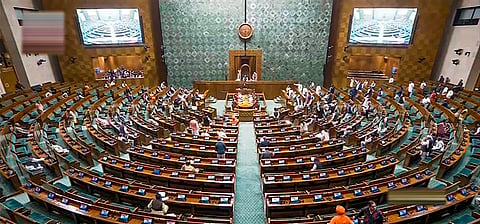
The Constitution Amendment Bill is to be tabled in the Lok Sabha on Monday, November 30, in a special sitting announced by the Union government on November 26.
The BJP’s previous attempt to pass the delimitation Bill was defeated in the Lok Sabha in April.
For a Constitution Amendment Bill to be passed, it requires a two-thirds majority among the members present and voting. The Constitution (One Hundred and Thirty-First Amendment) Bill, 2026, was defeated with 211 out of 489 members who were present voting against it.
This was during a special session convened while election campaigns were underway in several states. With the political atmosphere having changed since the election results were declared, the BJP hopes to get the required two-thirds majority of those present and voting.
Back then, the Bill did not include a written provision to increase the seats for each state uniformly and not on the basis of population, but simply proposed increasing the total strength of the Lok Sabha to 850. Though Union Home Minister Amit Shah had given an oral assurance in this regard, MPs from multiple states objected, seeking the provision in writing.
When asked for the reason behind expanding the Lok Sabha to 850 seats, Amit Shah had said that the idea was to expand the previous Lok Sabha by 50% so that when one-third of the seats set aside for women were accounted for, the remaining two-thirds strength would be similar to the original strength which are occupied predominantly by men.
The DMK and NCP are likely to support the bill as 50% increase and a 25 year freeze are among their primary demands.
With political defections of Members of Parliament from TMC, AAP and Shiv Sena (UBT), the NDA’s numbers have been bolstered.
Follow TNM's WhatsApp channel for news updates and story links.
