
Subscribe
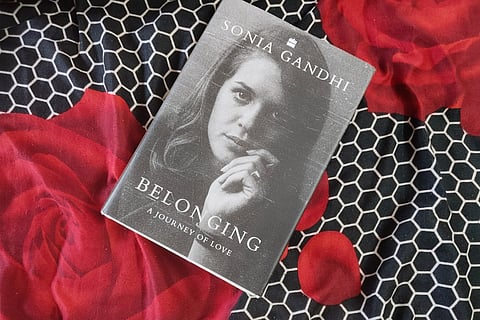
The picture in your head, as you read Sonia Gandhi's Belonging, can at first be black and white and grainy like the front cover, of her young face looking at an India of nearly 60 years ago, when she first came here for love. The picture gathers colour as you read on and find Sonia at home in India, slowly and almost hesitatingly growing into the Congress veteran she has become. Just like in politics, she seems to have inadvertently captured her extraordinary life, without really wanting to, in her from-the-heart memoir.
The book, selling like it had been awaited forever, though it was announced only earlier this year, may have that kind of pull because it comes from one of India’s most important political figures. But it is her writing that sustains that pull and keeps the reader turning the pages. When nonfiction has this kind of effect it is lazily lauded as reading like fiction. But Sonia’s life, overwhelmed with untoward incidents, could easily have become a chaotic mess on paper. One has to imagine that it is her artistic bent of mind (she writes about losing herself in museums) that brought order to the writing, placing in forefront the personal life that almost helplessly slips into the political.
The way she begins makes you wonder if she simply dived into her past and picked up her first memory of Rajiv Gandhi and their meeting in an English cafe. She was 19, he 21, just bereaved of his grandfather Jawaharlal Nehru, the first Prime Minister of India. But Nehru and Indira Gandhi, Rajiv’s mother and yet another Prime Minister-to-be, do not come into the picture until later. Sonia keeps it personal for many pages, almost cheesily so, describing their days of courtship and her feelings for the young and handsome man, who at times, lost his temper. She details her childhood, growing up in fear of her disciplinarian dad, who can seem like an Amrish Puri of Indian Cinema, only he is in Orbassano of Italy, towering over his subdued wife and three daughters.

It might be difficult to picture Sonia, the seasoned politician we have grown used to, as spending a regular middle class childhood in an Italian small town, and cowering in fear of her father. She waits too long to tell her parents about the relationship with Rajiv and when she does, predictably, all hell breaks loose. But in time, he allows her to visit India - to know the country as Rajiv insists Sonia should before planting her life there - only to be maddened by their hasty marriage.
This is where you are introduced to the dominating presence of Indira Gandhi, the formidable mother-in-law that Sonia, subtle as she is with her words, manages to convey an image of. Sonia writes she was shocked by the suddenness of the wedding and pained by her father’s absence but nothing about what she did about it. You wonder if she questioned Rajiv, if she opposed it. Her timidness is something that she keeps worrying about, that would trouble her even in her later years of politics. It comes through in the unquestioning way she accepted that it would be she who made the move to a new country and adopt and adjust and not Rajiv. You don't even hear what she wanted to work as, her ambition or passion. The only time she lets herself whine is when she has to lose her family name, her last thread to where she came from. There is not the tone of reproach, and even at the places she admits being hurt by one in the family, she hastens to justify their actions or words.
When the story shifts to life in India, the personal fades into the background and the political emerges. At first it is mere observation, learning of a new way of life, a new country, new people, and the governance of it. She makes no secret of having hated a life in politics and wanting no part of it for Rajiv or herself. She explodes when he decides to leave his beloved job of a pilot and plunges into politics as his brother Sanjay passes away. At several stages of her life, she looks back longingly at that old life, devoid of such fears and anxieties, and you wish for her that things had not gone the way they had and Rajiv had remained a pilot who loved photography.
But even as she is honest about her feelings, she is cautiously curtailed in her descriptions of the family’s disastrous actions that would cost many lives and choke the democracy she sings praises about. One of India’s darkest times, the Emergency declared by Indira Gandhi, is written about like an objective piece of reporting, minus all the adjectives (viz. brutal) that she uses profusely when one of the family or members of the party are at the receiving end. Even as she tucks in a line or two about its horrors, it is a watered down version of the catastrophe. Her preceding passages even allow a line of justification for Indira, as not having an option, since that would destroy Congress and pave the way for the divisive forces of the RSS and the BJP. Almost naively Sonia does not question if Indira’s solution was to suspend democracy. Indira, who was so far presented as tough and unyielding, seems to crumble in the face of losing power and later, before her own flesh and blood, Sanjay Gandhi.
Sonia is also disappointingly subdued in her writing of Sanjay Gandhi’s atrocities that brought so much havoc, including his forced vasectomies in the garb of family planning and the demolition at Turkman Gate. The only time she is liberal with her criticism of a family member is when she writes about Sanjay’s young wife Maneka Gandhi (who would later join the BJP).
In Rajiv Gandhi’s case - the reluctant politician and Prime Minister - Sonia’s justifications of the scandals that scar his image appear to come from a genuine place of trust. But then she skims through the Bofors case, insisting on his innocence, without dwelling into the details. Even as she strongly condemns the anti-Sikh riots of 1984, she vehemently vouches for his 'just and compassionate ways' that would never allow him to authorise such heinous acts. She does not skip the controversies, including the Shah Bano case and the opening of the Babri Masjid for Hindu prayers, but gives a clean chit to her beloved every time.
Her fears about his life from the very first time he goes into politics melts your heart, and the inevitable death you know is coming only makes the description of the preceding days sad. It becomes all too relatable when she keeps blaming herself for not joining him for that last trip to Madras, after he had asked her to, in which he would be killed.
Sonia could, more with sincere emotion than any technique of writing, have your heart racing as you read about her daughter Priyanka Gandhi knocking on her door urgently to pass on the news. She switches to the present tense to set the tragedy in real time, recounting the moment by moment shock of it. That she would fall and fall badly is a given. Sonia has unhesitatingly presented herself as a sensitive being, prone to tears, not bothering to project an iron-lady image in the ilk of her mother-in-law. She turns verbose in writing about the bond she holds with her children, Rahul who too enters politics after choosing another life, and Priyanka, who stands steadfastly behind her.
Even her decision to go into politics, a world she had wholeheartedly hated, seems to come more out of a sense of duty, because of her love and commitment and ways of obedience, than sheer will. But this does not portray her as a weak woman, only honest and unafraid to be so in this late telling of her story at the age of 80. Her strength in fact comes in these unrestrained but polite revelations. You have to shake your head when even in her passage about Narendra Modi, the BJP Prime Minister and political arch-enemy of the Congress, she tries to find a pattern, a reason for his ways. Not that she minces any words in her ‘polite’ criticism of the right wing or its many devastating actions and communal agenda.
Sonia is clearly a leader who grew into her place, something that she wasn't naturally inclined to, but trained herself to. It begins from learning to love a new homeland she is planted to, amid so many towering personalities and tumultuous events, adapting with a lot of effort, picking a new language, absorbing a new culture and making India her own. Yet, after all that, she is most let down, not because she had to give up the Prime Ministerial post she’d won fair and square, but because she is still not recognised as one of us. If not for the 500 pages of her memoir, just her telling title can say so much about what has always been so close to her heart.
Follow TNM's WhatsApp channel for news updates and story links.