
Subscribe
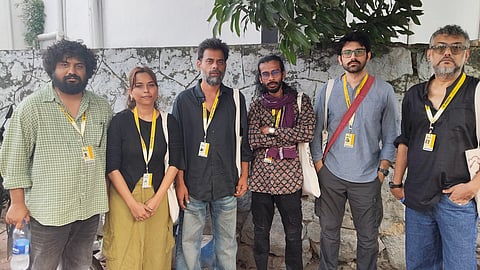
Standing in a group at the Kairali Theatre complex in Thiruvananthapuram, wearing black and looking dejected, are filmmakers and crew members of some of the films that were not allowed screening at the International Documentary and Short Film Festival of Kerala (IDSFFK) this year. They are hoping to meet the newly appointed chairperson of the Kerala Chalachitra Academy, actor Ravindran, to present their case.
No reason has been given for not allowing the screening of eight films, including five in the competition section, at the IDSFFK. The Union Ministry of Information and Broadcasting had initially denied censor exemption to 31 films selected at the fest, but after the government of Kerala wrote seeking permission, 23 of these were approved.
“We hope to meet the chairperson and ask for an explanation on why our films were denied approval. The IDSFFK is very important for us, and two of my previous films have won awards at the festival. This year I finished my film on time for the IDSFFK because this is the only place – if my film is good enough – it will be shown, it is almost like an Indian stamp that gives you confidence. It was last Sunday that I got an email saying that the festival committee has not got permission to screen my film, but I was still welcome to attend the festival,” says Spandan Banerjee, whose long documentary Parliament Street is among the films that are being denied screening.
Parliament Street and four of the other films that have been rejected are in the competition section of the festival. “We are asking if at least the jury will have a private screening of our films since they are in competition, or else will the entire competition be cancelled because how is it fair otherwise?” Spandan asks.
His film focuses on an artistic venture called People Tree, founded by artist Orijit Sen, which had been running on Parliament Street in Delhi for 33 years. Spandan shot his entire film on May 8, 2023, the day the shop had to close down, which also happened to be the day the new Parliament building was inaugurated. His film was submitted for the IDSFFK before May 2026, which was the deadline for submissions.
Spandan mentions the dates clearly to say that the film has nothing to do with the student protests initiated by the Cockroach Janata Party on Parliament Street this year. This is under the assumption that that must have been a reason that the Union government took issue with the film. However, the entire filming and even the submission happened much before.
Along with him are makers of the short documentaries Sanitised Republic and The Mali and the Parasite, which too are in the competition section and have been disallowed a screening. Afiya Khalid and Rizwan Rahman made Sanitised Republic on sanitation workers at Delhi hospitals who were promised permanent employment during COVID-19 but lost their jobs later. Their film focuses on contractual labour and the relationship between caste and sanitation work.

“This is the third film festival for which our film has been denied permission for screening, because of the same objections by the Union Ministry. They wanted us to cut a few references to the Prime Minister of India. We cut them and sent the film again. They asked us to further cut down some references, and we did that too. Even after that we didn’t get an exemption order. It is not about us as filmmakers but the film is important and we should leave it to the audience to decide if they like the reference. We had hoped that the film would be screened in Kerala, that’s why we came all the way. We are requesting that the film be at least watched by the jury,” says Afiya.
The Mali and The Parasite is about a group of Adivasi and Dalit communities in Odisha who resisted their displacement by a corporation called Vedanta Limited. “The Odisha government signed an MoU with Vedanta and hundreds of hectares of land were given on lease for 31 years. Resisting that, a collective of people fought against the corporate’s exploitation of the Sijimali Hills for four years. The film is about their fight,” says Sankaraa, director of the film.
The filmmakers feel that censorship has become more rampant in recent years, after the Union government singled out Anand Patwardhan’s Reason in 2019, for which he had gone to court and won a favourable verdict. The film was on the killing of rationalists in India in the years before.
The filmmakers at this festival also thought of approaching the court but the court is closed for the weekend, and even if they win a favourable verdict, it will be too late to get a screening at the festival, which ends on September 30.