
Subscribe
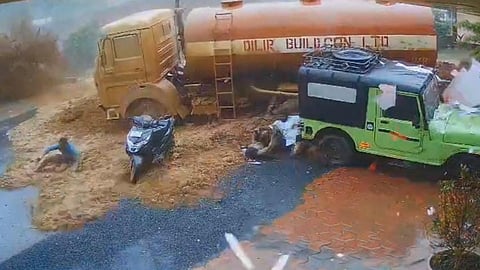
When a mountain of excavated soil came crashing down onto the Meenakshi bridge near Kalladi near Meppadi in Wayanad on July 7, sweeping away a tanker lorry and claiming at least three lives, it also exposed the callousness towards disaster preparedness despite clear warnings and official alerts.
Unlike the two earlier landslides that have struck Wayanad's natural Western Ghats slopes in recent years, this one happened at a site entirely shaped by human activity — a mound of tunnel-excavated soil stored beside a live construction project in an ecologically sensitive region prone to landslides.
Less than two weeks before the collapse, on June 25, a high-level PWD delegation inspected the Anakkampoyil-Kalladi-Meppadi tunnel project site along with officials from the District Disaster Management Authority, the State Environment Impact Assessment Authority (SEIAA), and the Konkan Railway Corporation Limited (KRCL), the executing agency.
The findings were stark enough.
The huge pile of excavated soil posed a risk of soil piping and soil instability, according to minutes of the meeting released by the PWD. The retaining wall and tarpaulin covering built by the contractor were not considered adequate protection against water seepage.
The KRCL was told to reduce the height of the pile. Officials also said that, in the event of heavy rain, families living near the Meenakshi bridge be moved to safety as a precaution.
Sources in the district administration said Dilip Buildcon was asked to stop work at the site on June 27. There is already a standing instruction to stop construction activity during the monsoon.
"There was no activity happening at the site for the past four days. On July 7 an engineer and a few of their staff went to the area where the soil was dumped to facilitate drainage of rainwater. Four people impacted by the mishap were security guards at the site."
A district administration official said they had identified a land near the construction site where the debris could be safely stored. TNM couldn't verify if the land was actually handed over to KRCL, which wanted the soil for their own use.
The KRCL's own response to the delegation revealed the scale of the problem: the project had generated roughly one lakh cubic metres of excavated soil, and the corporation said it had been unable to find suitable land to relocate it and requested the district administration to help solve the issue.
Noorudheen, a former member of Meppadi panchayat said the authorities were aware of the possibility of a tragedy and had asked the contractor to remove the soil. "They couldn't find a suitable land. The soil had been accumulating ever since the work began and the pile had become really high," he said.
Two weeks later, that same pile is what came down.
Chief Minister VD Satheesan and Agriculture Minister T Siddique, who holds charge of Wayanad district, placed the blame squarely on the contractor, Bhopal-based Dilip Buildcon Limited. They alleged that the company had ignored district administration orders to clear the accumulated debris from the site.
Dilip Buildcon has denied the charges, instead attributing the collapse to exceptionally heavy monsoon rainfall in Wayanad and maintaining there was no technical lapse on its part.
Badushah, an environmental activist based in Wayanad, who had moved the court against the project, said local residents were wary of the soil that accumulated in the area. "The government and authorities cannot get away blaming the contractor alone for this mishap. It was crystal clear that the region is not suitable for such a project," he said.
The construction work on the tunnel project intended to connect Kozhikode and Wayanad districts began in August 2025 and received final environmental clearance from the Ministry of Environment, Forest and Climate Change in February 2026. Controlled rock blasting started on March 6, formally launched by former Chief Minister Pinarayi Vijayan, ahead of the state Assembly polls.
For residents near the project site and families of the workers still missing, the Kalladi mishap was an avoidable tragedy, one that was flagged, in writing, weeks before it happened.
Follow TNM's WhatsApp channel for news updates and story links.
