
Before 2016, catching Pinarayi Vijayan with a smile was not an easy thing for photojournalists. He was taciturn and measured his words every time he spoke to the press, with enough pauses in between. No one knew the kind of fish he liked for lunch or the fact that he was fond of Tolstoy’s Anna Karenina or Victor Hugo’s Les Miserables. His public persona, shaped by the media, was that of the hardened party man: ideologically rigid and unfriendly.
Shortly before he assumed office as Chief Minister of Kerala, the CPI(M) leader felt the need for an image makeover. Kairali TV, the party's official channel, roped in Sreenivasan – the most maverick among Kerala's popular film personalities – for an interview aired in May 2016, shortly after the LDF's victory. It helped that Sreenivasan hailed from Patyam in Kannur, and that his father was known to Vijayan's father. Both were in their elements: Sreenivasan, the witty and vivacious interviewer, was eager to squeeze out juicy anecdotes. Vijayan, the hard-nosed politician, played ball, letting out his soft side, including his childhood fear of ghosts
It was soft-focus all the way, with no hard questions on his politics. But Sreenivasan was fearless in his repartees, his body language confident. Vijayan, who sat with his wife, opened his heart, dispelling his media image of being rigid and disdainful. Here was a man capable of warmth, humour, and vulnerability — qualities the public had never associated with him.
The years that followed witnessed the unsmiling disciplinarian transform himself from party apparatchik to mass leader and crisis manager with a caring face, catalysed by a series of unprecedented disasters that struck Kerala: the 2018 floods, Nipah, and Covid-19. His daily 6 pm press briefings during the pandemic – providing data, health advice, and emotional reassurance – turned him into a household figure. The Captain who leads, the Pater familias.
Three years later, in 2019, Prime Minister Narendra Modi timed his own apolitical interview with actor Akshay Kumar, sharing details of his personal life and making the world wiser about his love for mangoes and other such inanities. The format was identical. A friendly celebrity, no adversarial questions, and a carefully curated reveal of the 'human side' of a leader perceived as authoritarian.
But well before Pinarayi Vijayan or Narendra Modi, the credit for capitalising on political stagecraft during election time should go to the Congress in Kerala. In 2011, Jai Hind TV, a channel linked to the party, aired a freewheeling conversation between Oommen Chandy and Mohanlal, held at Cantonment House. The programme was curiously named Iruvar, after a movie in which Mohanlal played a politician. It set the template: the affable leader, the beloved actor, the warm exchange that felt more like a fireside chat than an interview.
Cut to 2026. Ahead of the Kerala polls, Cliff House, the Chief Minister's official residence, hosted a similar pseudo-event, later aired on February 26 by multiple channels. The PR honchos who designed it failed to recognise that the Chandy interview had already been branded Iruvar, and opted for the same name. Whether this was an oversight is unclear, but the fact that it was a rerun of a page from their own playbook defused Opposition criticism.
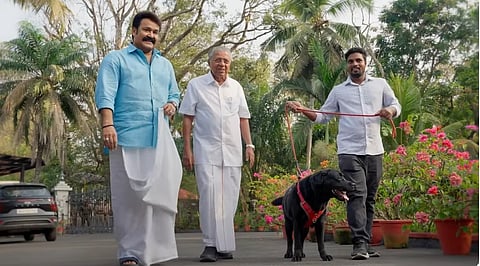
Pinarayi Vijayan grew emotional about his mother, spoke of a rival politician's plan to kidnap his children, discussed pets – a black Labrador called Robin – childhood struggles, hobbies, and favourite movies. Some of it was a repeat of the Sreenivasan interview, repackaged for a new election cycle.
Mohanlal appeared nervous throughout and seemed keen to elicit Vijayan's spiritual side. Vijayan obliged. He spoke about having read books like the Ramayana and Krishnapattu to his mother. "Maybe that brought in me a detachment from desires, like a monk," Vijayan, seeking a third term for himself as the Chief Minister, told Mohanlal.
The actor kept pressing him to sing a few lines — a request that was, we are made to believe, put off multiple times. Towards the end, Vijayan half fulfilled the wish by reciting a Sanskrit sloka on god residing in his heart, taught to him by a school teacher. "It's from the Upanishad and it's for you," Vijayan told Mohanlal.
There were no Leftist shibboleths. It was all wise-man vibes from a relatable father figure who might be an atheist and a Marxist but still draws his life philosophy from the archives of Hinduism. Pearls of wisdom, one could argue, aligned with Marxist humanism, yet one that sends unmistakable signals to a broad demographic who might share the same spiritual values.
Soft-focus interviews help politicians with a grandiose self-image who suffer from the insecurity of a likability deficit to rebrand themselves from a psychologically safe space. Add to the mix a popular actor who will not steer off-script and pose adversarial questions, and it ensures the projection of a wise, relaxed leader.
He appears to open up, but only on terms that have been pre-negotiated. The celebrity interviewer provides the validation that cuts across political affiliation. The audience is invited to witness a carefully choreographed intimate event, which itself is the news.
Pinarayi Vijayan's PR managers undoubtedly succeeded in placing him at the centre of electoral conversations in the state as the LDF government seeks a third term. TV channels once again became transmitters of a pre-packaged PR product, with little effort to interrogate the substance behind the sentiment.
Whether this dependence on the ideology of Lalism will help Pinarayi Vijayan in yet another image makeover remains to be seen. But one thing is certain: Mohanlal, the Complete Actor, is definitely in need of one. His nervous affect and his eagerness to please did not make for compelling television. If anything, the interview raised questions about celebrity endorsement of politicians, especially when they have nothing to do with their ideologies. It's only recently that Mohanlal began associating with the CPI(M) for political events. Everyone knew his political sympathies lay elsewhere. Even his shoulder tilt, which Lal himself called a manufacturing defect, is towards the right. A better choice perhaps would have been Kamal Haasan, with whom Vijayan shares a rapport.
The Mohanlal-Vijayan collaboration did not end with Iruvar 2.0. A recent video, purportedly an advertisement for the Kerala State Road Transport Corporation (KSRTC), released by the state's Public Relations Department, also features Mohanlal reminiscing about trips he has undertaken on KSRTC buses and wishing for a better future for the beleaguered public transport entity. The video feels less like a public service announcement and more like surrogate campaign material. It ends with the tagline, "Keeping left for safety and comfort" — a phrase that works as a traffic safety slogan only if one wilfully ignores its unmistakable political subtext.
The soft-focus politician interview is here to stay. But those who value the role played by the Left in Indian politics should be deeply worried when they try to blur the line between political communication and entertainment and their tallest leaders are sold as products through celebrity endorsement.
