
Subscribe
“I am Dr Asha Achy Joseph; a woman who has survived sexual assault at the workplace.”
These were the opening lines of a powerful column by documentary filmmaker and academic Asha Achy Joseph, in which she publicly identified as the complainant in the sexual assault case against former MLA and producer PT Kunju Muhammed. Through the column, published in Malayala Manorama in February, she was waiving the right to anonymity accorded to sexual assault complainants by law.
In the column, and in multiple interviews afterwards, Asha is clear about why she chose to come out publicly. The use of terms like “victim” and “survivor,” she wrote, made her feel as if society was attempting to erase her basic right to exist as an individual. No woman, she said, should be silenced in the name of protection or safety. By raising her voice now, she hoped another woman might feel a little less afraid about speaking out tomorrow.
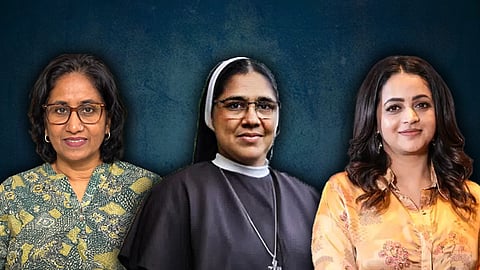
In deciding to reveal her identity, Asha joined two other complainants in high-profile sexual assault cases in Kerala: Sister Ranit MJ, the nun who accused the then bishop Franco Mulakkal of rape and revealed her identity in January this year, and Bhavana, the well-known actor who was abducted and sexually assaulted in 2017.
Their stand is yet another reminder that “shame must change sides” — the powerful phrase used by France’s Gisele Pelicot, who waived her anonymity in 2024 during the trial of her husband and 50 other men accused of drugging and raping her, transforming her into a global icon.
But the choices made by Asha, Sister Ranit, and Bhavana also raise difficult questions in India. If adult survivors wish to publicly identify themselves, why does doing so remain so complicated? Does the law meant to protect them sometimes end up limiting their agency? And how should society view these decisions – as individual acts of courage or as a reminder that more women are not enabled to make this choice?
To examine these questions, TNM spoke to lawyers and activists including Flavia Agnes and Supreme Court advocate Vrinda Grover, as well as former Supreme Court judge Justice Madan Lokur, who was part of the bench that issued key directions on protecting the identities of sexual assault survivors.
The right to anonymity — and the right to waive it
A survivor’s decision to renounce anonymity is never easy. But it can be empowering, and help challenge the stigma that continues to surround women who complain of sexual assault and rape.
“When women are able to speak out publicly, it helps to take away the stigma — why should they hide their identity when something wrong is done to them? A lot of women we work with ask why they should hide their identity,” says lawyer and women’s rights activist Flavia Agnes.
At the same time, she adds, the process itself needs to be simpler for those who wish to exercise this choice, including in cases where the survivor is deceased. “I don’t see why the provision of anonymity has to remain when the survivor is dead. What (alleged) honour is there to protect then?” Agnes asks.
Three years after the 2012 gangrape and death of a student in a moving bus in Delhi — whom the media had dubbed “Nirbhaya” — her mother publicly said: “My daughter was Jyoti Singh and I am not ashamed to name her… It is the offenders who should be ashamed and hide their name… From today, everyone should know her as Jyoti Singh.” Yet she continued to be widely referred to as Nirbhaya.
Even when survivors or their families wish to waive anonymity, the process can remain bureaucratic and state-controlled, says Supreme Court advocate and human rights activist Vrinda Grover.
“We talk of how women must have agency to waive anonymity, or how her family must, but no family can do this easily,” she says. “The law tries to behave as if it’s this great protector. But under that garb, the state and the courts actually snatch away their agency to take this decision.”
Section 228A of the IPC (now Section 72 of the Bharatiya Nyaya Sanhita), introduced in 1983, makes the publication of the name and identity of victims of rape and aggravated sexual assault a punishable offence. Complainant confidentiality is similarly mandated under the Sexual Harassment of Women at Workplace (Prevention, Prohibition, Redressal) Act, 2013.
Exceptions are allowed only with the written authorisation of the survivor. If the survivor has died, permission must be obtained from the next of kin through the head of a “recognised welfare institution or organisation”, a term that is not clearly defined.
These provisions were introduced in response to the deep stigma attached to rape and sexual assault in a patriarchal society, says Vrinda. “There was a notion that rape was a fate worse than death. It was a shame society cast on the victim instead of offering support.”
In 2013, Suzette Jordan in Kolkata famously came forward to reveal that she was the “Park Street rape victim.” "Why should I hide my identity when it was not even my fault? Why should I be ashamed of something that I did not give rise to?” she had told the media a year after the crime.
Suzette, who passed away in 2015 due to meningoencephalitis, had also said in another interview: “I am tired of hiding my real identity.”
In 2018, then Supreme Court judges Madan Lokur and Deepak Gupta, in their judgement in the Nipun Saxena case, issued a series of directions reiterating the prohibition on publishing the identity of rape survivors in the media. At the same time, the judgement acknowledged that survivors who choose to reveal their identities can inspire others.
“If an adult victim has no objection to her name being published or identity being disclosed, she can obviously authorise any person in writing to disclose her name. This has to be a voluntary and conscious act of the victim,” the judgement stated.
Justice Lokur, who co-authored the ruling, tells TNM that the requirement of written permission exists to prevent false claims of consent. “A person may say that he or she has permission to use her name and this may be false — how do you keep a check?” he asks.
Asked whether written permission must be sought repeatedly in cases where survivors have already publicly revealed their identities — such as Sister Ranit, who has given multiple interviews using her own name, or Bhavana, who identified herself as the survivor through a public Instagram post — he clarifies that it is not necessary.
“Provided it’s a public or media interview by the survivor or if the source (like a social media post) is available publicly, it’s fine (to use their name),” he tells TNM.
Ultimately, he adds, the decision must rest with the survivor because they bear the consequences of the crime. “The survivor gets ostracised for no fault of theirs, people point fingers — there are even instances of families disowning them.”
The need for support systems
The kind of support a survivor has access to is also crucial in determining whether they feel able to waive anonymity. “Much depends on the support structure they have. It’s easier to come out if that exists,” says Flavia.
These decisions, adds Vrinda, are not taken in isolation, but are contingent on the kind of support society provides. “Every person has to make this decision depending on her individual circumstances, not just their socio-economic location but also the kind of support she is getting.”
Complainants who have come forward publicly have themselves spoken about this. Despite pressure from the Church, Sister Ranit had the support of five nuns who stood steadfastly by her through the tumult, and her complaint sparked public protests against the accused in Kerala. Asha, who is also a founder-member of Women in Cinema Collective (WCC) formed after the assault on Bhavana in 2017, has said in interviews that such decisions cannot be taken without support.
But while the actions of these survivors are courageous, Vrinda cautions against framing them as acts of individual heroism. “It places too much of a burden on the woman,” she points out.
Rather, she views these recent decisions as illustrative of where we stand as a society. “We have not moved forward enough for all girls and women to be able to stand up and say, ‘I was wronged’.”
The agency to take that decision must remain with the woman, she adds. “But the responsibility is on all of society to enable her to make that decision.”
