
Subscribe
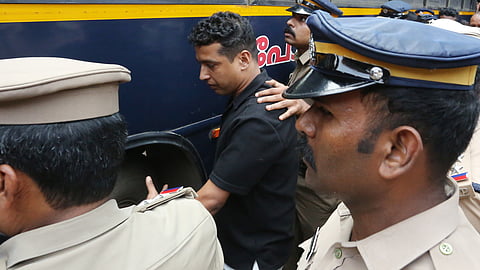
Pulsar Suni and five others convicted in the 2017 Kerala actor abduction and sexual assault case have been sentenced to 20 years of rigorous imprisonment each — the minimum sentence prescribed for gang rape — by the Ernakulam Additional Special Sessions Court (SPE/CBI–III). All six were also fined Rs 50,000 each, and the court ordered Rs 5 lakh in compensation to the survivor.
Special Judge Honey M Varghese said the circumstances didn't call for ”maximum sentence,” considering that all six accused were below 40 years old and only one had criminal antecedents. The judge also issued directions to investigating officer Baiju Paulose to ensure the safe handling and preservation of the memory card containing the assault visuals.
Calling the assault a “supreme violation of the dignity of a woman,” the judge added that while punishment must act as a deterrent, the sensational nature of the case “cannot influence the mind of the court”. She stressed that sentencing cannot be shaped by public pressure: “The court shall not be carried away by sensation or bias.”
The sentencing comes three days after the same court acquitted Malayalam actor Dileep, who had been accused of masterminding the crime.
Suni (A1), Martin Antony (A2), who was driving the survivor’s car the night of the assault, B Manikandan (A3), Vijeesh VP (A4), Salim H alias Vadival Salim (A5), and Pradeep (A6) were found guilty of criminal conspiracy, kidnapping, use of criminal force, and gang rape.
All six were additionally convicted under Sections 66E and 67A of the IT Act for recording the sexual assault on video. For the IT Act offence under Section 67A, Pulsar Suni received an additional five years of rigorous imprisonment and a Rs 1 lakh fine. The court also sentenced A2, Martin Antony, to three years of imprisonment and a fine of Rs 25,000 under Section 201 of the IPC, which deals with causing the disappearance of evidence or giving false information to screen an offender.
The judge allowed both Pulsar Suni and Martin Antony to serve their multiple sentences concurrently. The time the convicts have already spent in jail would also be reduced from the total sentence.
Emotional appeals inside the courtroom
Ahead of sentencing, the convicts made emotional pleas before the court and sought leniency in punishments. Pulsar Suni told the judge that he had no one to care for his elderly mother.
Martin, repeatedly breaking down in court, insisted he had not acted wilfully. “I have never committed any crime. I don’t even have a petty case against me,” he said, claiming he had already spent time in jail for a crime he didn’t commit. He also told the court that his ageing parents were in poor health and depended entirely on his income. Folding his hands, he said, “The money I earn is how my family sustains itself. Please understand my innocence and let me go.”
Manikandan also claimed he had no role in the conspiracy and that his wife and two children, aged nine and two-and-a-half, relied solely on him.
Vijesh, the fourth convicted, sought a lighter sentence and requested to be housed in Kannur jail, which is close to his hometown, Thalassery.
Salim and Pradeep also maintained that they were innocent.
Prosecution seeks maximum punishment
The prosecution urged the court to impose the harshest possible sentence for the convicts, not less than 20 years and extendable to life imprisonment, potentially for the remainder of their natural lives, along with a fine.
During arguments, Public Prosecutor Aja Kumar said the judgement should send a message to society, and therefore, the maximum punishment was warranted.
He also invoked the Delhi gangrape and murder case of 2012, more widely known as the Nirbhaya case. He said the case established that all accused in a gangrape must bear equal punishment.
Judge Honey M Varghese responded that while punishment could serve as a deterrent, a judgement itself was not written for society, nor shaped by what society wanted.
She also noted that while Suni committed the act of rape, the others did not commit it, though they played essential roles in the abduction, confinement, and facilitation of the assault. She said this distinction needed consideration during sentencing.
Responding, Public Prosecutor Aja Kumar argued that in a criminal conspiracy, it does not matter who physically commits the crime; all participants are equally responsible. He added that facilitation by other convicts was crucial in the crime.
“If the others had not confined and restrained the survivor, Suni would not have been able to commit the crime. Hence, all should be held accountable with the same gravity,” he added.
Suni‘s lawyer says not ‘grave’ rape
Pulsar Suni’s lawyer, Pratheeksh Kurup, argued that the present case was not like the infamous 2012 Delhi gang rape and murder — commonly known as the Nirbhaya case — after which the Justice Verma Commission amended criminal laws.
“In that case, each accused raped the victim and even used several objects. But here, the act was not as grave. The maximum punishment doctrine is for cases like that of Nirbhaya. The actor assault case is different, and the act is not as grave,” he argued.
Pratheeksh also said that in a case where Suni was earlier accused of attempting to abduct an actor, he was let go. The counsel was trying to establish that Suni has no history of such cases.
Advocate KV Sabu, who appeared for A5 and A6, Salim and Pradeep, said this case is a good example to award less punishment to the accused who did not commit the rape, considering mitigating circumstances. He also argued that A5 and A6 do not even have petty cases against them and that they should be punished in proportion to what they did. He further said that there is no bar for the judge to award a sentence lesser than the minimum punishment. He prayed that his clients be let off, considering the time they already served in prison
Actor Dileep, who was the eighth accused, charged with criminal conspiracy and the orchestration of what we know to be the first case of ‘quotation rape’ (hiring someone to rape a woman), was acquitted by the court on December 8.
The case pertains to the abduction and sexual assault of a prominent woman actor in a moving car in Kochi on February 17, 2017.
While Pulsar Suni was arrested a few days after the assault, the investigation led to Dileep’s arrest on July 10, 2017, on suspicion of a larger conspiracy.
The trial began on January 30, 2020, and unfolded over nearly five years. Special Judge Honey M Varghese was appointed in 2019 after the survivor sought a woman judge. Later, the Kerala government and the survivor made repeated requests to replace Honey Varghese, citing alleged bias. But the pleas were rejected at various judicial levels, including by the Supreme Court.
The final phase of the trial involved testimonies from more than 200 witnesses and detailed forensic analyses.
Read our detailed coverage of the Kerala actor assault case over the years here.
