
Subscribe
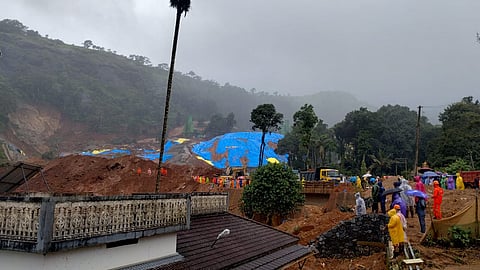
Uprooted trees are still visible at the landslide scarp at Meenakshikunnu in Kalladi, where a massive debris flow of excavated soil was triggered on July 7 — a sign that the crown of the landslide was in a forest patch, and did not stem from the slope failure of accumulated material, as initially reported.
The scarp is the steep, exposed surface of soil or rock left behind by a landslide.
Dileep Buildcon Ltd (DBL), the contractor building the Aanakkampoyil-Kalladi-Meppadi twin tunnel, has relied on this to deny responsibility. After a state minister described the incident as a man-made disaster and accused the company of "illegally and unscientifically" storing excavated soil while ignoring directives to shift it, DBL argued that the breach occurred outside the area under its control.
Displaying a pre-landslide image of the excavated soil partly covered with tarpaulins, Sebastian, an official with the DBL, said the soil stored by the company had been secured and that the breach occurred 10 to 12 feet above its jurisdiction, on forest land.
Ashique Ali U, Divisional Forest Officer, south Wayanad, confirmed that the landslide crown was indeed within a forest patch.
Around 17 hectares of forest land were diverted for the project.
“The landslide occurred at Bit 22 in Meenakshikunnu. But this is part of the forest area handed over for the project," he said. In forest management, a “bit” refers to a designated sub-area of a forest range.
Chief Minister VD Satheesan, who has ordered an inquiry into the cause of the landslide and suspended the work on the tunnel project, has said that this aspect would be examined by the panel before action is taken.
According to environmentalists, while DBL is technically correct in saying the landslide occurred in a forest patch, neither the company, the Konkan Rail Corporation Ltd (KRCL) which awarded the contract, nor the Kerala Public Works Department (PWD) can deflect responsibility, as it occurred close to the tunnel mouth in a landslide-prone area that had been handed over to the project proponent.
Yet, dodging responsibility was the only game that the state’s top ministers and company officials appeared to play after the mishap, which left at least seven people dead, all workers from other states, and injured nine others.
The game of blame-shifting
On the day the tragedy struck, Agriculture minister T Siddique lost no time in calling it a man-made disaster. “This is not a natural landslide. It is a man-made one that happened due to unscientific dumping of excavated earth,” he said. This sentiment was echoed by Home minister Ramesh Chennithala, a senior member of the Cabinet.
When TNM sought Siddique’s response to DBL’s denial, he pointed to the presence of shotcrete — sprayed concrete used to stabilise slopes — and excavated soil in the debris. “So it’s not right for DBL to say this happened because of a landslide in the forest area. There are several other violations as well. No permission was sought to dump the excavated soil, and they are also saying they were not given permission to test the forest soil. If they didn’t get permission, they should have stopped the work.”
Public Works Minister PK Basheer, meanwhile, said his department was not to be blamed for the landslide as the project was executed by the KRCL and funded by the Kerala Infrastructure Investment Fund Board (KIIFB). “PWD has no stake in it,” he told reporters in Kalladi on July 9.
However, project documents show otherwise.
The twin-tube tunnel road between Anakkampoyil in Kozhikode and Kalladi in Wayanad was born out of a tripartite agreement signed between KRCL, K-PWD, and KIIFB. While KRCL awarded the Engineering, Procurement and Construction (EPC) contract to DBL, the PWD is a signatory to the project.
Opposition Leader Pinarayi Vijayan, who fast-tracked the project as chief minister, when the Left Democratic Front (LDF) was in power, accused the UDF government of failing to avert the disaster by not removing the excavated soil. However, the mound of excavated earth had existed even before the United Democratic Front (UDF) assumed office and had long been a source of concern for residents of the nearby estate paddy lines.
“They have all been trying to point fingers at each other ever since the tragedy happened. It only shows that the concerns we raised were valid,” said Thomas Ambalavayal, a member of the Wayanad Prakrithi Samrakshana Samithi (WPSS), which challenged the Environment Clearance (EC) granted to the project before the High Court and the Supreme Court.
In April 2026, the Supreme Court had refused to interfere with a petition filed by the WPSS, citing the project’s “national importance.” When the counsel for WPSS pointed out that the tunnel was coming up in an ecologically fragile area prone to landslides, the court said the Expert Appraisal Committee (EAC), which evaluates large-scale projects, had accorded approval subject to various safety and structural conditions.
Thomas said the July 7 landslide is evidence that the project’s environmental safeguards need scrutiny, even as there is need to fix responsibility for the failures on part of both the contractor and the administration in preventing the disaster.
Despite the mishap, there is a groundswell of support for the project in Meppadi town. “It is clear that Siddique, who is in charge of Wayanad district, is also supportive of the project,” Thomas alleged.
The WPSS now wants the state government to register a case against DBL over its alleged lapses and blacklist the company. It has also demanded an investigation into the previous LDF government’s role in securing the Environment Clearance, alleging that it misled the Union Ministry of Environment, Forest, and Climate Change (MoEFCC) and obtained the clearance without an expert study.
Did the soil heap pose a risk?
Vishnudas CK of the Kalpetta-based Hume Centre for Ecology and Wildlife Biology suspects the landslide was triggered by human intervention.
“The slope where the incident occurred has exposed rock with sparse tree cover. Due to (excavated) soil accumulation, the natural drainage path for the runoff was affected. The rainwater that flows downhill would have infiltrated the soil heap through cracks on the shotcrete used for stabilisation,” he said.
A geological and geotechnical assessment carried out by the Geological Survey of India (GSI) along with TUMAS and DBL, between June 3 and June 11 at the tunnel’s north portal also throws light on the hazard posed by the site in the event of intense rainfall.
The assessment noted that the cut-and-cover section comprised a thick overburden of predominantly silty soil with low to medium plasticity. “The soil mass appears to possess relatively poor drainage characteristics, resulting in slow dissipation of pore-water pressure under prolonged rainfall conditions,” it said.
To stabilise the overburden slopes, the project used benching, followed by mesh-reinforced shotcrete and soil nailing. Soil nailing and shotcrete are geotechnical techniques used to stabilise steep slopes. While soil nails reinforce the ground internally by inserting steel bars, shotcrete involves spraying concrete onto a surface to improve its stability.
Despite these measures, the assessment found that continuous heavy rainfall had progressively saturated the overburden mass, leading to the development of multiple instability signatures, including widening tension cracks, earth slumps, erosion, cavity formation, and discharge of turbid seepage water. It also found that only a few drain holes were functioning effectively, indicating inadequate drainage.
The report further warned that cracks could deepen and allow more water to seep into the slope, while underground water flow indicated internal erosion. The risk conclusion was categorical: “Progressive weakening of the overburden slope could lead to localised or large-scale slope failure if conditions continue.”
Ramla Hamsa, president of Meppadi panchayat, said the local body had flagged concerns about the danger posed by the excavated soil heap to residents of the nearby estate paddy lines more than two months before the landslide.
“We had also taken up the issue of the Kalladi stream being contaminated by the excavated soil. People couldn’t use the water as it turned muddy, and DBL agreed to provide tanker water to residents of Ward 8,” she said.
The 181st meeting of the State-level Expert Appraisal Committee (SEAC), held on March 1, 2025, had also stressed the need to examine the possibility of increased landslides risk through a detailed evaluation of the causes and impacts of previous incidents. The committee pointed out that the project area falls within an environmentally fragile region comprising Environmentally Sensitive Area (ESA) villages and a high landslide hazard zone.
It also said the project should evaluate the anticipated impacts of activities during both the construction and operation phases using adequate scientific inputs.
While the twin-tunnel project was estimated to cost Rs 2043.74 crore, it failed to earmark the cost of implementing an Environmental Management Plan (EMP) in the ecologically fragile region. The SEAC observed that while KRCL submitted an additional report showing Rs 15.04 crore as EMP cost, the amount did not appear to be adequate, given that additional precautionary measures might become necessary as the project progressed.
Safeguards mandated by SEAC
Recognising the ecological fragility of the terrain, which falls within an ESA, the SEAC had directed the project to adhere to the Precautionary Principle and put in place multiple monitoring and safety measures.
They included:
A micro-scale mapping exercise to identify landslide-vulnerable zones, to be conducted by an experienced institution and approved by the Disaster Management Authority.
Regular monitoring of these critical zones by an Environmental Management Committee (EMC) to be set up by the project proponent, with findings reported to the local grama panchayat and the District Disaster Management Authority, while also publishing the maps on the project website for public access.
Automated weather stations with telemetry at the tunnel’s northern and southern ends to issue warnings during extreme rainfall and halt tunnelling work when necessary.
Four automated Ground Vibration Monitoring Stations, including one each at the south and north portal, to track seismic activity. The EMC was to manage this system and share data regularly with district authorities and the grama panchayat, with results also posted publicly online.
However, Meppadi panchayat authorities were unaware of any such monitoring system being in place and said they had not received any data from the project authorities.
Notably, the SEAC conditions also stipulated that muck should be disposed of without adversely affecting the local communities, and that no groundwater should be used. These, too, were violated.
The state government has now appointed an Expert Committee to probe the causes of the mishap but environmentalists are wary of the probe yielding accountability. WPSS in a statement said the role played by PWD officials also need to be probed.
"VD Satheesan was critical of the Wayanad tunnel project when he was in the Opposition. But the Budget presented in June had proposed another tunnel connecting Chooralmala and Pothukallu with token allotment. So we are not sure he would continue to display the same commitment," said Thomas Ambalavayal.
Follow TNM's WhatsApp channel for news updates and story links.
