
Subscribe
The Karnataka state government’s recent minimum wage hike—which will likely spur consumption and increase economic security for workers—has triggered a strong backlash from private employers. However, labour activists say that the wage hike has the potential to boost the local economy while at the same time increasing social and economic security for workers.
The Karnataka Labour Department headed by Labour Minister Santhosh Lad issued a notification on May 22, hiking the minimum wage for 83 types of employment. This includes 18 employments which are being brought under the ambit of the minimum wage for the first time. With Rs 21,251 per month at the lowest end of the spectrum and Rs 34,225 per month at the other end, Karnataka has set the highest minimum wage in the country.
Labour Minister Santhosh Lad posted about the increase on X, saying that his department had hiked the minimum wage by 60%.
Sathyanand M, Karnataka state Secretary for the All India Trade Union Congress (AITUC), India’s oldest trade union affiliated to the Communist Party of India (CPI), welcomed the state government’s wage revision.
“The Karnataka government has taken a huge political gamble to raise minimum wages to the highest in the country. It’s a huge transfer of income from people owning the means of production to people who work for a wage,” Sathyanand said.
The 60% revision would mean that about one crore workers who are entitled to the wage hike in 83 types of employment would see a monthly increase of around Rs 6,000-Rs 7,000 in earnings. Workers in the lower end of the spectrum used to earn Rs 13,000 before the revision.
However, according to Satyanand, it’s not just the quantum of the increase that makes the decision important. “They've done it on a scientific basis for the first time, factoring in a non-vegetarian diet which was never done earlier along with other things,” he told The News Minute.
He said that the Karnataka government had “done well” to follow the guidelines laid down by the Supreme Court in Reptakos Brett in 1991. He said that the government had factored in the cost of various food items, rent, clothing, and also factored in the cost of education, medical expenses and care of the elderly after conducting a state-wide study.
On Wednesday, May 27, the Joint Committee of Trade Unions, comprising 11 trade unions which are active in Karnataka, held a press conference lauding the government for the hike but also warning against a rollback given the likelihood of change in political leadership in the state.
“Minister Santhosh Lad resisted immense pressure from two ministers from his own party to issue the order for the workers,” said Kalappa, national president of the Hind Mazdoor Kisan Panchayat (HMKP).
Referring to the possibility of the resignation of Chief Minister Siddaramaiah, Rama TC, of the All India United Trade Union Centre (AIUTUC), warned that all the trade unions would take to the streets if the new political dispensation withdrew the minimum wage hike.
Meenakshi Sundaram, general secretary of the Centre for Indian Trade Unions (CITU), pointed out that the 60% hike was in effect, actually only a 6% hike given that the last hike was almost a decade ago in 2016-17. Under the law, the minimum wage must be revised every five years.
Backlash from employers
The wage hike has triggered protests from the Karnataka Employers’ Association and other industry bodies who say that the revision will adversely affect them.
But is what is adverse for employers, adverse for the larger economy? This question is the point of fracture between neoliberal and Marxist economics. While the former claims that wage increments would trigger capital flight and push up inflation, the latter maintains that increased wages would boost consumption and therefore, production.
Sathyananda cited a study done in the US by economists David Card and Alan Krueger. David Card won the Nobel Prize in 2021 for “his empirical contributions to labour economics”.
“Using natural experiments, David Card has analysed the labour market effects of minimum wages, immigration and education. His studies from the early 1990s challenged conventional wisdom, leading to new analyses and additional insights. The results showed, among other things, that increasing the minimum wage does not necessarily lead to fewer jobs,” the citation said.
In their 1992 study Minimum Wages and Employment: A Case Study of the Fast-Food Industry in New Jersey and Pennsylvania”, studied outcomes in two US states, one of which had raised wages and one which hadn’t. They found that raising wages did not lead to employment loss.
Satyanand also argued that raising the minimum wage was demand-side economics which was “in the interest of the economy”.
“Consumption accounts for 60% of the GDP. You can only increase consumption if you put money in people’s pockets. Just because workers have now got Rs 6,000-7,000 more, they’re not going to start hoarding it in Swiss banks. These workers will spend money on goods and services which will increase aggregate demand, which will generate pressure on factories and officers to generate more goods and services. It’s a virtuous cycle.”
On the other hand, supply-side economics held that slashing corporate taxes and minimum wage would boost the economy, which Finance Minister Nirmala Sitharaman had already tried with no results, Sahtyanand said. The Finance Minister slashed corporate taxes from 35% to 15% but even that had failed to boost private investment. Simultaneously, Foreign Direct Investment (FDI) too has not materialised, which is now being pointed out even by commentators such as Surjit Bhalla and former Chief Economic Adviser Aravind Subramanian.
“Currently, the economy is running on two pillars—consumption from individual households and government expenditure,” Sathyanand said.
Entitlements, not guarantees
Union leaders point out that the state government’s treatment of women workers exposes the Congress party’s grandstanding on how it has improved the lives of women through the guarantees as a lie.
Two guarantee schemes Gruha Lakshmi (Rs 2,000 per month) and Shakti (free bus travel) directly affect women. While the extra cash and financial concessions have been shown to enable a measure of both economic independence and social freedom, the delay in notifying the wages for the remaining 19 types of employments strikes at their rights and dignity of women workers.
Among the 19 employment types, are industries whose workforce has historically predominantly been female such as garment, beedi, agarbatti and plantation.
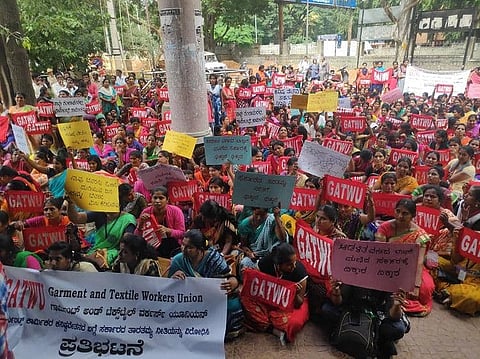
Pratibha R, Karnataka state president of Garment (GATWU), affiliated to the AICCTU, welcomed the wage hike and demanded an increase on par with the rest, for the garment workers and the other industries which had been left out.
She alleged that garment workers had historically had the lowest minimum wages in the state and had been fighting for parity. While the other types of work were paid Rs 18,000-19,000, garment workers had a Rs 13,000 monthly minimum wage.
“There was a 30% difference in minimum wage. All workers are the same, but only women’s work is paid less. The patriarchal mindset that women are second class workers hasn’t gone,” she said.
She also accused the Congress of hypocrisy for drawing mileage out of the guarantee schemes for women, while at the same time denying women workers a decent minimum wage.
“If the government had raised the minimum wage for garment workers, it would have been a permanent solution to their hardship. The government need not have given the guaranteed money, nor would workers need it. Now, workers are compelled to feel obliged to the government for that money. The congress will ask for votes during elections saying that they delivered on their promise. Instead, why don’t they increase wages and then ask for votes for that? They have no desire to do anything for the people,” she said.
