
Subscribe
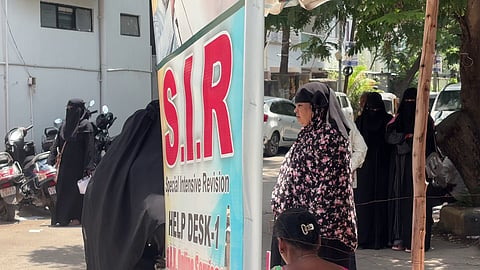
Less than a week into Karnataka's Special Intensive Revision (SIR) of electoral rolls, it has run into implementation-related concerns. Political parties have alleged that Booth Level Officers (BLOs) are not uniformly following the Election Commission's prescribed door-to-door verification process, while voters have expressed confusion over whether they need to furnish documents immediately, how the 2002 electoral roll is being used, and what happens if their names, or those of their parents, are missing from older records.
While the Election Commission (EC) says the revision is intended to clean up electoral rolls by identifying duplicate, shifted or otherwise ineligible entries, opposition parties and civil society groups argue that the process places an additional burden on voters to establish their eligibility and could disproportionately affect people with missing or inconsistent records.
In Karnataka, the SIR began on June 30 and will continue through July, with the draft electoral roll scheduled to be published on August 5.
What are the concerns?
The Election Commission has instructed BLOs to visit every household, distribute enumeration forms, and collect the filled forms through a door-to-door exercise. However, reports from different parts of Karnataka suggest that the process has not been uniform.
In Ramanagara, the Janata Dal (Secular) alleged that BLOs gathered voters at a wedding hall to complete the exercise instead of conducting house-to-house visits. The party also alleged that enumeration was carried out in the presence of political party representatives. Separately, a video circulated on social media purportedly showed a BJP Booth Level Agent accompanying a BLO during a door-to-door visit and distributing party pamphlets while enumeration forms were being handed over.
Chief Electoral Officer V Anbu Kumar told The Hindu that complaints of protocol violations should be reported to the respective District Election Officers, who have been authorised to inquire into them.
Chief Minister DK Shivakumar has said that conducting the exercise through mass camps is "illegal" and reiterated that BLOs must go door to door.
What is the confusion over documents?
One of the biggest sources of confusion is whether voters need to produce documents during the ongoing enumeration.
Election officials have clarified that no supporting documents are required at the current stage. During the ongoing door-to-door exercise, BLOs are only expected to distribute and collect the filled enumeration forms.
However, the Election Commission has also published a list of documents that may be accepted if a voter is asked to establish eligibility after the draft electoral roll is published. This has led many voters to believe they must begin collecting documents immediately, even though officials say these will only be sought if a notice is issued or if someone files a claim for inclusion.
The documents that will be accepted during the second stage include birth certificates, passports, educational certificates, government service or pension records, permanent residence certificates, caste certificates, family registers maintained by local authorities, and certain other government-issued documents.
What if your name is missing from the 2002 electoral roll?
Another point of confusion has been the use of the 2002 electoral roll as reference during the revision.
Many voters have reported that they are unable to locate either their own names or those of their parents in the 2002 rolls.
The Election Commission says this does not automatically make someone ineligible.
According to Karnataka Joint Chief Electoral Officer S Yogeshwar, voters can instead map themselves to other paternal or maternal relatives whose names appear in the 2002 electoral roll. The relative can be enrolled anywhere in India, and no documentary proof of that relationship is required at the enumeration stage.
If no such relative can be identified, the voter can apply for inclusion by filing Form 6 during the claims-and-objections period after the draft electoral roll is published.
What exactly is the SIR?
The Special Intensive Revision is a verification exercise of electoral rolls conducted by the ECI. Unlike the annual revision, every voter whose name appears on the electoral roll is expected to submit an enumeration form during the exercise.
According to the Election Commission, the objective is to update electoral rolls by removing ineligible entries while ensuring that all eligible voters remain on the rolls. After the draft electoral roll is published on August 5, voters will have a month to seek corrections, raise objections, or apply for inclusion before the final rolls are notified.
Similar SIR exercises in other states have generated large numbers of complaints. In West Bengal, lakhs of voters reportedly approached electoral tribunals alleging they had been wrongfully left out of the rolls and effectively disenfranchised.
