
Subscribe
The Karnataka government is committed to changing the alignment of the proposed Hebbal-Silk Board tunnel road to ensure it does not pass through Lalbagh, Bengaluru Development Minister Krishna Byre Gowda has said. Addressing a press conference on Wednesday, November 25, he said, “Alignment will definitely change; there should be no confusion about that. We have promised the people that we will go outside Lalbagh, and we are committed to that word.”
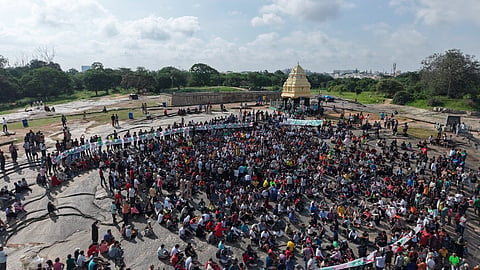
The original alignment of the North-South tunnel project included entry and exit points at Lalbagh, requiring the use of a portion of the botanical garden. The proposal triggered widespread protests by environmentalists, walkers and citizens concerned about the impact on the garden's ecological and geological heritage. In August 2026, thousands of Bengalureans gathered at Lalbagh, forming a human chain around the iconic Lalbagh Rock and demanding that the government drop the proposal to use park land for the project.
Speaking about the status of the project, the Minister said a survey was underway to assess alternative alignments and that the government had identified two possible locations. One of these would be finalised after evaluating the pros and cons and consulting stakeholders.
Asked why the government was delaying issuing the work order, the Minister said the government was simultaneously examining alternative routes and negotiating with the contractor to bring down the project cost. Adani Enterprises has emerged as the lowest bidder for this project.
“The Cabinet has decided to negotiate with the contractor, for which a committee headed by the Chief Secretary has been constituted. The committee includes officials from the Finance Department and the Public Works Department (PWD), among others. A couple of rounds of negotiations have already been held,” he said.
When asked whether the negotiations had resulted in a reduction in the contractor's quoted rate, he said discussions were still underway.
The Minister said the government would finalise one of the two alternative locations as soon as possible. However, he cautioned that moving the alignment away from the existing route could increase the project's length and, consequently, its cost.
“Currently, we have taken an optimum length. Now, moving away from that, if the length increases, we ourselves will have to bear the cost accordingly,” he said.
He also said that the government's contribution towards the project was fixed at Rs 7,000 crore, irrespective of the contractor's overall project estimate.
“Let their project cost be whatever crore; let them say Rs 22,000 crore, ours won't change. Let their estimate be anything; what the government gives is only Rs 7,000 crore,” he said.
However, a change in alignment could require fresh discussions on how the additional costs would be shared, he said. The revised proposal would have to be placed before the Cabinet for approval after the rate negotiations are completed. Only then will the government issue the work order, he added.
On the implications for commuters, the Minister said the toll would remain as fixed by the National Highways authorities, although the toll collection period could vary slightly following the alignment change.
He added that even after the work order is issued, the contractor would require considerable time to mobilise resources before construction can begin.
Environmental concerns and public consultation
Bharatiya Janata Party (BJP) MP Tejasvi Surya, who represents Bengaluru South, welcomed the proposed realignment away from Lalbagh, calling it a partial victory for the citizens' movement to protect the city's green spaces and heritage.
Thanking the thousands of citizens who protested in August 2026, he said, “This is an initial victory for the people of Bengaluru. I thank every citizen, environmentalist and expert who raised their voice to protect Lalbagh. The sustained public movement has demonstrated that in a democracy, the voice of citizens must prevail.”
However, Surya cautioned that changing the alignment would not address the larger concerns surrounding the project.
“Moving the tunnel away from Lalbagh does not make the project scientific. Experts from IISc and other institutions have raised concerns about its impact on traffic congestion. The government must put the project's assessments and rationale in the public domain and engage in an open debate on its merits,” he said.
He also flagged the proposed Hebbal Short Tunnel's impact on over 3.4 acres of Hebbal Lake and raised concerns about the implications of the long tunnel project for Metro expansion, including the dropping of the Veterinary College station on the Red Line.
“Bengaluru cannot sacrifice public transport to accommodate projects that encourage private vehicle usage,” he said.
Environmental activist AN Yellappa Reddy, who spearheaded the protests against the proposed tunnel alignment through Lalbagh, questioned the basis for pursuing the project and called for public consultation and independent technical scrutiny.
“So what is the basis for persisting with the project? Otherwise, what is the criteria? It is only to help some car owners. And where are they going to dump the debris? How long will Bengalureans have to suffer, and who are the beneficiaries of this project? Is it not their moral responsibility to inform the general public and take their opinion?” he said.
Reddy also raised concerns about the impact of tunnelling on Bengaluru's underground water systems, saying the project required detailed scrutiny before being taken forward.
“How will the hydrological systems be ruptured? It requires a lot of technical scrutiny. It is a public property, isn't it? Public opinion is required,” he said.
He added that the government's approach could have electoral consequences, arguing that citizens were increasingly questioning the rationale behind such infrastructure projects and who stood to benefit from them.
Follow TNM's WhatsApp channel for news updates and story links.
