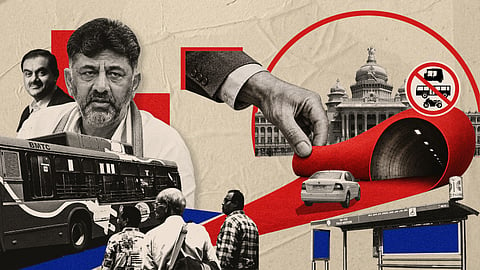
In the last three years, if there is one infrastructure project that has taken over the public imagination in Bengaluru, it is the twin tunnel road project. Pitched by Deputy Chief Minister-turned-Chief Minister DK Shivakumar as his “lasting legacy” for the city, the plan envisions two tunnel roads: one running from Hebbal in the north to Silk Board in the south, and another from KR Puram in the east to Nayandahalli in the west. It has been sold as the answer to a city choking on its own traffic and wrapped, like so much else, in the shiny packaging of ‘Brand Bengaluru’.
But the closer the project gets to reality, the more it has come to resemble a lightning rod. The government has already been hemmed in by a High Court order stating that any contract awarded for the tunnel project would remain subject to the outcome of the public interest litigations challenging it, with no equities to be created in the meantime.
That order effectively froze its plans just as it had zeroed in on Adani Enterprises as the lowest bidder for the North-South tunnel, a bid that came in at a staggering Rs 4,600 crore above the government’s own estimate of Rs 17,698 crore. Then, in the face of massive public protests, the government was forced to withdraw an amendment that would have opened up lands inside public parks for infrastructure, a second setback for what is often called Shivakumar’s “pet” project.
What makes these setbacks telling is the breakneck pace at which the government has tried to push the project through. The Detailed Project Report (DPR), the document on which a project of this magnitude is supposed to rest, was a rush job completed in just three months by Rodic Consultants, against an industry norm of nine to 12 months. It was a sloppy one too. The draft referred to locations in Maharashtra instead of Karnataka, earning the consultants a Rs 5 lakh fine from Bruhat Bengaluru Mahanagara Palike (BBMP), followed by another Rs 10 lakh for more errors.
Petitioners before the High Court say the DPR had no site-specific studies, no initial borehole drilling or on-site geotechnical testing, and a traffic model that left out two-wheelers and autos, which make up nearly 70% of Bengaluru’s vehicles. The government, it turns out, had called for bids to prepare the DPR before the feasibility report it was meant to build on had even been submitted.
IISc reports have warned that tunnel roads could merely shift traffic bottlenecks to new choke points rather than resolve the city’s congestion. The tunnels are meant only for cars, at a probable steep toll of about Rs 640 for a round trip between Hebbal and Silk Board, which means a project that claims to help the city “move forward seamlessly” would serve only a sliver of its people, unless the government subsidises it. And all this while the Metro’s Red Line crawls, the Suburban Rail project languishes at under 20 per cent progress, and BMTC struggles to meet the city’s basic bus requirements.
For a city choking on traffic, the question is what the government hopes to achieve with a project that would cater to a minuscule population of car owners, even as scientific assessments question its ability to ease congestion.
This story examines the legal challenges and financial and environmental implications of the tunnel project. Drawing on court petitions, government documents, the Detailed Project Report (DPR), and interviews with experts, activists and government representatives, it looks into the questions surrounding the project and the government's defence.
A chokehold called ‘Brand Bengaluru’
Talks about setting in motion plans for construction of two tunnel roads – North-South and East-West corridors – began as early as July 2023, a mere two months after Congress came to power in Karnataka. And the then Bengaluru Development Minister, DK Shivakumar set off a slew of projects, long tunnels, short tunnels, elevated expressways, flyovers, double-deckers, et al., to ease traffic congestion and decrease commute times—all in the name of ‘Brand Bengaluru’.
This blunt force approach has only succeeded in aggravating a city fatigued with constant construction, badly maintained roads, poor traffic management and the average driver’s penchant for lawlessness on the road. Commute times have been steadily increasing, and vehicular speeds have only been decreasing. Potholes and poor asphalting dot every road all over the city. Traffic management is often erratic, with police focus on tech-driven solutions not making any headway with the ever-increasing vehicular density.
The biggest casualty in the government's singular pursuit of the tunnel project has been the neglect of public transport projects. For instance, the North-South corridor of the tunnel project from Hebbal to Silk Board practically runs parallel to the Metro Red line or Phase 3A – a 37.8 km line from Hebbal in the north to Sarjapur in the southeast – which was announced by the BJP government in the 2022-23 budget.
That metro proposal has moved at a snail’s pace, while the government was practically ready to approve the more expensive tunnel project, catering to a minuscule population of private car drivers.
Right off the bat, the Union and state governments were in a standoff over the design for the line. The state government wanted a double-decker, a road and the elevated metro segment (23.52 kms), something the Union government objected to, as it would reduce the point of having a metro and increase costs. After much back and forth and consultations, the government scaled back on the double-decker and even removed a station at Veterinary Science College and brought down the costs from Rs 28,405 crore to Rs 25,999 crore for the 37.8 km stretch. This line has still not received Union government approval.
As recently as November 11, Bengaluru Development Minister Krishna Byre Gowda said that there was a demand for a double-decker on that corridor, and the state government would seek the PM’s intervention for approval of the line.
Even if that happens, the earliest the work would commence would be the end of next year, according to the state government’s estimate.
If the Adani bid moves forward, then we are looking at a tunnel road, whose cost will be Rs 1,329.37 crore per km, while it will be Rs 687.80 crore for the metro red line.
The most unfortunate of public transport projects has been the Bengaluru Suburban Rail Project. This is a 148-kilometre commuter rail network, covering four routes, and it is expected to carry 20 lakh passengers daily. The project took decades to get approval from the Union government. It was constantly set aside to give priority to Metro; the Indian Railways were reluctant to take it on since they treated this as a loss-making proposition, and there was general apathy, as no department took the lead in pushing it.
It finally got off the ground with the Union government’s approval in 2020. As of 2026, it is crawling at this stage, with only 19.95% of overall progress in physical terms and 20.66% in financial terms. The original deadline of October 2026 has been pushed to 2030.