
Subscribe
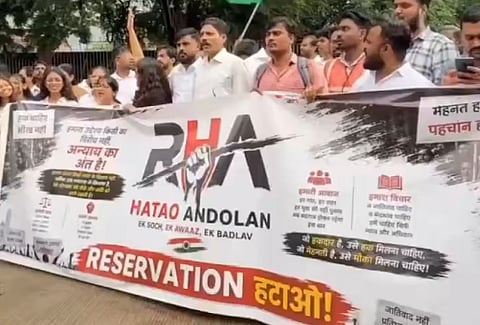
When the Cockroach Janata Party (CJP) protests put the Union government on the back foot, the big news channels along with several social media handles began a curious campaign against caste-based affirmative action to discredit the protests.
The explosion of anti-reservation content on social media and the establishment media’s focus on it at this juncture warrants a closer look at certain quotas that are never subjected to the same scrutiny as caste-based reservations—management quotas and the Economically Weaker Sections (EWS) quota.
In an ANI interview, CJP founder Abhijeet Dipke raised this question. “The way people talk about reservation, why do they not say that about management quota. All colleges have management quota, but why doesn’t anybody talk about that?”
Decades of political mobilisation by Ambedkarite, Dalit and tribal groups have made it impossible for anyone to outright question the need for caste-based reservation without inviting massive backlash.
The political philosophy underpinning caste-based reservation is to ensure inclusion. The management quota in private and self-financing colleges perverts the idea of universal education.
Its internal workings remain opaque, differing from institution to institution. But the sole qualification required to avail this quota is wealth. Seats provided through the management quota in professional colleges range from a few lakhs to a few crores.
This begs the question: Why does the management quota, through which lakhs of students get admission, never face the same vitriol directed at caste-based reservations?
Admissions to engineering and other professional courses are regulated by a complex system in which the total number of seats in private colleges are split into government seats, management seats (60%), and NRI quota. Under the management quota, in Karnataka, the Consortium of Medical, Engineering and Dental Colleges of Karnataka (COMED-K) gets a fixed number of seats which are regulated by the COMED-K entrance exam.
The cut-off marks put up on COMED-K’s website are illuminating.
For instance, a ‘General Merit’ student with a rank of 80,000 or 90,000 can study aerospace engineering, and a student with a rank of over one lakh could study artificial intelligence and machine learning.
This is a particularly delicious irony, given the Mandal era “joke” about an Indian space expedition having barely any astronauts because caste quotas had to be met.
The obverse of this joke among medical graduates of the CET era in Karnataka is that all students who failed their first year in medical school were management quota students.
Subhash, state treasurer of the All India Democratic Students Organisation (AIDSO), said that there was practically no concept of qualifying marks for medical and engineering courses when it came to management and NRI quota.
An engineering graduate himself, Subhash recalled that during the three years he taught at a private college in Bengaluru, the management simply admitted anyone who could pay the fees.
He said that about 40% of engineering seats in the case of Karnataka are completely unregulated in terms of who gets to study, as they are fixed as management quota. The more reputed colleges would snap up students with CET rankings of up to 60,000-70,000. But after that, it was a free-for-all. “As long as you pass pre-university, and write these entrance exams, that's enough. You can pay and get admission.”
However, another teacher at an expensive private university in Bengaluru that TNM spoke to said that the institution had set the qualifying marks at 80% at the pre-university level.
“They set it up a few years ago, and to the best of my knowledge, it has never been violated.” He believes the university did it out of necessity, because if students don’t have qualifying marks, the university results are affected. “What can the teachers do if large numbers of students fail?” he said.
A similar situation exists for medical seats, where today, the fact that one has appeared for the NEET exam is enough to study medicine in a private college as long as one has the money to pay for it.
The relaxation in minimum standards for students who are disadvantaged by their castes derives its legitimacy from the Constitution.
Parliament amended the Constitution in 2000, after the Supreme Court held in S Vinod Kumar v Union of India that relaxation of minimum standards with regard to promotions was not in line with Article 335 of the Constitution.
By the 82nd amendment, Article 335 of the Constitution gave the government to make any provision for SCs and STs to relax the qualifying marks, or standards of evaluation for reservation in matters of promotion. The 82nd Amendment was passed with minimal debate and overwhelming support: the Rajya Sabha passed the Bill 139–nil, while the Lok Sabha passed it 340–nil.
Selective application of merit
B Shripad Bhat, author of Unnata Shikshana: Olagoo Horagoo (Higher Education: Inside Out), cited two examples of how the idea of merit is selectively applied only to students or civil services aspirants from the Scheduled Castes, Scheduled Tribes and backward classes to portray them as undeserving of an education or employment.
He pointed out that in the civil services, the cutoff for the EWS quota was actually lower than that for OBC candidates. This includes the cutoff marks for preliminary exams, which determines who gets to write the main exams, and the main exams.
In 2025 the cutoff for the prelim exams for EWS candidates was 89, while it was about 92 for OBCs and General Category. The pattern holds for the main exam and the final exam.
The cutoff marks for the preliminary exam for people with disabilities ranged between 40 and 54. For the main and final exams, they were still significantly lower than the cutoffs for other categories.
Shripad pointed out that the EWS quota also enjoys income eligibility concessions, while the concept of creamy layer is applied to OBC reservations. Individuals whose annual income is Rs 8 lakh is eligible for EWS quota while an OBC individual with the same income is considered undeserving despite the recognition that caste inflicts disabilities on that person, Shripad said.
In the case of Karnataka, the EWS category is even more pernicious because in practice it almost amounts to exclusive Brahmin reservation, Shripad argued.
EWS quota applies to people not already covered by any other reservation, and in Karnataka, that leaves just five communities—Brahmin, Jain, Aryavaishya, Nagarthas and Modaliars.
Karnataka barely has any people from the Aryavaishya, Nagarthas and Mudaliars castes while the Digambara sect of Jains come under the OBC quota. “That leaves almost the entire 10% EWS quota for Brahmins whose population is 3%,” Shripad said.
The far right ecosystem
In less than two weeks, the rage against reservation that piggybacked on the anger against the NEET paper leak has only gained momentum.
A casteist reactionary response to the student protests which delegitimised the Modi government in an unprecedented manner is part of a larger growth in far-right movements seen the world over, according to Shripad.
He pointed to right-wing influencers such as Ajeet Bharti, who have been spewing anti-reservation rhetoric online since the protests began over the NEET paper leak.
“Now that Modi has been delegitimised, we’re seeing these movements grow in India. They want to bring Brahminism back. The fringe elements have now become prominent due to support from the government and the BJP… This is the most consolidated sentiment against reservations since the anti-Mandal protests.”
Television channels gave that fringe sentiment a platform and a push toward the mainstream.
After the first interview with NDTV on July 23 during which he launched into a tirade against reservation, student Harsh Dubey was invited to other channels where he continued his tirade. He has now called a protest on August 21 demanding “reforms” in reservations.
“People have been making videos for many years on YouTube demanding reforms, but no one heeded it because we did not take to the streets to protest. And we must protest now… We must take our rights, this must not happen to the next generation, this must not happen to our brothers and sisters. We must fight,” Harsh said.
