
Subscribe
Many A Thousand Years (English)
Night after night, when the curtains fall on their performances, two actors meet near a rock and wait. Nothing happens, nobody comes, nobody goes; it's awful. As it was for Vladimir and Estragon in Waiting for Godot, so it is for Mano and Gomi in Many A Thousand Years. Except, there is no Godot to look forward to, even if in vain.
The fourth major production by Kochi-based Rasa Theatre Collective, Many A Thousand Years attempts to explore the ‘waiting’ that is central to human existence, inspired by Samuel Beckett’s Waiting for Godot. It is written by Aparna Ashok and directed by Rahul Thomas.
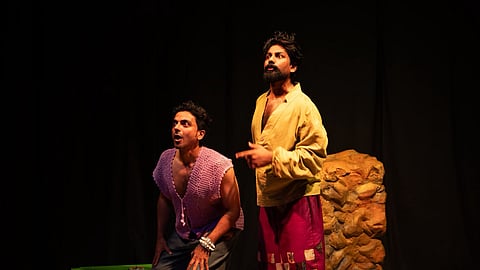
Rahul plays Mano, a theatre actor who transforms into Hamlet on stage, seeking an answer to the centuries-old question: to be or not to be?
Each night, as Mano washes off his makeup and removes his costumes, he is joined by another actor, Gomi, played by Abraham Vadakkan. Day in and day out, Gomi plays Bhima, who, with a swing of his mace, breaks Duryodhana’s thigh in the Mahabharata. The audience erupts in applause, the curtains fall, and Gomi resumes the wait for the next day.
Monotony is the norm of their lives. The play progresses through several nights during which the same two actors wait at the same spot and discuss the same things.
One night becomes indistinguishable from the next, and neither of them seem to know what they are waiting for. It is absurd theatre, and so the dialogues and gestures are bound to be repetitive and illogical.
The play makes an attempt to lay bare the psyche of the artist who craves both adulation and meaning. Gomi revels in the appreciation his craft receives, hungers for more, and seems aware that he is larger than himself when playing Bhima on stage. Even when off stage, he refuses to take off a bangle that is part of his Bhima costume. Mano seems to be chasing a perfection that is just beyond reach when he is shown trying different modulations for the same line or looking for a lost hat that was perfect for him.
The metatheatrical elements are not limited to the existential questions raised by the actors played by actors. The ‘stage’ leaves them notes, asking them to ‘Try again' or ‘Prepare’. The fourth wall is broken on more than one instance to invite the audience to ponder on the endless waiting that is life.
The invitations to join the existential reflections were rather in your face throughout the play, not just when the fourth wall was broken. There were one too many literary references, letting us know that the play intends to evoke existential dread in the audience. It seemed weighed down by the gravity of its philosophical questions, which were almost spelt out for the audience through the dialogue on many instances. Unfortunately, the forced efforts only seemed to have the opposite effect on the viewer.
One wishes the play wasn’t so conscious of its absurdist nature; that it would leave room for the audience to think and ask their own questions. The attempts at humour too fell flat on more than one occasion.
But that is not to say the play is without merits. There were several clever elements, like the arch drawn on the floor with white pebbles within which the performance unfolds, serving as a figurative salt circle marking the boundary between the artist and the world. Mano grabs a handful of pebbles on a few occasions and spreads them over the arch, as though reinforcing the boundary. At one point, Gomi tries to push past the limit, the arch of pebbles expanding to outline his straying feet. But such details may have escaped the notice of viewers beyond the first row, given that the stage and the audience were all seated at the same level.
Towards the end, Gomi discovers that the rock they sat near was scribbled with the names of others who had waited there before them. The actors read out the scribbled names, which include Albert Camus, Beckett, Vaikom Muhammad Basheer, and several others, as well as the names of audience members. ‘You are also waiting,’ the play tells the audience, again. But despite the bluntness of the message, it was a smart use of a stage property.
Both Rahul and Abraham bested each other in acting. Sujith V and Aravind, who handled the music and lights, respectively, made sure that the play was brought together well. The costumes by Merianna Kurian also deserve special mention.
Many A Thousand Nights premiered at the Ala Centre for Culture in Ernakulam’s Mulamthuruthy on November 22. Rasa Theatre Collective’s previous productions include Niyamavarthanam and Guards at the Taj.
Disclaimer: This review was not paid for or commissioned by anyone associated with the play. Neither TNM nor any of its reviewers have any sort of business relationship with the producers or any other members of its cast and crew.
Follow TNM's WhatsApp channel for news updates and story links.
