
Subscribe
Sumit Baudh’s recent piece seeks to invoke the writings of Dr BR Ambedkar to critique the focus on the right to self-identification of one’s gender, which is at the centre of current opposition to the 2026 amendment to the Transgender Persons (Protection of Rights) Act, 2019. However, the author seems to be unable to appreciate the significance of self-identification for the trans community, or its relationship to dignity, equality, and fraternity.
What is troubling about the article is its complete failure to acknowledge the current political context in which the right to self-identification has been taken away by the 2026 amendment. The author does not acknowledge that the amendment, albeit for different reasons, also treats self-identification as a bridge too far, and hence specifically repeals Section 4(2), which had recognised that a person “recognised as transgender under sub-section (1) shall have a right to self-perceived gender identity.”
Self-identification as a dignity interest
As the Yogyakarta principles note, “Gender identity is understood to refer to each person’s deeply felt internal and individual experience of gender, which may or may not correspond with the sex assigned at birth, including the personal sense of the body (which may involve, if freely chosen, modification of bodily appearance or function by medical, surgical or other means) and other expressions of gender, including dress, speech and mannerisms.”
It is this deeply felt experience of gender that lies at the heart of the ‘liberty’ interest. It cannot be limited by equality and fraternity, but should instead be strengthened by reference to these principles. As the judges held in NALSA v Union of India, “Each person’s self-defined sexual orientation and gender identity is integral to their personality and is one of the most basic aspects of self-determination, dignity and freedom and no one shall be forced to undergo medical procedures, including SRS, sterilization or hormonal therapy, as a requirement for legal recognition of their gender identity.”
As recognised in NALSA, self-identification is linked not only to freedom but also to dignity. It bears recalling that the word “dignity” finds a place in the Preamble of the Indian Constitution because of the insistence of Dr Ambedkar. As Aakash Singh Rathore demonstrates in his work, Ambedkar's Preamble: A Secret History of the Constitution of India, the Objectives Resolution moved by Jawaharlal Nehru did not include a reference to dignity. It was the Drafting Committee, chaired by Ambedkar, that introduced dignity into the Preamble.
Self-identification is therefore not just an attribute of liberty, but also an essential dimension of dignity. As such, it remains an irreducible aspect of personhood, one that cannot be limited to the question of benefits. This crucial dimension of self-identification the author fails to appreciate. If gender identity and gender expression are understood as part of dignity, then the question, as the author asks, should not be whether self-identification can operate as an “absolute principle” within law, but whether a core aspect of personhood can be subjected to legal restriction.
Beyond benefits: Misunderstanding equality
When it comes to the question of equality, the fundamental question is whether certain forms of gender identity and expression (particularly non-cisgender identities) are treated differently from cis forms of expression. If the answer is yes, the principle of equality requires that all forms of gender identity and expression be recognised on equal terms.
The author, however, limits the equality principle largely to the question of benefits, particularly while asking: “If gender identity is treated as wholly self-declared for all legal purposes, how should the state determine eligibility for targeted welfare measures or reservations?”
The relationship between fraternity, liberty, dignity, and equality is not conflictual, as suggested, but rather one that, when rightly understood, can enhance the rights of the transgender community. Self-identification of one’s gender as a dimension of liberty, dignity, and equality is the crucial starting point. Once individuals identify themselves, the possibility of forming a community emerges. The formation of the community is the actualisation of fraternity.
The criminalisation of fraternity
Dr Ambedkar’s dream of fraternity is specifically denied to the trans community under the 2026 amendment. Under Section 18(g), anyone who, by “allurement, inducement, or undue influence,” compels any person to “dress, present, or conduct themselves outwardly as a transgender person against the will of such person” may face imprisonment up to ten years and a fine of up to Rs 1 lakh.
A close reading of this provision suggests that it risks criminalising forms of support extended to those exploring their gender identity. To give an example, assume that Chris is a college student who is exploring his transgender identity. Chris reads online about a support group, Transgender Lives Matter, which he is keen on visiting to meet others like him. Those who run the group are not sure whether to allow him to attend, as his availing of their support in this manner may be construed as the offence of “allurement, inducement or undue influence” towards compelling a person to dress or present themselves as a transgender.
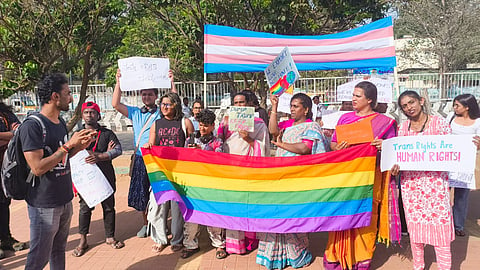
The 2026 Amendment thus hits at the transgender community’s right to liberty, equality, dignity and fraternity. It is for this reason that other social struggles, including women’s groups, Dalit movements, and civil liberties organisations, have stood in solidarity with the transgender movement in opposition to the 2026 amendment.
There is no doubt that the amendment runs counter to an Ambedkarite commitment to seeing these principles as interrelated and mutually sustaining. For that reason, the amendment must be opposed.
Arvind Narrain is an author, lawyer, and the President of People’s Union for Civil Liberties, Karnataka.
Views expressed are the author’s own.
