
Subscribe
For years, a familiar stereotype has followed Telugu youth: that they are more invested in cinema than politics. Social media timelines are routinely dominated by fan wars between followers of Telugu film stars, reinforcing the perception that young people in Andhra Pradesh and Telangana are more likely to defend their favourite actor than participate in political movements.
The stereotype resurfaced during the nationwide protests over the NEET-UG paper leak. As thousands of students occupied New Delhi's Jantar Mantar demanding accountability from the Union government, social media was flooded with posts mocking Telugu youth, suggesting that they were too busy arguing over films to join one of India's biggest student movements in recent years.
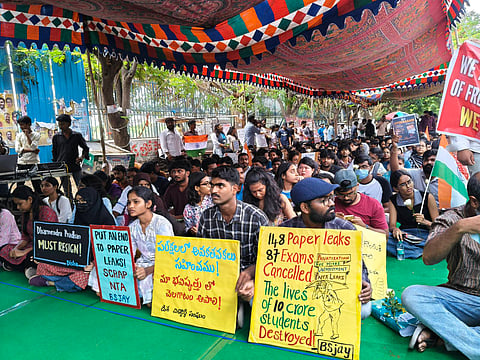
Yet, organisers and participants say that narrative overlooked what was unfolding across the Telugu states. While the protests in Telangana and Andhra Pradesh never matched the scale seen in Delhi or Bihar, they drew a noticeable number of first-time protesters, especially after the Delhi Police's July 20 crackdown on the Cockroach Janta Party's (CJP) Chalo Sansad march.
For many activists, the protests demonstrated something that history has repeatedly shown: political consciousness among Telugu youth never disappeared. It merely surfaces when issues resonate deeply enough.
For Hyderabad-based writer and activist Arunank, who participated in the protests, the July 20 police crackdown transformed public opinion in the Telugu states.
"The obsession with cinema among Telugu youth is real. But the brutality of the police made many students take a side. Even those who usually remain fence-sitters felt the BJP was clearly in the wrong," he noted.
The image of politically disengaged Telugu youth sits uneasily with the region's history.
Students were at the forefront of the 1969 Telangana agitation demanding a separate state. Campuses, particularly Osmania University, became centres of political mobilisation where students organised rallies, strikes and demonstrations despite repeated police action.
Four decades later, during the Telangana statehood movement between 2009 and 2014, universities once again emerged as the movement's backbone. Osmania University and Kakatiya University witnessed relay hunger strikes, massive marches and prolonged sit-ins. Students became the public face of the demand for statehood.
The Telugu states have also witnessed decades of Left student politics. Student organisations have consistently mobilised around issues ranging from unemployment and privatisation to caste discrimination, fee hikes and threats to civil liberties.
The institutional murder of Rohith Vemula at the University of Hyderabad in 2016 became another defining moment, triggering nationwide protests and placing Telangana once again at the centre of student-led political mobilisation.
Against this backdrop, activists argue that reducing Telugu youth to cinema fans ignores a much richer political tradition.
The CJP launched its nationwide agitation on June 20 after alleged irregularities in the NEET-UG examination sparked outrage across the country.
What initially began as a protest against NEET soon evolved into a wider movement questioning the integrity of India's competitive examination system, government accountability and the state's response to dissent.
For 36 days, students, parents, teachers and civil society groups occupied Jantar Mantar. The movement reached its defining moment on July 20 when Delhi police and the Rapid Action Force (RAF) personnel stopped protesters marching towards Parliament, using force to disperse them.
Images of students being beaten, dragged and detained spread rapidly across social media, triggering solidarity protests across several states, including Telangana and Andhra Pradesh.
The agitation eventually ended after the Union government accepted the protesters' key demands, including the resignation of then Union Education Minister Dharmendra Pradhan, making it one of the most significant student-led movements in recent years.
Hyderabad-based writer and activist Arunank, who participated in the protests, said what stood out was not merely the turnout but the number of first-time participants. "Unlike the regular crowd of activists, many new students were part of the protests," he said.
According to him, participation could have appeared much larger had logistics been better coordinated. "People were being accommodated at different places, so participants were scattered. Otherwise the crowd would have looked much bigger."
Unlike Delhi or Bihar, Telangana did not witness massive street mobilisation.
Arunank believes one reason is that the Telugu states have been affected differently by the NEET issue.
"The examination issue has had greater consequences in several north Indian states. Naturally, participation there was larger. But despite that, there was meaningful solidarity from students in Telangana."
He also points to the political landscape.
"The southern states have not been directly ruled by the BJP in the way many northern states have. That changes how students perceive the issue and the urgency with which they mobilise."
Geeta, founder of Disha Students' Organisation, said solidarity in Hyderabad grew significantly after the July 20 crackdown.
"The response was good right from when the CJP announced the protests in June. But the police violence changed everything."
According to her, every demonstration that followed attracted between 200 and 300 students. "We saw many fresh faces. These were not the usual activists. Many students joined because they felt what happened in Delhi crossed a line."
The movement unfolded somewhat differently in Andhra Pradesh.
Sujan N, a member of Naujawan Bharat Sabha (NBS), which organised solidarity protests in Visakhapatnam and Vijayawada, said there was visible anger over the NEET issue, even if it did not always translate into large street protests.
"On July 23, we organised demonstrations in Visakhapatnam and Vijayawada. Around 80 people joined in Vizag and about 120 in Vijayawada. I think those are good numbers."
At the same time, he believes the criticism directed at Telugu youth is only partly misplaced. "There are distractions—cinema, fan wars, caste identities. The spontaneity of mobilisation in Andhra is definitely lower."
Yet, he insists there was considerable interest.
"People kept asking on Reddit and other platforms whether protests were happening in their cities and how they could participate."
According to Sujan, even independent attempts emerged.
"A group of students aged around 18 to 20 in Visakhapatnam tried to organise a protest under the banner 'Voice of Vizag'. Their Instagram page had gathered over 5,000 followers before it was taken down. The protest couldn't happen, but there were genuine attempts in different pockets."
He also notes that many urban students from Andhra Pradesh pursue higher education outside the state. "A significant number move to Hyderabad or Bengaluru, so naturally participation within Andhra itself is somewhat affected."
Sujan says activists have been visiting coaching centres and junior colleges to engage students preparing for competitive examinations. "The students respond positively. They participate in discussions. But coming out onto the streets is another matter."
He believes students often fear repercussions from parents, coaching centres and educational institutions. "They know what is happening. When we mention allegations that protesters were 'anti-national' or funded by Pakistan, they laugh. They know those claims are absurd."
The problem, he argues, lies elsewhere.
"The broader political context is not reaching them. Mainstream media doesn't explain it properly, and progressive organisations also need to communicate their politics more effectively."
According to him, many young people in Andhra remain trapped within the electoral binary of the Telugu Desam Party (TDP) and the YSR Congress Party (YSRCP), leaving little space for broader issue-based politics.
"There is also the Pawan Kalyan factor. Many people above the age of 25 who once believed he would transform politics now seem to be losing those illusions."
For decades, cinema has occupied a unique place in public life in the Telugu states. Film stars command enormous fan bases, online rivalries frequently dominate social media, and cinema continues to shape electoral politics.
But activists argue that this culture has always coexisted with a deep tradition of political mobilisation.
The same campuses that produce passionate fan associations have also produced leaders of the Telangana movement, anti-caste struggles, labour campaigns and civil liberties organisations.
The NEET protests, they argue, once again demonstrated this duality.
For a generation often dismissed as obsessed with films, the movement became a reminder that political engagement has not vanished. It simply requires moments compelling enough to bring students from classrooms, coaching centres and campuses onto the streets.
The crowds may have been smaller than those in Delhi, but for many organisers, the protests marked the continuation of a long tradition—one in which Telugu students have repeatedly shaped the political history of the region, even if that history is sometimes obscured by the louder spectacle of cinema.
