
Subscribe
Follow TNM’s WhatsApp channel for news updates and story links.
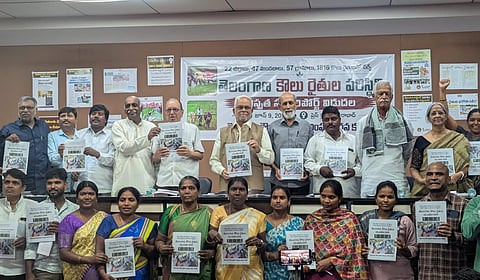
The Kaulu Raitula Gurtimpu Sadhana Committee, a group dedicated to fighting for the rights of tenant farmers in Telangana, on Tuesday, June 9, released a survey report imploring the Congress government to recognise tenant farmers in the state. Activists who worked on the report said that 36% of farmers relied on tenancy, and reminded Telangana Chief Minister Revanth Reddy had vowed to solve their problems once the Congress formed government.
A tenant farmer (kaulu raithu in Telugu) is a cultivator who rents or leases land from a landowner to grow crops. Conventionally, a tenant farmer contributes her own labor, equipment, and operating capital, and pays the landowner rent.
The major issue brought up by the activists was the scrapping of the Andhra Pradesh Land Licensed Cultivators Act, 2011, a law brought in before the bifurcation of the Telugu states which was designed to provide tenant farmers with Loan Eligibility Cards (LECs). It aimed to grant tenants access to institutional credit, crop insurance, and input subsidies without compromising the property rights of the original landowners. However, the law was neither implemented by the Bharat Rashtra Samithi (BRS) led state government and despite promises has also not been implemented by the Congress.
The event was attended by chairman of the Telangana Agriculture and Farmers Welfare Commission M. Kodanda Reddy, retired Justice B Sudershan Reddy, and other civil society leaders of Telangana.
Speaking at the report release at the Basheerbagh press club in Hyderabad, several tenant farmers brought up the lack of recognition. “The land isn’t registered on our names so when its time for crop booking and selling our yield, the OTP [one-time password] goes to the land owner who then demands a cut in every little profit we make or sometimes doesn’t share it with us at all,” said Sadhanandam, a tenant farmer from Karimnagar.
The OTP was a reference to how the digitisation of agricultural land was based on who owns the land and not the cultivator which meant that every farmer benefit scheme went to the landowner and not tenant farmers.
Ramakanth, another farmer from Adilabad spoke about how tenant farmers don’t get access to loans. “Banks are unwilling to give loans to tenant farmers as they do not own land. The state government should aid tenant farmers financially and also ensure that the loans we get have a much lower interest rate,” he said.
Rythu Swarajya Vedika (RSV) convenor Kiran Vissa said that while former Telangana Chief Minister K Chandrashekar Rao (KCR) had said that the Rythu Bandhu scheme would reduce lease rates for tenant farmers, they ended up increasing. He also added that only 6.7% of tenant farmers were able to sell yield on their own name.
Justice Sudershan Reddy also criticised the previous BRS led government for removing Column 16 in the ‘Pahani’ land records, in which the name of the actual cultivator of farm land used to be listed.
What the report said
The survey highlights a worsening economic situation for tenant farmers. “Lease rates have risen sharply—reportedly up to Rs 53,000 per acre, with an average of Rs 14,936 per acre—while farm profitability has declined, forcing many tenants to lease larger areas to remain viable,” the report noted.
The study also shows that Scheduled Castes and Scheduled Tribes are disproportionately represented among tenant farmers and generally operate smaller holdings. At the same time, medium and semi-medium farmers in irrigated areas are expanding through mechanization and additional leased land, contributing to changing patterns of land cultivation.
The report also noted that only 22.8% of surveyed tenants accessed subsidized urea, while most were forced to buy fertilizer at nearly double the subsidized price. Access to government procurement systems is similarly restricted, with only 6.7% of cotton cultivators and around one-fifth of paddy cultivators able to sell produce in their own names and receive payments directly. Despite widespread crop losses from floods, heavy rains, and hailstorms, only 0.7% of affected tenants received disaster compensation in their own accounts.
“As a result, many farmers are compelled to use costly intermediaries, sell produce below MSP, route payments through landowners, or depend on high-interest private borrowing, leading to mounting debt, higher cultivation costs, and growing frustration over the lack of direct access to government support,” the report concluded.
Following the release of the report, Telangana Agriculture and Farmers Welfare Commission Chairman Kodanda Reddy said he would soon hold consultations with tenant farmer representatives and other stakeholders to identify priority issues and recommend practical solutions to the government.
Kodanda Reddy also said the commission has proposed enabling banks to provide loans to tenant farmers based on guarantees from fellow cultivators and has submitted recommendations for stricter enforcement of the Telangana Money Lenders Act to protect farmers from exploitative private lending.
